
As a fifth-grade teacher, Larissa Coreas believed that addressing student mental health is the shared responsibility of an entire school, but after the COVID-19 pandemic, she felt called to address mental health and trauma a little more directly.
Coreas already balanced teaching with addressing student mental health in the classroom in Greenville County Schools, and Coreas was inspired by the school’s counselor, whom she enjoyed working with to address student issues.
It was that school counselor who brought Amanda Rumsey’s work and an opportunity at Clemson to Coreas’ attention. Coreas jumped at the chance to be part of Community Collaboration for Counselors. This research project would allow her to continue teaching in Greenville County Schools while earning a master’s degree in school counseling. She was part of the project’s first graduating cohort, and she is now serving as a school counselor at Mauldin High School.
“It was amazing to be a part of this work and be alongside 11 other people from the same district who had made the same decision to move into counseling,” Coreas said. “We were very excited to share our experience about the stuff we have seen as teachers working in public schools.”
Considering Coreas and her fellow cohort members were working in schools as they gained a degree, Rumsey and fellow Clemson faculty members Liz Boyd, Corrine Sackett and Brooke Wymer did not have to wait long to see the positive effects of her research project across Greenville County Schools. The project was funded by a $5.8 million award from the U.S. Department of Education, which allowed teachers such as Coreas to continue working while pursuing the opportunity.

The work of Coreas and her fellow cohort members serves as an early example of the current and potential future impact of a research project that allows Greenville County Schools to “grow its own” school counselors. Teachers becoming counselors results in more service to students and innovative solutions and programming informed by experience in the district.
Coreas completed the 60-credit-hour program, which included 700 hours of supervised field experience in a Greenville County School, making the coursework as relevant as possible. Rumsey said this approach has paid off in thousands of hours of counseling services for students and in initiatives that draw on the knowledge educators from the district can bring to their work.
“Our cohorts have already provided more than 21,000 hours of counseling services to students, and we have more cohorts on the way,” Rumsey said. “We knew this level of service would come, but we have also been so thrilled to see really innovative, impactful initiatives and solutions coming from our cohorts because these are the schools and the district they have worked in and know so well.”
Coreas’ introduction of a meeting for multilingual learners navigating post-secondary options – whether those options include college or workforce preparation – has already been a great success at Mauldin High School.
Coreas has a master’s degree in teaching multilingual learners and often worked with them in her teaching career. As she helped coach and inform students at Mauldin High School about their options after graduation, she noticed a greater need for information among that student population. She used the knowledge she had gained of this population as a teacher to create a highly relevant session for students and families.
“Along with the Hispanic Alliance, I organized a targeted meeting and gathered student questions beforehand to ensure that the session was as relevant as possible,” Coreas said. “Students left the session better informed, and some began the application process for college shortly after the session concluded.”
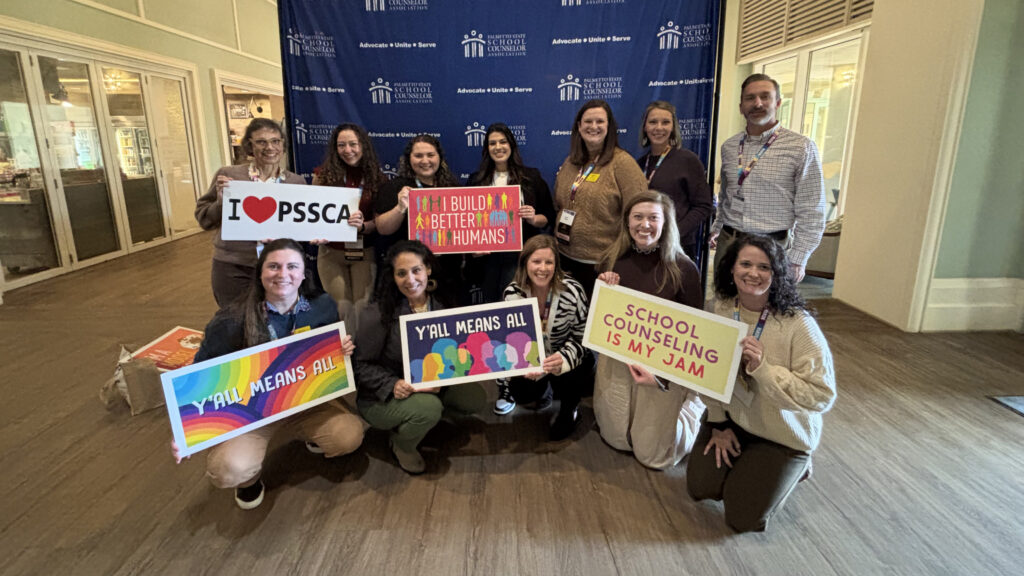
Erica Brewster, another teacher-turned-counselor from cohort one, is now a school counselor at Greenville High School. While in the program, she interned at a school in a rural part of the county and found a 17% gap between the percentage of students who reported wanting to pursue further education and the percentage who enrolled in higher education.
Brewster presented her work and interventions to other high school counselors in the district and has helped to increase the number of students receiving scholarships, including $126,000 in Martin Luther King Jr. Scholarships.
Rumsey is happy to report similar successes in schools across the district, which spans the urban-to-rural spectrum. Greenville County Schools is the largest school district in South Carolina, with 106 schools and centers across a large geographic area. The district serves the largest number of students in the state from low socioeconomic backgrounds, with over 60% of its 77,000-plus students from impoverished homes.
Rumsey said the project’s greatest contribution may be in retaining counselors. Students in the program commit to serving at least three years as a school counselor in a high-needs school after graduation. Considering these counselors have already demonstrated a commitment to the district or an individual school, Rumsey said the project should lead to better long-term retention.
“It’s similar to a teacher sticking with a school or district because they went to school there; counselors who got their start in a district are more likely to stay,” Rumsey said. “They’ve already ‘bought in’ to these communities, and they are invested in them, which ends up being the best for the school and, most importantly, for the students.”