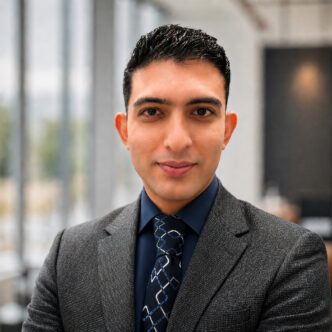

Clemson University doctoral student Nima Zafarmomen is using artificial intelligence to tackle one of engineering’s growing challenges: predicting and managing stormwater risks.
His innovative research in hydroinformatics and urban water systems has earned him the J. Waldo Smith Hydraulic Fellowship from the American Society of Civil Engineers. This award recognizes both his academic excellence and his work to improve infrastructure resilience in the face of climate-related challenges. It is presented annually to not more than two graduate students, who will use the fellowship for tuition, research and living expenses.
The ASCE scholarship is awarded by the nation’s oldest civil engineering society and one of the field’s most respected professional organizations. For Zafarmomen, the honor represents the culmination of years of hard work in engineering and research.
“Receiving this American Society of Civil Engineers scholarship is a great honor and a very meaningful recognition of my academic and research efforts,” Zafarmomen said. “This scholarship feels like an important outcome of many years of hard work, persistence and dedication to my education and research.”
His Clemson experience
Originally from Iran, Zafarmomen came to Clemson to pursue research opportunities in hydroinformatics, water resources and artificial intelligence (AI) applications in water resources. He is a second-year doctoral student in agricultural systems management, focusing on machine learning applications in hydrologic and urban drainage systems.
He works in the Clemson Hydroinformatics Lab under the guidance of Clemson assistant professor Vidya Samadi, conducting research that combines advanced computational methods with real-world water challenges, including urban stormwater, drainage infrastructure and climate-related risks.
His work also contributes to several National Science Foundation-funded projects aimed at improving stormwater prediction and decision-making for water infrastructure.
Clemson’s strong research environment and interdisciplinary collaborations drew him to the University.
“I was especially drawn to the opportunity to work with Dr. Samadi in the Hydroinformatics Lab, where I can combine my civil engineering background with machine learning and data-driven water modeling,” he said.
Receiving the ASCE fellowship motivates him to continue pursuing high-impact research with practical applications that can improve community resilience and infrastructure planning.
“With the increasing availability of data and computational resources, I see significant future potential in my field of study, especially at the intersection of water resources and AI,” Zafarmomen said.
Zafarmomen plans to graduate in 2028 and hopes to continue in academia as a faculty member and researcher.
“This achievement is not only an individual accomplishment, but also the result of strong mentorship, teamwork and collaboration,” he said.
Zafarmomen expressed gratitude to Samadi and the other members of his doctoral committee, Edoardo Borgomeo of the University of Cambridge and Venkataraman Lakshmi of the University of Virginia, for their guidance and support as he advances research to address critical water infrastructure challenges. In addition, he thanks Charles Privette, chair of the Clemson Department of Agricultural Sciences.
A list of Zafarmoment’s publications can be found on his Google Scholar profile.
Recognition well deserved
Samadi said Zafarmomen is “an exceptionally motivated and accomplished doctoral student” whose work is advancing the use of AI in water systems engineering.
“Nima integrates AI, hydroinformatics and urban water systems modeling to improve resilience to stormwater and urban infrastructure stress,” said Samadi in her recommendation letter. “His intellectual curiosity, technical versatility and commitment to advancing science for public benefit make him an ideal candidate for the fellowship.”
Zafarmomen, who maintains a 4.0 GPA in the Clemson agricultural systems management–hydroinformatics program, currently serves as a research assistant on Samadi’s NSF-funded FloodEngine project. Samadi highlighted his role in developing a physics-informed AI analytics package that quantifies stormwater impacts on urban systems in South Carolina.
“His work is an example of how engineering and AI can be combined to improve infrastructure management and environmental forecasting,” she said.
Samadi also praised Zafarmomen’s leadership beyond research, noting his involvement in the NSF-supported WaterSoftHack initiative, where he helped develop training modules to introduce students and researchers to machine learning applications in water science.
“These contributions exemplify his dedication to translating cutting-edge research into practical, real-world solutions while cultivating the next generation of water scientists and engineers,” she said.
Calling him “one of the most creative, reliable and self-driven students” she has supervised, Samadi said Zafarmomen has demonstrated a rare ability to “synthesize theory and practice, communicate technical ideas clearly, and collaborate effectively across disciplines.”