

Clemson University Arthropod Collection celebrates 100 years
There is a quiet pocket of the Clemson University campus, between the reflection pond and President’s Park, where time stands still. There, behind a quaint courtyard landscaped with small grassy hills and framed by the more modern glass-and-steel Daniel, Martin and Jordan halls, sits a sturdy brick building that embodies the quintessential American college experience: Long Hall.
Long Hall was constructed in 1937 with aid from President Franklin D. Roosevelt’s New Deal. Walking its corridors is like stepping onto a movie set where a classic American college movie like “Dead Poets Society” is being filmed. Numbered classroom doors with glass windows line the white walls, with the shiny white tile floors everyone knows, and high ceilings. The scene repeats itself as you make your way from the first floor to the second. But on the west end of the third floor, it changes.
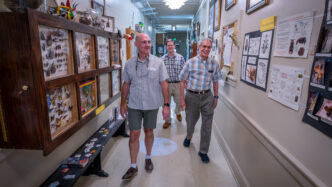
The last doorway before the stairs is lit by splashes of color from two whimsical umbrellas hanging from the ceiling, and the hallway behind is covered floor-to-ceiling with vibrant displays, pictures, decorations and even Lego models . . . of insects.
This is the entrance — some might say, the portal — to the Clemson University Arthropod Collection (CUAC).

Studying bugs
Moving from the corridor into this strange world is like stepping out of a hospital waiting room into a little kid’s birthday party — an apt comparison because, as Professor Michael Caterino, John and Suzanne Morse Chair of Arthropod Biodiversity, says, a fascination with insects is a natural part of childhood.
“Think about it. All kids are interested in insects,” Caterino says.

Who hasn’t chased a butterfly when they were little, or tried to catch a firefly? The small creatures that hop and fly and stick to walls and branches, living in their own worlds within our world, can seem magical through a child’s eyes. Some people never lose that fascination, and that’s how we get entomologists.
For 100 years, the entomologists at the CUAC have harnessed their curiosity to compile data used to track pollution, cure diseases, predict the weather and much more. It turns out those little insect worlds are inextricably intertwined with our own, and the study of how and why that is has been a critical part of Clemson’s land-grant mission since its inception.

A growing database
“Entomology was one of the very first things that people did at Clemson because it was an agricultural college, and people needed to identify pest insects to protect the agriculture,” says Caterino. “It still supports the University’s core values like almost no other program. Think about it: Research, agriculture, outreach, the land-grant mission, community health — entomology touches on all of it.”
John Morse, professor emeritus of entomology, director emeritus of the Clemson University Arthropod Collection, and the namesake, with his wife, Suzanne, of Caterino’s named professorship, received his master’s degree from Clemson in 1968 and returned as a visiting assistant professor and to oversee the CUAC in 1974. He’s been there ever since and has witnessed profound changes in the program and in entomology itself.

“When I got here, all the faculty were involved in the chemical control of pest insects,” Morse says. “I was working on insects that were not responding well to the pesticides going out on the fields, so I was the oddball. Of course, since then, we’ve learned how to manage pest insects in much more environmentally sensitive ways.”
At 100, the CUAC is more than a decade older than Long Hall itself and has done its own bit of molting over the years. A fire in Sikes Hall in 1925 destroyed the collection up to that point, and the University hired Franklin Sherman, a North Carolina native, to oversee its rebirth. Sherman was so successful that the collection now holds more than 1.5 million specimens, including the first boll weevil and last American Burying Beetle collected in South Carolina, to name just two of the jewels in the collection.

“It’s not just a bunch of dead bugs, it’s a growing database,” says Michael Ferro, CUAC collection manager. “A good analogy is the weather. We’re constantly recording the weather wherever we can, and even though we’ve been doing that for 100 years, we’re going to continue because it helps us know what tomorrow will be like and, hopefully, what 10 years will be like.
“It’s the same thing with bugs. If we’re preserving our insect specimens and their associated collection data, they help us to understand what’s going on in the environment. They allow us to reconstruct: was this a forest? Was this a grassland? If you pull pollen off the bees, you can see what they were pollinating 100 years ago at a particular place.”
“The collection of literature here supports the research that goes on in the museum, and most of these books are older references that have very low circulation and are not represented in too many libraries. Historically, most libraries would consider them extra weight and would have deaccessioned them or removed them to off-site storage. But we refer to these books all the time.”
Caterino, Morse and Ferro work out of offices that also look like set designers decorated them. Shelves lined with books cover every wall from the floor to the ceiling, but Caterino explains that what might be an afterthought to the casual visitor is another valuable part of the CUAC.

“There are probably 40,000 species of insects in South Carolina, whereas all other animals together would be fewer than 1,000,” says Caterino. “We are constantly finding new things. We’ve found previously unknown species right here at Clemson in the past few years, so we’re still discovering what lives here. It never ceases to amaze me.”
Many of those discoveries are made by students. At least half a dozen undergraduates work in the collection during any given semester, with additional graduate students supervised by Caterino and Morse, with help from Ferro.
“We have three graduate students who arrived this summer, and two of them have already found new aquatic insect genera since they got here, and one has a new species of aquatic insects,” says Morse. “It’s extraordinary because this is a group of bugs that’s been worked on quite extensively since the 60s. To walk out and find a new genus is kind of unheard of. It’s easier to find a Bigfoot.”

Another timely example Morse offers is a current undergraduate Creative Inquiry research project by two of his students — Lauren Asbill, a senior majoring in Animal and Veterinary Science, and Rachel Barney, a junior majoring in AVS — about microplastics in caddisflies.
“Many of them build little houses, or cases made of sand grains, that they carry around with them as larvae for protection and camouflage, and it also helps them with respiration,” he explains. “The material in those little houses tells us a lot about the environment in which those insects lived.”
Starting with caddisfly specimens in the CUAC from the 1960s, Morse’s students have mapped in detail the slow accumulation of microplastic particles in their cases, reflecting exactly what is going on in the environment.
“This is only possible because we have specimens in the collection that go back decades.”

Useful creatures
Morse’s research specialty is the identification, biology and historical development of caddisflies, which he has been studying for nearly 60 years.
Like Caterino, Morse became fascinated with insects as a boy, a curiosity that took deep roots in him thanks to an uncle who was an entomologist.
“I went to undergraduate school at Davidson College up the highway here past Charlotte, and somewhere between my junior and senior year, my uncle asked me the inevitable question, ‘What are you going to do with that biology degree when you graduate?’ I didn’t know.”
Morse’s uncle took him into his wood shop and put together a pair of broom handles and some window screen. He took Morse to a spring down the road where he kicked up some rocks and caught some larval caddisflies on the screen.
“He told me caddisflies didn’t have very many people studying them and predicted they were going to be important for the environment. Well, he was very prescient, because they are now used around the world to help monitor water pollution.”

Morse’s six-decade career at the forefront of caddisfly research is a prime example of how entomology is not just the study of eradicating insects but also of putting them to use.
According to Caterino, about two-thirds of entomology is dedicated to keeping insects off plants — namely, food crops — but they are also used to help crops. One of the best examples of this is bees and their critical role in pollinating, but it doesn’t stop with bees.
“About a third of the global food supply depends on insects,” says Caterino. “As the field has developed, we’ve realized that insects are as beneficial as they are detrimental. Many of the insects that live here naturally are predators or parasites and can be used to help control those pests.”
Pests also occur in domestic settings and can pose medical concerns in livestock.
“So, the relevance of what we do here in CUAC to, for instance, the new Harvey S. Peeler Jr. College of Veterinary Medicine is high,” says Caterino.

New worlds
Clemson University, like all institutions of higher learning, is a living organism: Constantly climbing, evolving and shedding its old layers for new as it grows. The heart remains beneath the exoskeleton through all the changes, and the same holds for the CUAC.
“When I got here in 1974, the entire pin collection and workspace for me and one graduate student were housed in one room of 325 square feet,” says Morse. “The Collection has expanded greatly, and I hope it continues to grow.”
“Our alcohol collection of aquatic and immature insects alone is second to none,” says Ferro. “It takes up an entire room and part of another room. Decades of John’s students have contributed to it, and it is one of the largest in the country.”
Today, Caterino, Morse and Ferro serve about a dozen graduate students and the same number with entomology minors.
“We want to continue to grow, representing the changing fauna of the state,” says Caterino. “We want students to continue to use it, the faculty necessary to maintain it supported, and we’d like to be able to share it more. My dream is to have some kind of public-facing museum for it one day.”
Near the end of the conversation, Ferro produces a small black box with rows of buttons, a small screen and an electric plug dangling from a wire and sets it on a table next to a small box holding a pinned monarch butterfly.

“That is a 1974 Hewlett-Packard calculator,” Ferro says. “It’s a tool, and the University is full of tools — everything from Post-its to buildings. A lot of these tools get old, and they lose their value. I’ve seen desks and chairs thrown away. Computers obviously get old. This calculator is still working, but it’s really not useful. That will happen to a lot of the things here. But this butterfly specimen gains in value with age. The older it is, the more valuable it is, the more it tells us about the past, and the more difficult it is to replace.”
That, in a snail’s shell, is the CUAC.