As spring planting begins in South Carolina, Clemson University scientists say farmers facing rising fertilizer prices can rely more on nutrient-management strategies to control costs.
Farmers can adjust how they manage soil nutrients to offset higher costs, said Bhupinder Farmaha, a nutrient management specialist at the Clemson Edisto Research and Education Center near Blackville, South Carolina.
“Farmers can use animal manure for immediate needs and cover crops for longer-term soil health,” Farmaha said. “Crop rotation, reduced tillage and integrating livestock can also increase soil organic matter and reduce fertilizer needs. Precision soil testing can further limit unnecessary applications.”
An economic analysis, including purchase and transportation costs, should be conducted to determine the feasibility of fertilizing with animal manure.
Doctoral students Karamvir Kaur and Simranpreet Kaur are conducting on-farm poultry manure studies on nitrogen and potassium use in corn and soybean crops. They found farmers may be able to reduce nitrogen, phosphorus and potassium use. Site-specific data will be available later.
As for cover crops, legumes can help replenish soil nitrogen and improve soil health over time.
Soil tests can help determine nutrients needed to improve soil health. South Carolina farmers can send soil samples to the Clemson Agricultural Lab for testing.
Once the test results are received, Farmaha can help farmers determine fertilizer needs specific to their farms. He can be reached by phone at 217-778-5170 or by email at bfarmah@clemson.edu.
“Each farm is different,” Farmaha said. “That is why we must use data from each farm.”
Fertilizer support tools
Corn planting is underway in South Carolina. The crop requires significant fertilizer inputs, particularly nitrogen, phosphorus and potassium.
Michael Plumblee, a Clemson Cooperative Extension Service corn and soybean specialist, said rising fertilizer costs are affecting farmers across the state.
“Profit margins for 2026 were already very tight,” Plumblee said. “Any additional increase in input costs puts even more pressure on farm budgets.”
Online tools are available to help farmers efficiently manage fertilizer use. One tool is the Fertilizer Recommendation Support Tool, or FRST.
Clemson scientists joined other experts from across the U.S. to develop this national web-based platform.
The tool, released in 2024, provides science-based interpretations of soil test results to determine whether adding phosphorus or potassium is likely to improve crop yields.
Developed through a collaboration of more than 100 soil scientists and agronomists from universities, federal agencies and partner organizations, the platform aims to address inconsistencies in fertilizer recommendations between states.
By identifying soil nutrient levels at which additional fertilizer is unlikely to increase yields, the tool could help farmers reduce unnecessary fertilizer use, lower costs and limit nutrient runoff that affects water quality.
Clemson FRST contacts are Farmaha and Shannon Alford, Agricultural Service Lab director.
Another tool to help with nutrient-management strategies is the Clemson Precision Ag Fertilizer Blend Calculator. This calculator can make customized recommendations, including manure applications and following legumes, using the Guided Worksheet application rate entry mode.
More calculators and web apps are available online from the Clemson Extension Service.
Crop fertilizer requirements
Corn typically requires about 1.1 pounds of nitrogen per bushel yield goal, depending on the source, application method and previous crops. It is common to apply nitrogen at 150-250 pounds per acre, depending on whether the crop is irrigated.
During winter meetings, Plumblee encouraged farmers to base fertilizer applications on realistic yield expectations and split-apply fertilizer where possible. Split application is the practice of dividing fertilizer, commonly nitrogen, applications into smaller doses over time.
“We need to supply enough nutrients without applying more than the crop can realistically use,” he said.
Some farmers may delay fertilizer purchases where possible or split-apply fertilizer throughout the growing season in hopes that prices will decline.
Because much of corn’s nitrogen is applied in-season, farmers still have some time before the bulk of nitrogen is applied, providing some flexibility.
“Hopefully, prices will come down in the next few weeks,” Plumblee said. “It would be great to see them fall as quickly as they rose.”
Still, the year ahead may be difficult.
“Making sound agronomic decisions while markets and input prices are volatile is not easy,” Plumblee said.
Crop switch
Some farmers may consider switching crops.
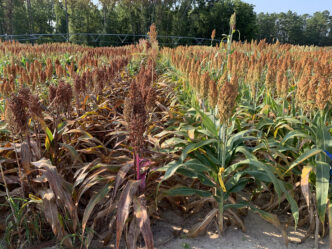
Grain sorghum can serve as an alternative to corn in crop rotations. Sorghum is well adapted to survive dry conditions and uses nutrients efficiently. It has a deep root system that spreads out, allowing it to reach more water and nutrients in the soil than many other crops.
Alexander Coleman, a Clemson Extension small grains and grain sorghum specialist, said both crops are grasses that use similar herbicides and equipment.
However, market demand differs.
“Corn farmers usually have no trouble finding a buyer,” Coleman said. “Sorghum farmers don’t always have that luxury. Producers should identify a market before planting.”
Large shifts in corn acreage are unlikely this season because many farmers have already ordered seed and secured financing. Some farmers have even begun planting.
If acreage changes, it will most likely be due to farmers comparing potential profits among crops such as cotton, peanuts, and soybeans. Commodity prices and transportation costs associated with all major commodities will also influence these decisions.
Estimated reading time: 4 minutes