
When Shalini Etukuri thinks about the path that led her to Clemson University, she begins with her parents.
Growing up in rural India, Etukuri watched her mother and father balance two demanding callings: farming and teaching. Their days often began before sunrise in the fields, continued in the classroom and ended back on the farm. Through their example, Etukuri learned lessons that would shape her future, including hard work, perseverance and a deep respect for agriculture.
“My parents showed me that you can pursue your passion while serving others,” Etukuri said. “They are my greatest inspiration.”
Today, those lessons guide her as a doctoral candidate in the Clemson Department of Plant and Environmental Sciences, where she is conducting research to improve cotton and support the future of sustainable agriculture.
Finding a home at Clemson
Etukuri earned her bachelor’s in agriculture from Acharya N.G. Ranga Agricultural University in India and her master’s in plant molecular biology from Alabama A&M University, where she worked with Venkateswara Rao Sripathi.

She was initially drawn to Clemson because of its strong reputation in plant breeding and genetics. What ultimately convinced her to join the University, however, was the culture she found within the laboratory of Christopher Saski, systems geneticist.
“The environment here is incredibly supportive,” Etukuri said. “People genuinely want to see each other succeed. That sense of collaboration makes a huge difference.”
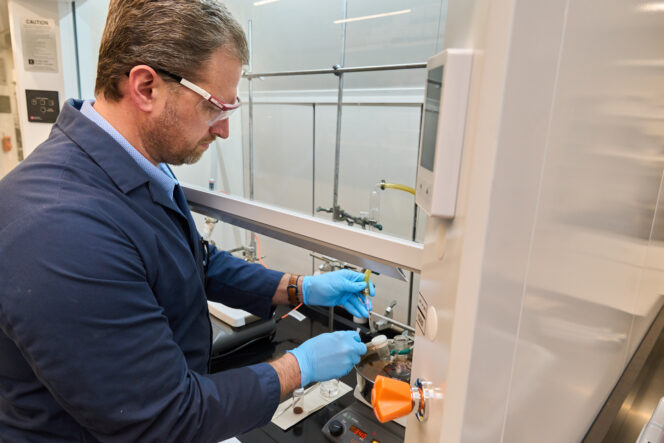
Her research focuses on understanding the genetic basis of cotton fiber quality. Under Saski’s mentorship, Etukuri has grown as both a scientist and a professional. She credits him with helping her develop skills in research, communication and collaboration while demonstrating the importance of patience and leadership.
“I’ve never seen him lose his temper,” she said. “He approaches challenges with calmness and clarity, and that’s something I try to emulate.”
Perhaps most importantly, she said, Saski consistently encourages his students to aim higher than they believe possible.
“He believes in us, often more than we believe in ourselves,” she said.
For Saski, Etukuri’s success comes as no surprise. He describes her as the type of scholar graduate education strives to produce.
“Shalini sets the bar extremely high as a graduate student,” Saski said. “She is exceptionally hardworking, self-motivated, scientifically curious and an excellent communicator.
“She represents the epitome of a successful doctoral student,” he said. “She takes ownership of her research, asks meaningful scientific questions, follows through with rigor and communicates her work with clarity and purpose.”
Connecting science to agriculture
What sets Etukuri apart, Saski said, is her ability to connect scientific discovery with real-world agricultural challenges. Her research has important implications for growers, industry partners and the future of natural fiber production.
“She does not simply complete tasks,” he said. “She wants to understand the biological question, the agricultural relevance and the broader impact of the science. That combination is rare and exactly what we hope to cultivate in graduate education.”
For Etukuri, that perspective comes naturally.
Agriculture was never an abstract concept during her childhood. She helped on the family farm and witnessed firsthand the uncertainties farmers face each season. She learned that success often depends on patience, resilience and the willingness to adapt.

She also experienced the power of community, watching neighbors work together during planting and harvest seasons.
“That sense of teamwork stayed with me,” she said. “It’s something I value deeply in my research today.”
Saski sees a direct connection between those early experiences and the scientist Etukuri has become.
“Her background in an agricultural community and her family’s connection to both education and farming are clearly reflected in the way she approaches science,” he said. “She brings a deep respect for agriculture and a scientist’s desire to improve it.”
A foundation built on family and farming
For us, the land is sacred. We treat it with respect and gratitude.
Roopa Sundhar Etukuri
The values guiding Etukuri today were first cultivated on her family’s farm.
Her father, Roopa Sundhar Etukuri, and mother, Subhashini, have spent their careers balancing agriculture and education. Alongside her brother, Lalith Adithya, she was raised with equal emphasis on academic achievement and hands-on experience in the fields. Her family still lives on their farm in India.
“Farming has always been a part of our lives,” her father said. “Our ancestors were involved in growing crops and raising animals, and we have continued that tradition while working as teachers.”
Through those experiences, he said, his daughter learned lessons that extend far beyond agriculture.
“She learned responsibility because crops require constant care,” he said. “She learned patience because farming teaches that not everything goes according to plan. She also developed respect for farmers and an understanding of how important they are to society.”
The family continues to farm using primarily organic practices and grows crops including mangoes, peanuts, paddy, sugarcane and cotton, along with fruits and vegetables for household use. Etukuri’s mother and grandmother, Guramma Nadendla, maintain a kitchen garden that reinforces the family’s connection to the land.
“For us, the land is sacred,” Roopa Sundhar Etukuri said. “We treat it with respect and gratitude.”
Those values remain at the heart of Etukuri’s work today.
“The cotton industry needs talented, creative scientists who can connect genomics, breeding, industry needs and real-world agricultural challenges,” Saski said. “Shalini is exactly that kind of scientist.”

National recognition and future goals
Etukuri’s dedication has earned recognition beyond Clemson. She was named a 2026 National Association for Plant Breeding Borlaug Scholar and received the 2025–26 Wade Stackhouse Fellowship. Her research has also been supported through opportunities provided by the Foundation for Food and Agriculture Research and industry partners, including Cotton Incorporated.

According to Saski, her selection as a Foundation for Food and Agriculture Research Fellow reflects both her accomplishments and her potential.
“The FFAR Fellows Program is designed to prepare future food and agriculture scientists through professional development, mentorship and engagement with industry and academic partners,” Saski said. “Shalini has embraced those opportunities fully. She is developing not only as a scientist but also as a leader and communicator.”
Etukuri expects to graduate in December 2026. She plans to continue working in plant breeding and agricultural research, focusing on solutions that benefit farmers and promote sustainability.
“Ultimately, I want my work to make a difference,” she said. “I want to contribute to agriculture in ways that help farmers and strengthen food and fiber production for future generations.”