When Clemson University chemistry professor Rhett Smith took his research group to lunch at Chick-fil-A, he gave them an unusual instruction: do not throw away the trash.
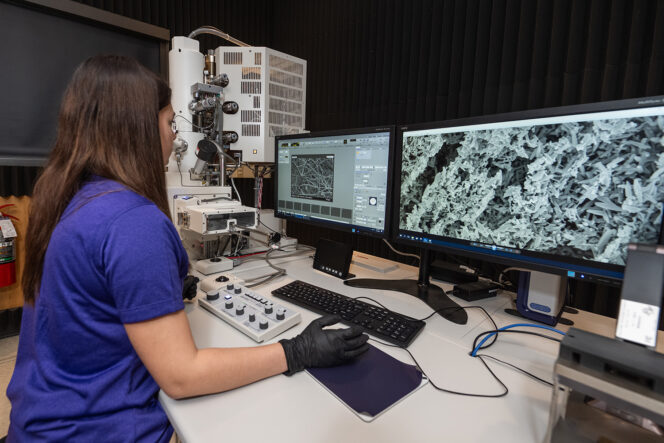
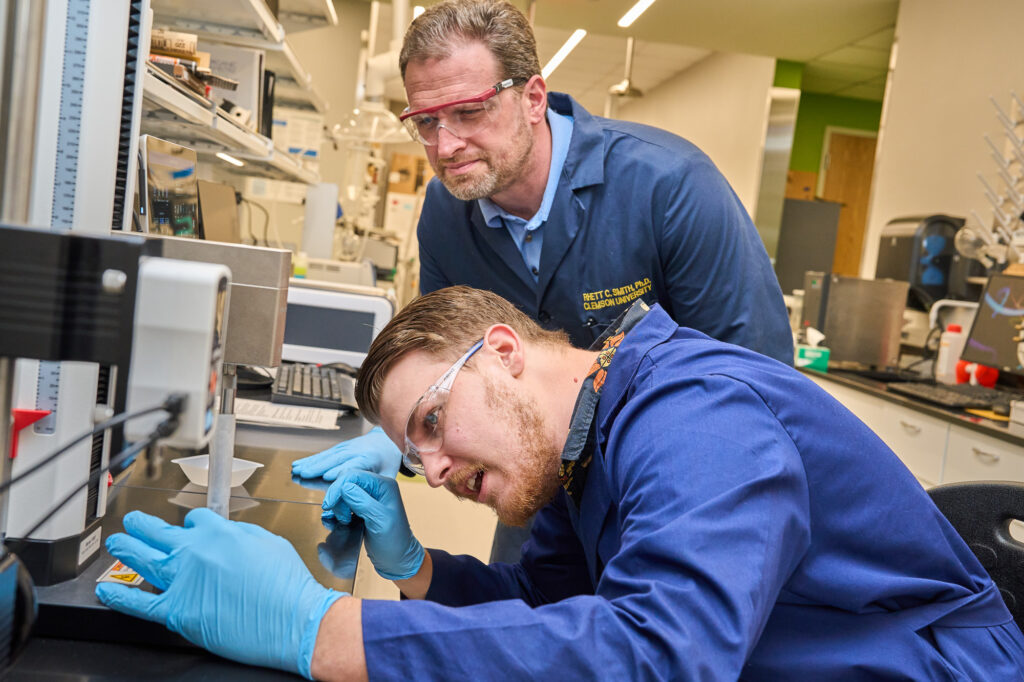
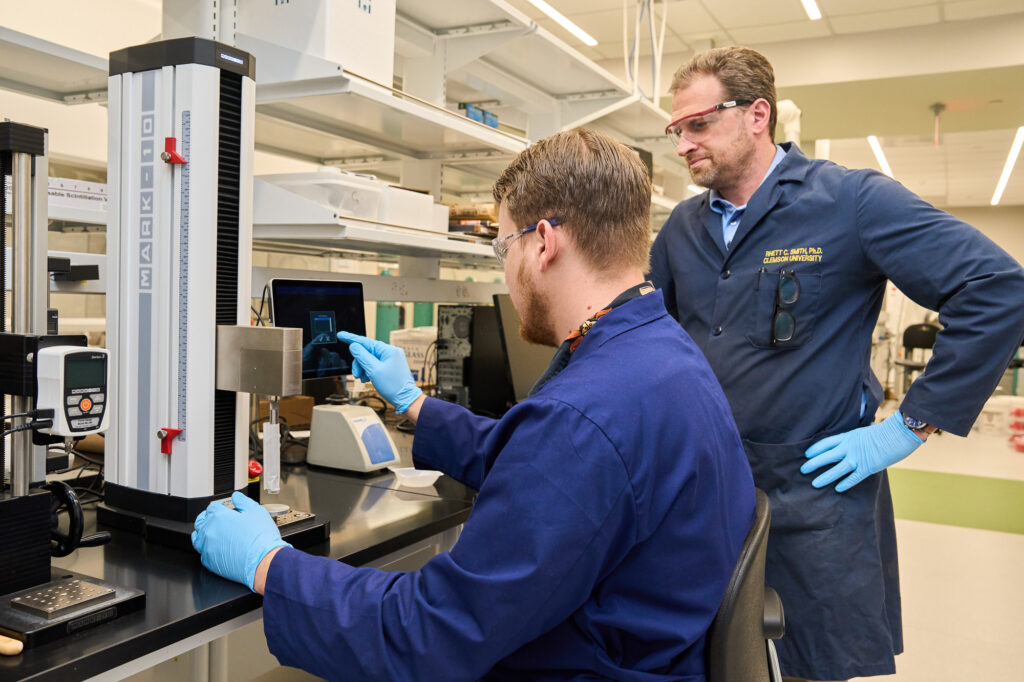
The sandwich boxes, bags, napkins, cups, straws and leftover fries were returned to the laboratory, where they were ground into a pulp and formed into bricks. Smith took the first brick home and parked his car on it. The group then measured in the lab how much load the material could bear.
The experiment illustrates Smith’s research focus, which is converting some of the waste that is most difficult to recycle into construction materials using an inexpensive, abundant ingredient that is often stockpiled in enormous quantities.
It’s National Chemistry Week, and the focus this year is on the essential role of chemistry in building design, safety, durability and materials science, ranging from concrete and steel to glass, stone and eco-friendly infrastructure.
Smith’s research has the potential to change how the world builds.
A problem in the recycling bin
Recycling is less effective than many people assume. Only about 9 percent of plastic is recycled, Smith said, and many communities send much of what they collect to landfills.
The challenge increases when plastics are combined with food, paper and other materials. A peanut butter jar, a cardboard box and a paper label may all end up in the same bin, and the chemistry used to recycle paper differs substantially from that used for plastic. Separating the materials accounts for much of the energy and cost associated with recycling.
The key ingredient: sulfur
Smith’s group avoids this problem by using elemental sulfur, which he said sells for less than $100 a ton. Sulfur is a byproduct of refining oil and gas, and it must be removed to prevent the formation of sulfur compounds that cause acid rain. The result is vast stockpiles. One pile in Canada is lower in height than Egypt’s largest pyramid but greater in volume, Smith said, and companies must pay for land simply to store it.
His work begins with plastic, which is largely produced for a single use and then discarded, even though its manufacture requires considerable energy.
Smith’s lab melts sulfur at a relatively low temperature compared with many chemical recycling methods, then combines it with waste to form new chemical bonds. Because sulfur is an inorganic material with mineral-like properties, the resulting product can be formed into bricks and behaves more like rock than soft, stretchy plastic.
Why cement?
Smith selected cement because of its impact on the climate. Producing cement generates nearly a ton of carbon dioxide per ton of material, he said, and its total emissions exceed those of all commercial automobile traffic. Public concern tends to focus on cars, but few people recognize how much carbon is associated with cement.
The connection between chemistry and construction is deeper than most people realize, Smith said. Communities depend on infrastructure to move food from where it is produced to where it is needed, which helps them withstand periods of drought. Cement is the primary ingredient in the roads that make this possible.
“Cement is the most produced synthetic material of humankind,” Smith said, and demand continues to grow as more countries build cities and replace wood with cement in permanent structures. “I think the people that are engaged in cement chemistry and making it more environmentally friendly are going to be some of the more important people to address our problems in sustainability.”
The new material produced by Smith’s lab performs well in terms of strength. A house foundation requires cement rated at about 17 megapascals, and his group’s strongest formulation reaches 41.
The environmental benefit is significant. Smith estimated that using his material in the foundation of an average-sized house avoids as much carbon dioxide as hundreds of trees can absorb in a year. Across the many subdivisions under construction in the Upstate, the savings would equal the carbon uptake of thousands of trees.
A lightbulb moment
The idea originated at a conference presentation on the use of sulfur in thermal imaging cameras, where its light-absorbing properties can replace expensive lenses.
“It was kind of a lightbulb moment,” Smith said. “I was trying to think about more impactful science to do, and I went to a conference, and I saw someone talk about using sulfur for thermal imaging cameras. … I thought, ‘Oh, why isn’t he using this for just structural materials?’ I got very excited.”
Upon returning to Clemson, he directed his group to complete the papers they were writing and then shift their research to sulfur. The change proved successful, and he now encourages students to attend conferences because a single talk can alter the course of a career.
From plant oils to whole waste streams
When Smith’s lab was featured by Advanced Science News in 2020, it worked mainly with plant oils and plant-derived compounds. Since then, it has expanded to include waste plastics that are difficult to recycle by other means and, most recently, entire mixed waste streams.
The fast-food bricks demonstrate the approach. The group sorted and weighed each type of waste before blending all of it together: paper and cardboard, polystyrene foam cups, polypropylene straws and fries rich in plant oil and starch, since Chick-fil-A cooks in peanut oil. The mixture was consistent enough that, in principle, the same method could be applied to waste from fast-food restaurants nationwide. Smith calls the project “drive-thrus to driveways.”
The advance is significant because most of the energy required for recycling is spent separating different kinds of waste. Chemists prefer to begin with a single, well-characterized compound, Smith said, and it is “much more complicated to take a mixture of a bunch of different things.”
If the approach gains adoption, he said, society could reclaim and reuse resources collected over the last 70 years, much of which has been buried in landfills since the 1950s.
Smith hopes National Chemistry Week encourages the public to recognize what chemistry can accomplish. Chemical companies are often assumed to generate toxic waste, he said, but the emergence of green chemistry has led communities and chemists to make a deliberate effort to stop discharging those pollutants.
“Most people don’t realize all the great things chemistry can accomplish,” Smith said. He hopes this trend towards sustainability will “improve the quality of life for everyone.”