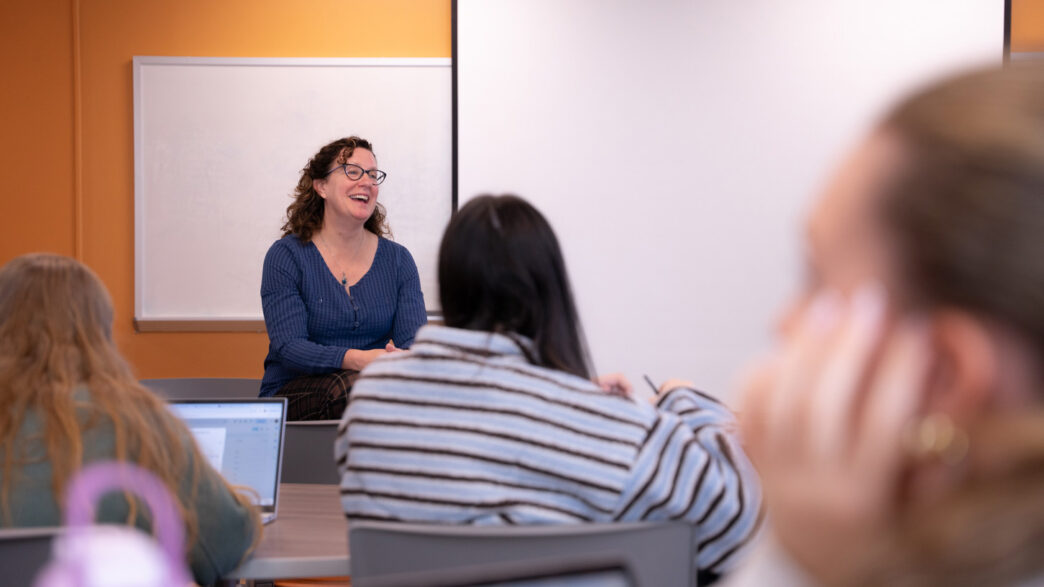
Megan Che serves as an associate professor in the Department of Teaching and Learning at Clemson University. In the College of Education, Che prepares the next generation of math teachers, and she likes to serve as an example of how math can always stay interesting.
She also proves that you can find your passion in life in the most unlikely places. In her case, it was inside a tornado. And she was also — partially — struck by lightning in the process.
That initial spark of inspiration led to a lifelong love of math and, more specifically, to teaching others how to use it effectively. We talked to Che about that fateful brush with static electricity, how she encourages vulnerability in the classroom and what she enjoys doing outside of work.
What is your teaching philosophy?
At the core of my approach to teaching is a fervent belief that talent and potential live everywhere, and that every student can contribute meaningful and interesting ideas and insights to mathematics classrooms. My teaching philosophy is also deeply grounded in our understanding that our cognitive structures are individual and idiosyncratic, and that our brains actively construct knowledge and insights from our experiences with and in our worlds.
To me, this means mathematics classrooms are vibrant spaces with at least as many viewpoints and ways of thinking as there are people, which provides teachers nearly endless possibilities to draw out and draw on those ways of thinking to fuel classroom understanding.
Why do you love teaching?
I love teaching because I think it is such a worthwhile use of one’s life to spend it nurturing people of the next generation while also challenging them to grow their brains. I also love teaching because it never gets stale — I will never get bored of talking to students and asking them questions about how they think.
Where did your initial interest in teaching start?
From childhood through almost my college senior year, I wanted to be a meteorologist. Specifically, I wanted to study lightning at the University of Oklahoma, the university in my backyard at the time, which happened to be in the top three schools for meteorology on the planet.
I was privileged to be placed as a researcher with a scholar at the National Severe Storms Laboratory during all four years of my undergraduate studies, during which time we released multiple instruments into multiple supercell— at times tornadic— thunderstorms in the Great Plains. I even got partially zapped by my research interest, lightning, during one storm chase, which is a fun story to ask me about sometime.
This all maybe sounds fascinating and exciting, and it was. However, I came to realize that the mathematics we used to describe atmospheric dynamics were the most interesting aspect for me. Then, of course, I realized that those equations do not change much (at all) over time, so once I mostly made sense of those, I began to understand that my interest and passion for meteorology were waning quickly.
Luckily for me, I realized that talking with students about mathematics would never grow old, so I shifted gears in graduate school and found my purpose. Don’t get me wrong — I am so glad I had those experiences as an undergraduate, but I am also passionately happy to be an educator.
Describe an effective approach you use in the classroom.
The approach I rely on the most and feel I’m most adept with is questioning. I tend to pose mathematical queries as broadly as possible and then re-pose with increasing specificity as the context requires. This approach means I need to listen closely and carefully to students’ responses to questions so I can figure out what to ask that might continue to push students to reason and make sense, with the goal of constructing mathematical meaning.
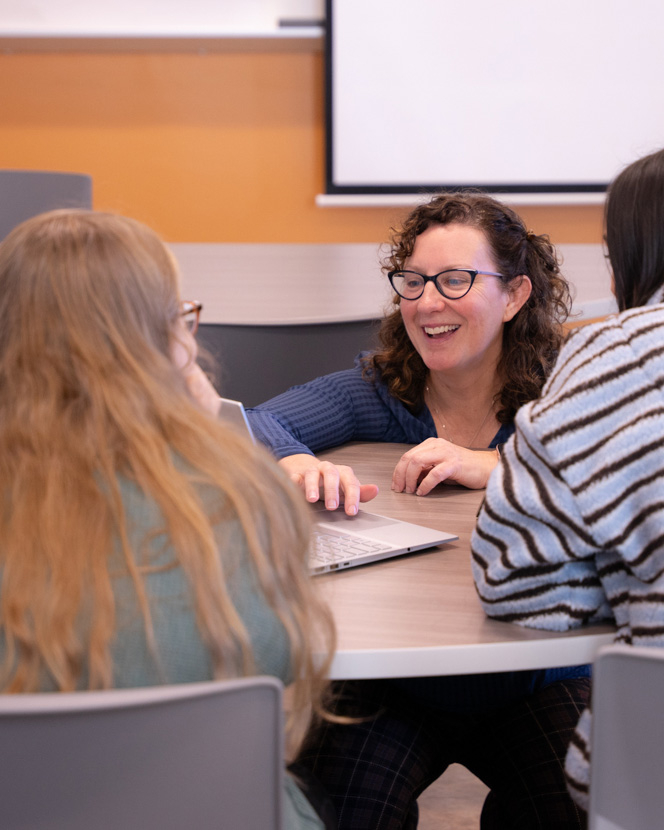
Co-constructing a mathematical learning environment that expects students to think, consider, persist, explore, inquire, debate, justify and doubt means that both students and I experience productive struggle as we encounter hopefully gnarly mathematical situations. Such teaching is not always easy, but it is also never boring.
A current student of mine recently coined the term “productive skepticism” to describe our expectation that claims and conclusions must be accompanied by convincing arguments and evidence and that our default stance as classroom contributors should be to keep asking and doubting until we are presented with convincing arguments and evidence.
I would also point out that if students are to engage in all of these brain-growing processes, the learning environment needs to be one of “productive vulnerability” in which students feel that it is safe to take risks, to try strategies that might not work and to contribute even and especially when they might not be fully confident in their results.
A learning environment that challenges students to think deeply while providing them the psychological safety to do so is critically important to constructing spaces where students can set free their curiosity and explore ideas and connections.
Is there any subject that you’re interested in that might surprise people?
I am fascinated by the Bronze Age collapse. Well, and the Bronze Age in general, but especially its collapse.
What do you enjoy doing when you are not teaching?
I have just recently gotten into community theater and am having the time of my life. I’ve been in “1984” and “The Legend of Sleepy Hollow” and hope to see everyone at the next show I’m in!