
Ever wondered if the “five-second rule” actually keeps your food safe? Or if double-dipping a chip is really “like putting your whole mouth in the dip,” as proclaimed in the 1990s sitcom “Seinfeld”? And what about blowing out birthday candles — are we basically spraying germs all over the cake?
These are the kinds of questions that Professor Paul Dawson and his students love to dig into in his long-running Creative Inquiry (CI) class. Dawson, a professor in the Department of Food, Nutrition and Packaging Sciences, said his department was one of the first departments to integrate CI into the curriculum soon after CI was started 20 years ago.
“It was an opportunity to get undergraduates involved in researching topics that genuinely interested them,” he said. “It was a way to get them into the lab for some hands-on activities, even as freshmen.”

Dawson said many of the research topics his classes have tested over the years are ideas generated by the students themselves. CI has also given him the opportunity to investigate questions that he had long been curious about but hadn’t had the time or resources to research himself.
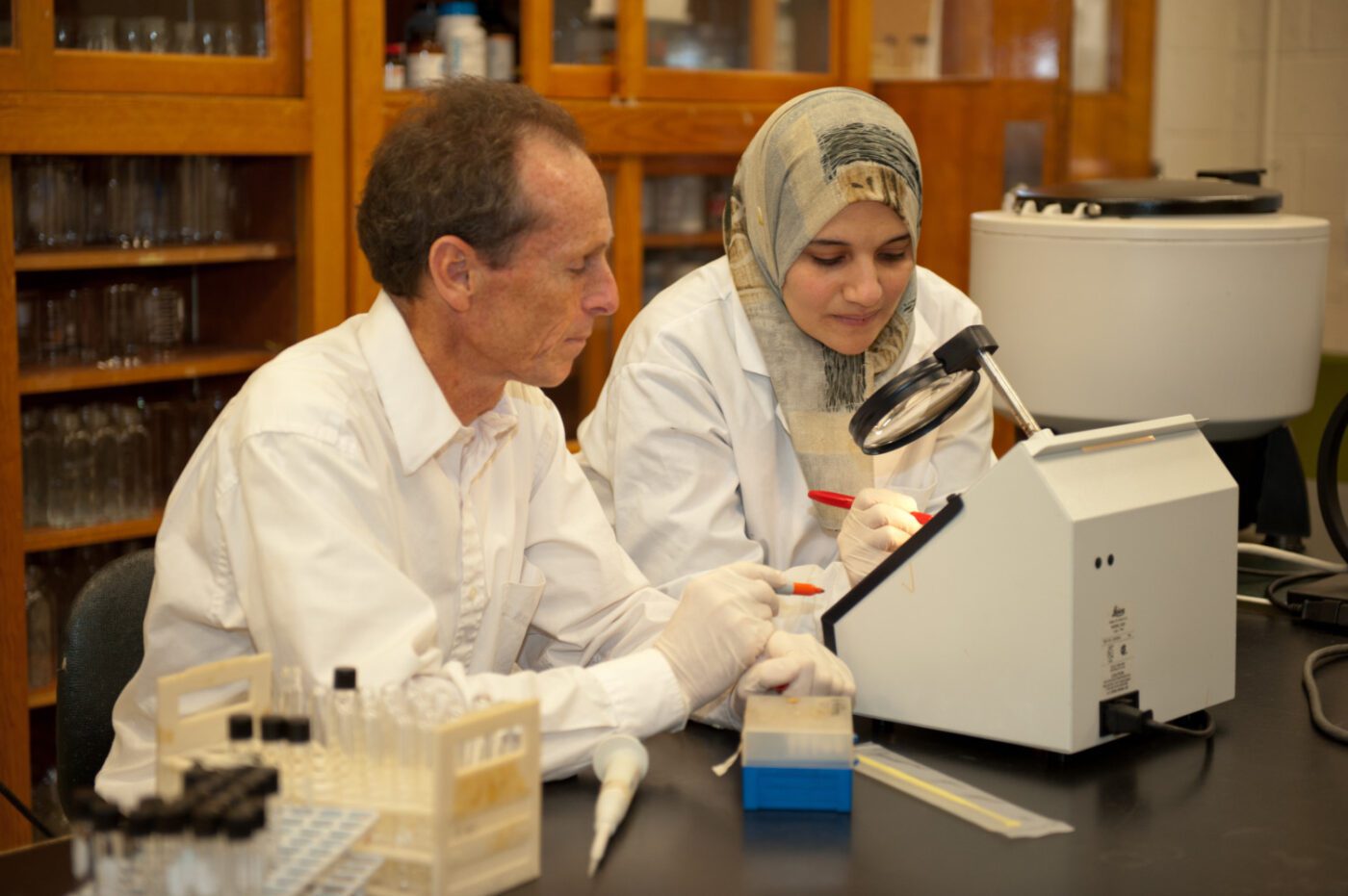
Most of the class’s research dives into how bacteria move — from surfaces to food and beyond — tackling everyday myths and habits to answer one simple question: could this actually make someone sick? But for Dawson, the real goal isn’t just the results, it’s teaching students how to think like scientists and apply the scientific method in a hands-on way.
In the first two weeks of the semester, students brainstorm and pitch their own research ideas. Then, as a group, they vote on the most compelling topic and map out how to design and carry out the experiment.
“We’ve taken on some really fun topics over the years, and that’s what keeps students engaged,” Dawson said.
And the outcomes have gone far beyond the classroom. The students’ findings have been published in peer-reviewed journals, earned grant funding for larger studies, and even caught the attention of major media outlets. It’s no surprise, really — their work explores questions that connect with just about everyone. After all, we all have to eat.
Dawson said the first time he got called by the New York Times requesting an interview about the five-second rule research “it was a shock.” He said for about six to 12 months after that, he got multiple calls per week from media outlets across the globe, as far away as Australia and Europe. He has been interviewed by CNN, MSNBC, FOX News, National Public Radio, the Washington Post, the Wall Street Journal, USA Today, National Geographic and the Associated Press, to name a few. To this day, he still gets occasional media queries about that research, which was first published in 2006.
The CI projects his class has covered ultimately led to Dawson publishing a book titled “Did You Just Eat That?” in 2018 with Norton Publishing. The book includes chapters on topics such as the five-second rule, blowing out candles on a birthday cake, how germs spread when people share popcorn at the movies, the effectiveness of hand sanitizer, and bacteria harbored in public restroom hand dryers. Dawson has also started a YouTube channel where he posts videos about the different CI projects.
At the end of the day, though, Dawson said the most important aspect of CI is the impact that it has on students.
“The main goal is enhancing the student experience. Students get to come into a lab and collect data, and they walk away with a real understanding of how to do research and how to work as part of a team,” he said. “They are very engaged. It really has been a huge success in our department. Students learn so much more by doing.”
In addition to his myriad of bacteria-related CI projects, Dawson also mentors a CI class looking at food advertising claims, and he co-mentors a class on the science of brewing and fermentation with Clemson Extension food systems and safety agent Alex Thompson.
He said he would like to see CI integrated into the curriculum across departments, complementing lecture courses with hands-on research activities.
“I have been really impressed with the undergraduate students I’ve had in my CI classes. They are really hungry for research experience and want to get into the lab. That’s where I see the value of CI. It takes the learning to another level.”
Professor Paul Dawson
This story is part of a series focused on long-standing projects and faculty mentors who have been involved with Creative Inquiry + Undergraduate Research since nearly the beginning of the program. For more information, visit clemson.edu/ci.