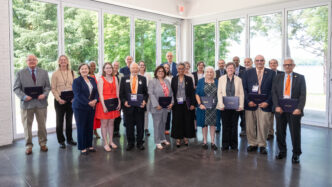
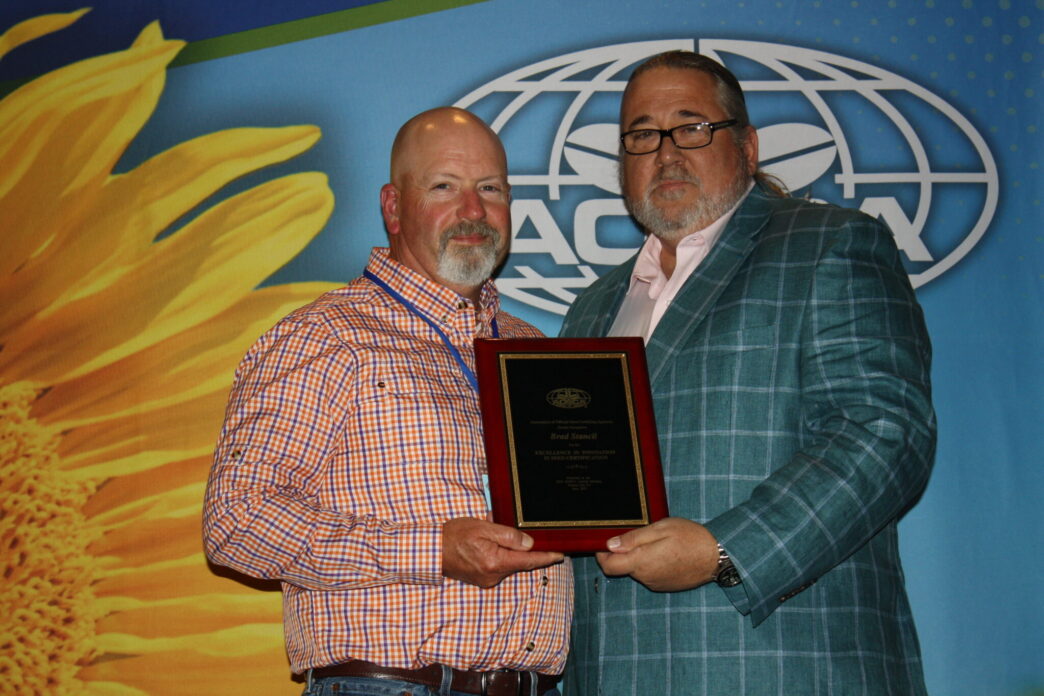
Brad Stancil, assistant director of Clemson University’s Fertilizer Regulatory and Certification Services, which includes the Certified Seed program, a unit of Clemson Regulatory Services, has been recognized with the 2025 Excellence in Innovation Award from the Association of Official Seed Certifying Agencies (AOSCA), a national organization that sets standards for seed certification across the United States.
The award honors Stancil’s work to modernize how Clemson’s regulatory and certification programs operate with innovations that are already delivering faster, more efficient service to South Carolina farmers and agribusinesses.
Stancil’s role sits at the intersection of seed certification and fertilizer regulation, two systems that are closely linked in practice. His team of inspectors is responsible for both programs, ensuring that products meet state standards and that farmers receive the quality they expect.
Innovation driven by real-world needs
The award stems from a series of improvements Stancil led to streamline inspection and reporting processes. The changes were born out of necessity and shaped by the day-to-day realities of fieldwork.
Previously, inspectors navigated multiple systems, logins and paper-based processes to complete routine tasks. Today, those same inspections are completed through a single, streamlined web-based system that allows inspectors to enter data directly from the field.
“That work was really about simplifying the system without changing the work itself,” Stancil said.
The new system reduces duplication, minimizes errors and eliminates delays associated with manual data entry and mailed reports. Inspectors can now submit results in real time, and reports are delivered electronically, often within days instead of a week or more.
“Brad’s dedication and commitment to agriculture in South Carolina is unparalleled and this national award is an example of how he consistently goes above and beyond the call of duty to serve our growers. We are very proud of Brad’s work,” said Steve Cole, Executive Director of Clemson Regulatory Services.
Delivering faster results for farmers
While the innovation improves internal efficiency, its most important impact is external.
Faster turnaround times mean farmers and fertilizer providers receive critical information sooner, enabling them to make timely decisions that directly affect crop performance and profitability.
“If there’s an issue with a fertilizer blend, they need to know quickly,” Stancil said. “That allows them to correct the problem, adjust their inputs and protect their crop.”
In some cases, quicker reporting can help prevent the use of deficient products, saving farmers both time and money. Suppliers can also identify and address issues earlier in the supply chain.
Protecting farmers and ensuring fairness
Clemson’s fertilizer and seed certification programs play a critical role in protecting South Carolina’s agricultural industry. Through inspection, sampling and verification, the programs ensure that products meet established standards and perform as advertised.
“At the end of the day, we’re here to make sure that farmers get what they pay for,” Stancil said.
That work also helps maintain a level playing field across the industry by holding all producers to the same standards and preventing substandard products from entering the market.
For seed certification, the program provides additional value by verifying variety identity and quality, usually indicated by certification tags that signal a product meets national standards. This helps farmers make informed decisions and supports confidence in the marketplace.
Adapting to a changing industry
Stancil’s work comes at a time when seed technology and agricultural systems are evolving rapidly. As more breeding and production moves into private systems, certification programs must adapt to remain relevant and valuable.
That adaptability has been a hallmark of Stancil’s approach.
“Being able to provide a service that meets industry needs is what makes these programs valuable,” he said.
By modernizing systems and improving efficiency, Clemson’s Regulatory Services is better positioned to support both traditional certification programs and emerging industry needs.
A Clemson model with statewide impact
South Carolina’s seed certification program is uniquely housed within Clemson University, integrating academic expertise with regulatory oversight. This model allows the University to respond quickly to industry challenges while maintaining high standards for quality and compliance.
Through these programs, Clemson supports farmers, protects consumers and strengthens the state’s agricultural economy.
Stancil credits the success of the innovation to the collaborative efforts of his team and Clemson’s information technology staff, who worked together to design and implement the new systems.
While the award recognizes his leadership, Stancil emphasized the broader mission behind the work.
“Our goal is to serve the people of South Carolina,” he said. “Everything we do is about making sure the system works better for them.”