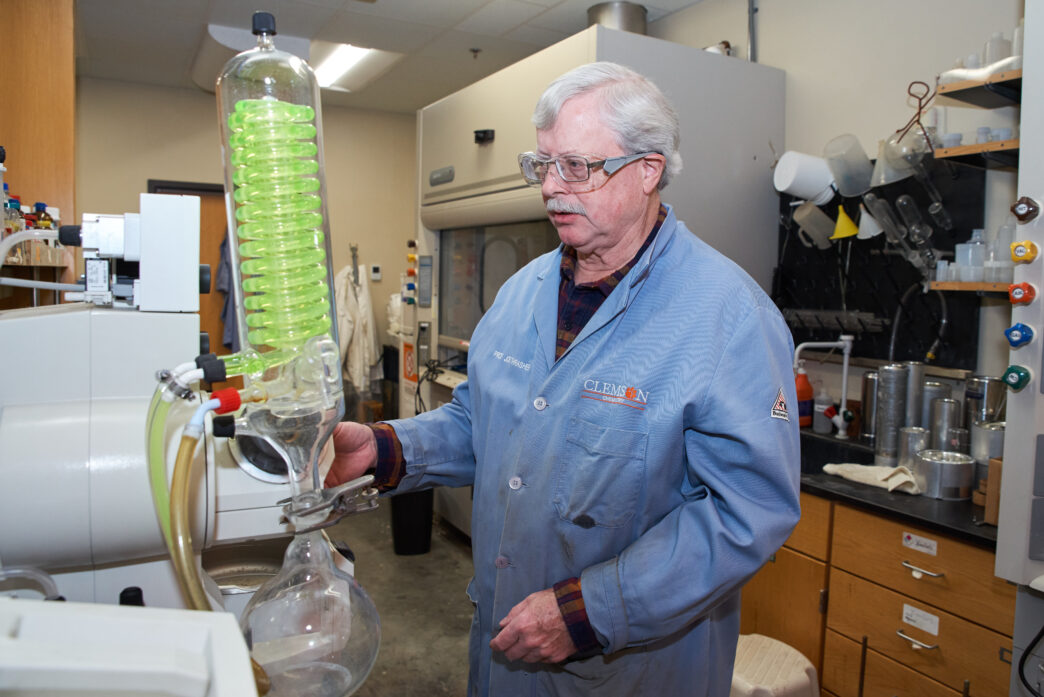
Clemson University Chemistry Professor Joe Thrasher and two long-time collaborators have received a national honor for their work on high-performance lubricants that keep machinery running under extreme conditions.
The 2026 American Chemical Society Division of Polymeric Materials: Science and Engineering Cooperative Research Award recognizes a three-member team: Thrasher, industrial chemist Jon Howell of DuPont and later Chemours, and Trinity Western University Professor Chad Friesen, one of Thrasher’s former doctoral students. They were nominated by another of Thrasher’s former Ph.D. students, University of Connecticut Professor Luyi Sun.

The honor recognizes decades of joint research that has led to new materials and a portfolio of patents and created a launchpad for students into careers in industry.
“I think the award shows the power of partnerships. When you can show industry, a research institution and a school focused on undergraduate education contributing to and advancing science, it sends an important message,” Thrasher said. “Most of our students will not become professors; they will go to work in companies that make the materials people rely on every day. If we can give them real experience while they’re still in school, everybody benefits.”
Thrasher traces the roots of the project to the mid-1990s when his lab at the University of Alabama began working with DuPont on fluorinated lubricants known as PFPEs, short for perfluoropolyethers.
The research centered on PFPEs, which are lubricant molecules built from carbon, fluorine and oxygen that can survive high temperatures and oxidative and corrosive environments where conventional hydrocarbon oils are prone to fail more quickly. These materials are used in aerospace components, jet engines and advanced manufacturing equipment.
Small-molecule way of thinking
Thrasher’s group applied what he calls a “small-molecule” way of thinking to these polymeric materials by painstakingly distilling industrial PFPE mixtures to isolate oligomers — short-chain fragments with defined lengths and end groups — that could be chemically modified one by one. That allowed derivatives with improved thermal and oxidative stability. One of the team’s most cited advances involved PFPEs with a perfluoroisopropyl end group that remained stable at temperatures higher than earlier formulations. Other work produced PFPE-based bromides and iodides that served as safer, more versatile starting points for synthesizing additives.

The award comes at a time when fluorinated chemicals are under scrutiny, especially per- and polyfluoroalkyl substances – so-called “forever chemicals.” Thrasher acknowledges the environmental and health concerns raised by some small, persistent fluorinated molecules, but said not all fluorinated compounds behave the same way in the environment. PFPE lubricants and related fluoropolymers are large, non-volatile molecules designed to stay put in sealed systems and last a long time in service, he said.
“If you want to do away with all fluorocarbons, get ready to give up air conditioning, refrigeration and electronic devices, like cell phones, laptops, flat-screen TVs, microchips, etc.,” he said. “If we do away with all these materials, what are the replacements? We have to make sure we don’t create worse problems by too quickly switching to things that don’t perform as well and maybe actually harm the environment even more.”
Current research
Thrasher’s current research interests focus on halogen bonding, condensation polymers and computational chemistry.
Thrasher earned his bachelor’s degree in chemistry and his doctorate in inorganic chemistry from Virginia Tech. After earning his Ph.D., Thrasher did a postdoctoral fellowship at the Free University of Berlin before working as a visiting assistant professor of chemistry at Clemson.
From there, he went to the University of Alabama, where he served on the faculty from 1984 until 2011. He returned to Clemson in 2011.