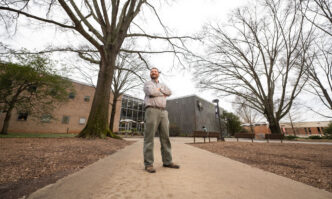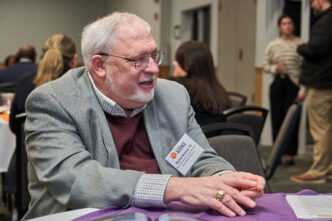

When Michael Newman picked up the phone one afternoon and found himself talking to Walt Disney’s daughter, it was just one twist in a communications career that has had him covering everything from the science behind a presidential assassination to helping a medical researcher publicize his discovery of a new immune cell.
It all started at Clemson University, a school Newman had never heard of before his junior year of high school in Houston, when he signed up for a National Science Foundation summer program that placed students in college research labs.
During the program, Newman spent time in a Clemson poultry science lab where he came up with a way to slow-freeze the microbes that cause turkey malaria for future study. He eventually became interested in Clemson’s unique microbiology curriculum.
Jumped into student life

Once on campus as a first-year student, Newman jumped into student life. He joined the microbiology society, the German club and student government. In his junior year, he helped start a state chapter of the National Federation of Students of German and became its first president. He also was a member of the Student Senate for three years, chaired the academic affairs committee and eventually became communications director for the student body president.
While serving as communications director, Newman reported on student government activities on WSBF, Clemson’s student-run radio station, and published a monthly student newsletter.
“This was before PCs and desktop printing, so we would type out the articles and cut and paste them into something that we could send to the print shop and run off copies to deliver to all the dorm rooms,” Newman says.
Newman graduated in 1978 and is now two years away from his Golden Tiger reunion marking the 50th anniversary of his graduation.
“You start bleeding orange as soon as you get to Clemson, and you never stop.”
Michael Newman ’78
“You start bleeding orange as soon as you get to Clemson, and you never stop,”
After graduation, Newman returned home to Houston to pursue a Ph.D. in virology at Baylor College of Medicine. He soon realized that while he loved science, bench research was not for him because he wanted to learn about more than just the one aspect of science on which his doctoral thesis would focus. Looking for a fresh start, Newman withdrew from graduate school.
Another path
His writing and communication experience at Clemson helped Newman see another path. He decided to combine his interests and pursue science communications.
While earning a bachelor’s degree in communications at the University of Houston, he worked part-time as a reporter for the Houston Chronicle’s WATCHEM column. Readers sent in consumer complaints, requests for government services and trivia questions, which the paper then investigated and solved.
After moving to Maryland in 1989, Newman pitched the idea of a similar column to the Journal Newspapers, a greater Washington, D.C., media group. The freelance column, named “Answer Line,” ran until 2006 and was a reader favorite.
One of his favorite headlines that he created for the column stemmed from a question about whether Walt Disney was put into a cryogenic state after his death and buried under the Pirates of the Caribbean ride at Disneyland: “Skating Shows are Only True Disney on Ice.” On the phone call with Newman, Disney’s daughter confirmed her father was cremated.
His career moves soon took him into medical television production at the Texas Medical Center and then to a producer’s role at the ABC affiliate in Houston, the 10th largest television market in the country.

Varied career
Corporate and government communications roles followed, including a pivotal move to Maryland and three years at the National Cancer Institute as a press officer and science writer. In 1991, Newman became the director of media relations for the National Institute of Standards and Technology (NIST), the federal government’s research and development laboratory that works with U.S. industry to improve the quality of products and services. He would spend almost the next three decades of his career there, the last 11 years as NIST’s first senior communications officer.
“NIST does standards, measurements and testing for practically everything you come in contact with in your daily life—using research in mathematics, information technology, materials science, biotechnology, quantum physics, building and fire research, solar energy and so much more,” Newman says. “For a science communicator, it’s the smorgasbord of all places to work!”
At NIST, Newman was the government’s official spokesperson for the scientific and technical investigation of the collapses of three buildings resulting from the 9/11 terrorist attacks on New York’s World Trade Center complex: the Twin Towers (WTC 1 and 2) and WTC 7, the smaller office building that collapsed later that afternoon. The investigation focused on how to make buildings more resilient and easier to evacuate in the future.
Importance of science
During this time, when there was a lot of rhetoric, misinformation and conspiracy theories about 9/11, Newman emphasized the importance of communicating science-based evidence against rumor and hearsay, allowing people to make their own decisions about what really occurred that day.
Another high-profile project Newman worked on at NIST was when the institute’s forensic experts created high-resolution scans and 3D images of the bullets and bullet fragments from the 1963 assassination of President John F. Kennedy for the National Archives, preserving the evidence digitally so people could study it without exposing the originals. He also did media relations for another milestone project for the National Archives when NIST created high-tech encasements for the Declaration of Independence, the Constitution and the Bill of Rights—the historic documents known collectively as the Charters of Freedom.
Communicating research
After working at NIST for 27 years, Newman retired from the federal government and joined Johns Hopkins Medicine as a senior public affairs officer and medical communicator in 2019. His main focus there, as before at NIST and NCI, is helping scientists and physicians communicate their research clearly and accurately to the public. He plans to retire later this year.
“It’s important to communicate what value Johns Hopkins Medicine research and medical advances bring to everyone,” Newman says. “And there are benefits for the researchers as well, and I tell them ‘You’re going to see citations go up, you’re going to get people contacting you about potential collaborations, and you’re going to let the public know that your work is making a difference in their lives.’”
Newman has been involved with science communication organizations like the National Association of Science Writers and the DC Science Writers Association (DCSWA, for which he served as president in 2024-2025). After he retires, he plans to start a program through DCSWA to take science communicators to college campuses in Delaware, Maryland, Virginia and the Washington, D.C., area to inform students about careers in science communication.
Newman also plans to become more involved with Clemson, serving on an advisory committee for the College of Science to help plan new curricula, ensuring that coursework includes training in successfully communicating science to the public. He also plans to write a biography of Anita Martini, a pioneer in women’s sports broadcasting.