
Alumni of Call Me MiSTER® often say they feel “called” to become servant leaders in education. Lyman Dawkins III is no exception, but these calls in his career usually come in the literal form from superintendents or family members. It seems that just as Dawkins is settling into a leadership role, he is asked to take on another role or pushed to expand his impact in his home community of Gaffney, South Carolina.
This push from others — and himself — is why Dawkins quickly parlayed an award-winning teaching career into work with the MiSTER program at Limestone College, a move into school administration and an election as mayor of Gaffney. During that time, Dawkins earned master’s and educational specialist degrees simultaneously from Anderson University and Converse University, respectively, before pursuing his EdD at Clemson University.
Dawkins successfully defended his dissertation in Spring 2026 and will serve as a speaker at the May 5 doctoral commencement ceremony, where he may reveal a little about how he managed to do all this within the first 10 years of his career as an educator.
“I don’t think my career has ever been planned so much as it’s been spiritually guided,” Dawkins said. “I think I have focused on how I could be used for service rather than concentrating on chasing ‘roles.’ I learned that through MiSTER; an early exposure to successful educators in the program was really transformative for me.”

The mentorship provided by Call Me MiSTER was nothing short of life-changing for Dawkins. He still remembers the first leadership institute he attended, where he heard from numerous MiSTER alumni during a panel discussion. One of those alumni was Marquice Clark, a then-teacher who would go on to become South Carolina Principal of the Year in 2025.
By chance — although Dawkins would doubt that anything happens by chance — Clark was assigned as Dawkins’ mentor as he was graduating from Limestone College. Clark leveled with Dawkins early on by saying that whatever effort Dawkins put in as a mentee, he would match as a mentor. Dawkins took advantage of the opportunity and found that Clark was a man of his word.
“That time was formative for me,” Dawkins said. “We’d be in his classroom into the evenings talking about instruction, talking about politics, talking about family. He became a friend and a brother to me, and we are still close to this day. His commitment inspired me to do the same for my students and now for everyone I encounter in my job and community.”
Dawkins was already an assistant principal at Limestone Central Elementary when he began the EdD program at Clemson University. He knew Clemson’s reputation in graduate education, but the program’s focus on rural communities and providing solutions to “problems of practice” in education made the degree program all the more attractive to him.

The program’s focus on improving systems has borne fruit for him and his work at Limestone Central Elementary and later Gaffney Middle School, where he now serves as principal. The problem of practice guiding his research centered on the lack of structured, intentional opportunities for teachers to critically reflect on how their beliefs, experiences and perspectives influence instructional decision-making and classroom interactions.
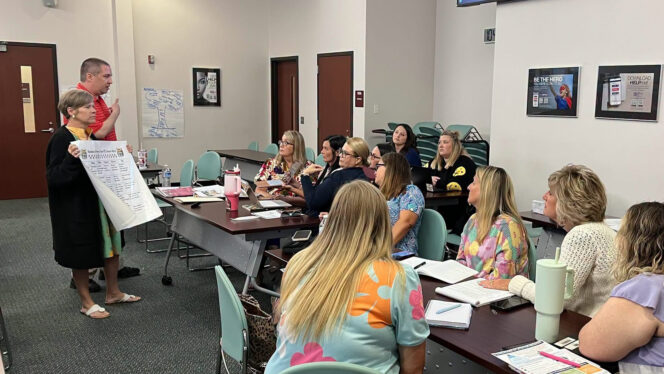
Dawkins designed and implemented a professional development model that integrates reflective practice, data-informed decision-making and iterative cycles of improvement. He has found that a critical look at systems in this way can improve a teacher’s experience, just as it can help accommodate parents and community members.
“One small example is [school leadership] noticed we didn’t have the engagement among parents that we wanted, so instead of blaming them, we made adjustments to meeting times, and then their attendance and engagement increased,” Dawkins said. “It can be that simple if you just step back from a problem and look at the system that creates it. When we look at the systems that allow poor food access, poor mental health care, poor mentoring — that’s when we can create solutions to address these things.”
As the mayor of Gaffney, Dawkins is already using this same continuous improvement process to engage others and improve the community surrounding Gaffney Middle. His superintendent called Dawkins to move from an assistant principal role to that of principal at Gaffney Middle, but it was his own family that pushed him into politics.
After his first year of teaching, Dawkins began serving on the county council after conversations with his father about politics. Dawkins’ grandmother and some of her friends practically petitioned him to run for the county council seat. After mobilizing younger voters and being elected to the council, he served for seven years. In 2024, Dawkins decided to run for mayor and won the runoff in August, becoming the first Black mayor in Gaffney’s 150-plus-year history.

“I threw my name in the hat because I’m from this community, my family lives in this community and I’m raising a family in this community, and there just wasn’t much unity at the time in our local politics,” Dawkins said. “I want to make this place the best it can be, and the community spoke up, and I think that election says a lot about community members’ belief in me. We’ve seen a lot of positive things in a year and a half.”
Brandi Hinnant-Crawford, associate professor of educational leadership, served as chair of Dawkins’ dissertation committee and has observed his journey not only through the EdD program but also in his roles as school and community leader.
“Dr. Dawkins brings his full humanity to his work. His faith and his heart for his community drive what he does as an educator and as a community leader,” Hinnant-Crawford said. “What makes him stand out as a student is his belief in the individuals he serves; his dissertation work sought to help good teachers become great teachers by growing in ways they had not previously considered. He does not see teachers as deficient; he sees them through the eyes of possibility.”
Hinnant-Crawford said Dawkins understands the concept of continuous improvement as a powerful tool of shared meaning and collective learning. She saw him come to use data as a tool to promote reflection and catalyze personal growth among the teachers in his school. Hinnant-Crawford said she is excited to follow Dawkins’ future as an administrator and politician, as she believes someone who excels in education is uniquely prepared to help communities at large.
“Education is a microcosm of society; as we understand systems in schools, systems theory broadly and become systems thinkers, we can see how systems operate in every facet of life,” Hinnant-Crawford said. “Dr. Dawkins is not what comes to mind when I think of a politician; I guess that is what probably makes him the best kind of politician. He is a problem solver who loves people — and that orientation to life serves him well as an educator and as the Mayor of Gaffney.”