When disaster strikes in the future, survivors’ lives could depend on groups of drones and robots that can quickly share the right information as they work together, even when the wireless signal is weak.
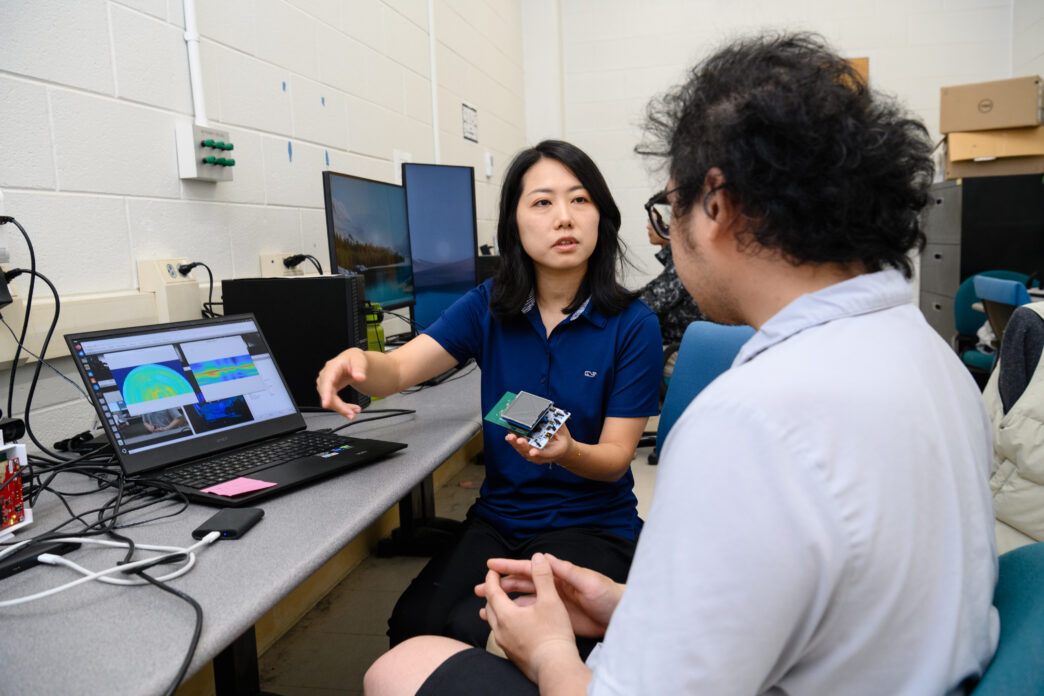
That’s the challenge Lan Zhang of Clemson University has accepted in research she is leading as part of a CAREER award from the National Science Foundation.
Zhang, an assistant professor of electrical and computer engineering, is developing a new approach to wireless communication designed specifically for AI systems that must work together.
Instead of treating every piece of data equally, her research helps AI systems prioritize the most important information so teams of drones, robots, vehicles and sensors can collaborate more effectively.
The work sharpens the focus on “swarm AI,” a form of artificial intelligence in which groups of devices work together like a flock of birds or a colony of ants. No single device has all the information, but together they can accomplish a task that one machine could not handle alone.

As artificial intelligence moves beyond data centers and into the physical world, communication is becoming just as important as intelligence itself. These devices must constantly exchange information to coordinate their actions, Zhang said.
The applications are many, including searching for disaster survivors, monitoring crops, and transmitting critical safety information among autonomous cars.
The challenge is that the wireless spectrum they rely on is limited. Zhang’s research explores how wireless communication can adapt to the needs of AI, making better use of that scarce resource.
For decades, wireless networks have been designed to move bits of data as accurately as possible. Zhang’s research asks a different question: Can wireless communication prioritize the information that matters most for AI systems to make good decisions?
“Imagine a crowded room where everyone is talking at once,” Zhang said. “The goal isn’t for everyone to speak more loudly. It’s to make sure the people with the most important information are heard first. We’re bringing that same idea to AI systems so they can use limited wireless resources much more intelligently.”
For example, a team of drones searching a disaster area would not need to send every full image of trees, rocks and empty ground. Instead, they could focus on sharing the information that matters most, such as a location where one drone may have found a survivor.
In addition to the research, the project includes an educational component with new course material, hands-on learning, mentoring for undergraduate and graduate students and K-12 outreach focused on the connection between AI and physical devices.
CAREER awards are reserved for early-career faculty who have the potential to serve as academic role models in both research and education. They are seen as indicators of leadership and future success in higher education.
Hai Xiao, chair of the Holcombe Department of Electrical and Computer Engineering, congratulated Zhang and her group and said her award reflects her creativity and hard work.
“This is a well-deserved recognition for Dr. Zhang and her team,” Xiao said. “Her research addresses an important challenge at the intersection of wireless communication and artificial intelligence, and she is well positioned to help advance this emerging field.”