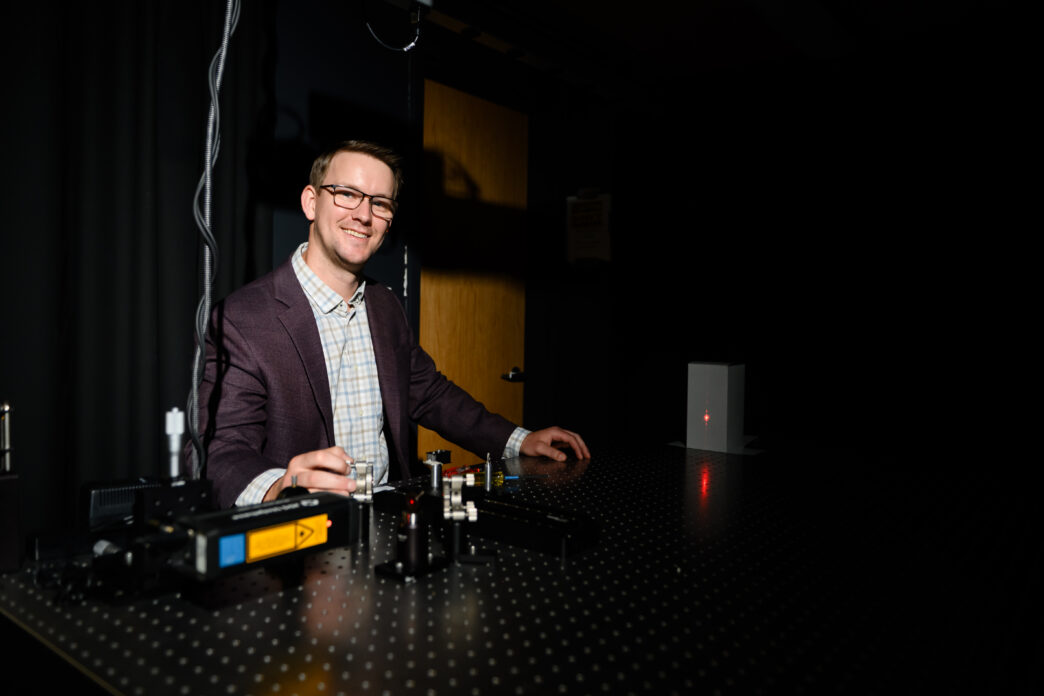
Glass is so ubiquitous that it can be easy to take for granted, but Brian Topper of Clemson University is helping show just how much can be done with it, especially when it comes to channeling light.
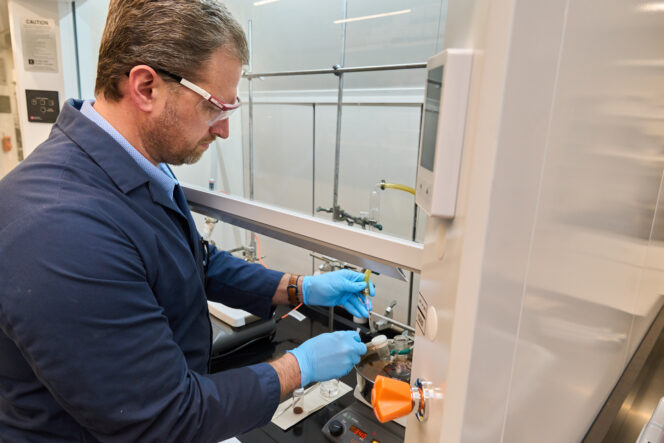
Since joining Clemson in 2024, Topper has been helping Clemson faculty and students advance their research in materials science and engineering while conducting his own line of inquiry.
Now his efforts are paying off. Topper is starting the fall semester with a promotion from research assistant professor to tenure-track assistant professor– and a prestigious research grant from the Air Force Office of Scientific Research’s Young Investigator Program.
In his newly funded project, Topper is working with collaborators to further develop glass fibers that are only a fraction of the width of a human hair.
The research is in the early stages, but in the long term the fibers could help make lasers shorter and more compact, which would make it easier to attach them to aircraft.
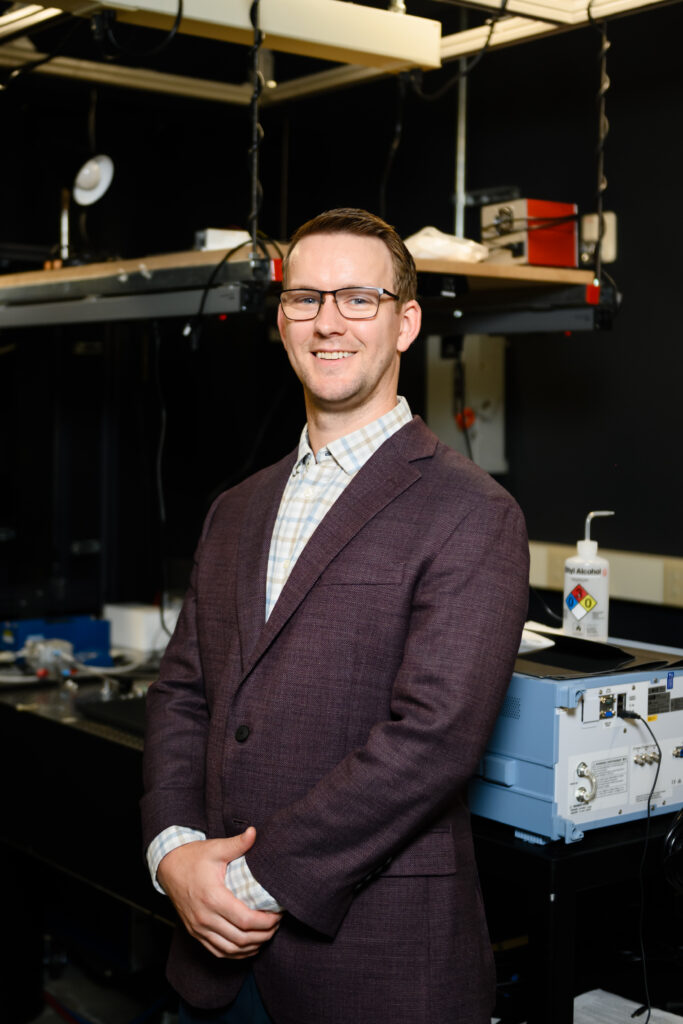
They also hold the potential for expanding bandwidth as artificial intelligence and other technology drive up the demand for transmitting data.
But the fibers that Topper studies are not made of ordinary window glass.
Topper and his collaborators mix a custom recipe of metal oxides, often including rare-earth ingredients, that give the material its laser-friendly properties. Many of the mixtures can’t touch a container as they cool because the container tends to make them crystallize, ruining them.
Instead, a tiny bead of the glass is floated on a stream of gas and melted with a laser. Then it is pulled into a fiber thinner than a human hair, using a specialized process that can be pictured as touching a stick to honey and pulling away a long, thin strand.
The primary goal in Topper’s new three-year project is to investigate innovative ways of wrapping cladding around the glass fiber. The cladding would help channel the light through the fiber more effectively by reducing scattering and keeping more light confined inside the fiber.
Topper also plans to tailor the glass compositions so the core and cladding have compatible optical and physical properties.
“I’ve been doing a lot of this on the side, so it’s exciting and fun to have the green light to work on this versus having to find time,” he said. “I like the materials, and I love working with my collaborators.”
Kyle Brinkman, chair of the Department of Materials Science and Engineering, said the award recognizes Topper as a rising researcher.
“Brian has shown exceptional ability and promise in research, and this award gives him the opportunity to pursue a bold idea with potentially far-reaching impact,” Brinkman said. “I congratulate him on beginning his tenure-track career with this recognition and look forward to working with him in his new role.”