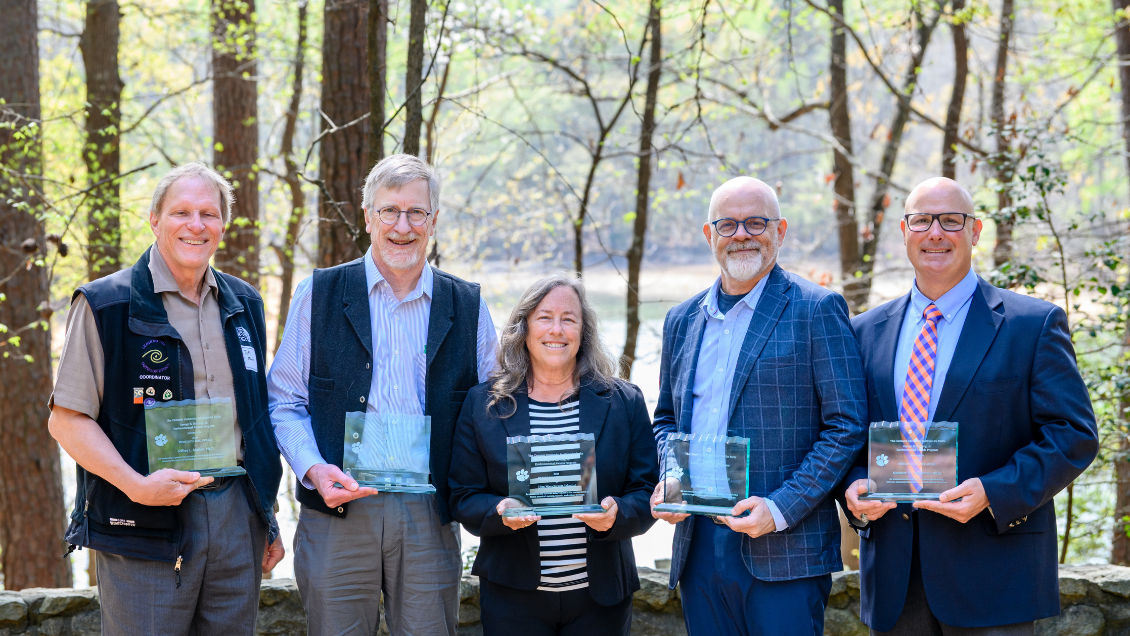

The Clemson University Institute for Parks (CUIP) recently hosted the 2026 George B. Hartzog Jr. Lecture and Environmental Awards program to honor individuals who have demonstrated exceptional leadership and commitment to sustainability, stewardship and community engagement in the fields of parks and conservation.
The annual event honors the legacy of George B. Hartzog Jr., who served as seventh director of the National Park Service (NPS) from 1964 to 1972 and led the largest expansion of the national park system in United States history. His administration oversaw the addition of more than 2.6 million acres and 72 units to the system, including national parks, seashores, lakeshores and historic sites.
“The annual lecture and award ceremony is a cornerstone event for the Institute for Parks, bringing us together to celebrate extraordinary leaders whose work preserves and protects public lands and strengthens the future of parks and conservation nationwide. CUIP is a nationally recognized leader in research, teaching and service, and the 2026 award winners were chosen for their lifelong commitment to excellence in service and stewardship. It is an honor to recognize their lasting contributions and achievements,” said Bob Powell, director of CUIP.
This year’s honorees include:

Jeffrey Marion, Ph.D., retired employee of the National Park Service (NPS) and U.S. Geological Survey and adjunct professor at Virginia Tech, received the Benton H. Box Award for leadership in preserving the natural environment and inspiring the pursuit of knowledge and environmental ethics. His lifelong research focuses on the effects of recreation on vegetation, soil and wildlife and the sustainable management of trails, recreation sites and campsites to preserve and protect the environment.
READ MORE
Jeffrey Marion, Ph.D., recently retired from a 39-year career with the National Park Service and U.S. Geological Survey and currently serves as an adjunct professor at Virginia Tech. He is co-founder and leading author of the Recreation Ecology field of study, which investigates the environmental impacts of visitor use in protected natural areas such as parks and wilderness.
His studies have focused on recreation impacts to vegetation, soil and wildlife; the sustainable management of trails, recreation sites and campsites; and the development and efficacy of Leave No Trace, a framework of seven principles designed to minimize human impact on nature. He is a founding member of the Leave No Trace Board of Directors and, for its first decade, chaired the committee that developed and refined low impact principles, practices, educational literature and courses. In 2014, he authored the organization’s official book, “Leave No Trace in the Outdoors,” and is currently working on a revised edition, as well as three open-source technical books. He is a recipient of the Department of the Interior’s highest honor, the Distinguished Service Award, and the George Wright Society’s Natural Resources Achievement Award.
He is a lifelong outdoor recreationist who has completed the Appalachian Trail and is now section-hiking the Pacific Crest Trail. He has been a Scoutmaster for five years and co-ed Venture Crew Leader for 18 years with Scouting America. Throughout his career, he has worked with scouting professionals to incorporate Leave No Trace into the scouting handbook, fieldbook, courses and outdoor practices. For this work, he is the recipient of the scouting community’s highest conservation awards, the Hornaday Gold Medal and Gold Badge and the Distinguished Staff Alumni Award from Philmont Scout Ranch.
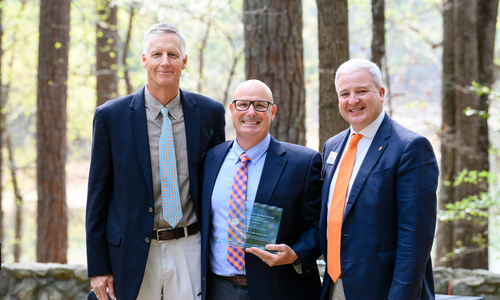
Matthew Brownlee, Ph.D., professor in the Department of Parks, Recreation and Tourism Management with a joint appointment in the Department of Forestry and Environmental Conservation at Clemson University, received the Dwight A. Holder Award for his outstanding work to foster understanding, wise use and conservation of natural and cultural resources.
READ MORE
Matthew Brownlee, Ph.D., is a professor of parks, conservation and outdoor recreation in the Clemson University Department of Parks, Recreation and Tourism Management with a joint appointment in the Department of Forestry and Environmental Conservation.
Brownlee earned a Ph.D. in parks, recreation and tourism management with an emphasis in parks and conservation area management and advanced training in applied social science methods and statistical measurement from Clemson University in 2012. He also holds a master’s degree in outdoor recreation administration from Aurora University, complemented by additional coursework in statistics from the University of Kentucky, and a bachelor’s degree in outdoor education from Northland College.
Brownlee’s interdisciplinary research connects outdoor recreation, park planning and resource management. His applied research supplies information to park and protected area professionals and natural resource managers to characterize and evaluate human-nature interactions, including park visitor behavior, visitation estimation and visitor capacity; people’s interactions with and attachments to climate-sensitive and climate-impacted environments; and connections within dynamic environmental-social systems. He specializes in research design and analytical methods, specifically related to applied social science research in parks and protected areas. He often uses methods that transcend traditional concentration areas and degrees, including advanced quantitative modeling, experience sampling, social network analysis, cognitive mapping, Global Positioning System (GPS) tracking, Geographic Information System (GIS) applications, participant-employed photography and photo elicitation.
One of his greatest joys is working closely with graduate and undergraduate students through applied research. During this process, he and his students work collaboratively to address critical management needs in addition to unanswered academic questions. His contribution to training the next generation of scientists and natural resource stewards has been substantial, chairing 11 doctoral students and 17 master’s students since 2013, while serving on more than 40 graduate committees at Clemson University, the University of Utah, Kansas State University, the University of Maine and the University of Tennessee.

Award-winning journalist Kurt Repanshek received the Walter T. Cox Award for sustained achievement in public service and a journalism career dedicated to public lands, wildlife, recreation and the environment.
READ MORE
Throughout his life, Kurt Repanshek has never been far from national parks. As a child, his parents introduced him to Acadia, Shenandoah and Great Smoky Mountains National Parks – and in college, he was a river guide on the New River before it was added to the National Park System. Professionally, as a respected, award-winning journalist covering public lands, wildlife, recreation and the environment, he led the Associated Press’s state office in Wyoming and became deeply involved in covering Grand Teton and Yellowstone National Parks. A key aspect of that coverage included reporting from Yellowstone during the hot, fiery summer of 1988.
While Kurt left the AP in 1993, he continued to write about national parks. As a freelance writer based in Park City, Utah, he authored hundreds of articles involving Yellowstone, Grand Teton, Great Smoky, Grand Canyon, Arches, Canyonlands, Zion, Bryce Canyon and Capitol Reef. He also wrote the books “America’s National Parks for Dummies” and “National Parks with Kids.”
In the summer of 2005, he launched the National Parks Traveler website, which he started as a way to find stories to pitch to magazines. From just 400 readers during its first week online, it evolved into a stand-alone, national publication and podcast with more than 4.5 million readers and listeners. In 2025, the Traveler’s weekly podcast was cited as one of the top 100 in the world by Listen Notes, an industry tracker.
Repanshek received the Stewart L. Udall Award from the Western National Parks Association in 2019; the George B. Hartzog, Jr. Award from the Coalition to Protect America’s National Parks in 2017; and the Communications Award from the George Wright Society in 2015.

Thomas Medema, former associate director of the National Park Service and keynote speaker during the 2026 George B. Hartzog Jr. Lecture Series, received the William C. Everhart Award for sustained achievements that highlight, promote and foster an appreciation of the nation’s natural and cultural heritage.
READ MORE
A dedicated conservationist with over thirty-five years of experience, Tom Medema is a veteran leader of the National Park Service. Driven by a deep passion for public lands, his journey began in 1988 as a volunteer at Rocky Mountain National Park. Over the course of his career, Medema has held pivotal roles at national parks across the country, including Denali, Cuyahoga Valley, Mount Rainier, Fort Vancouver National Historic Site and Rocky Mountain. He also served as chief of interpretation and education at Yosemite National Park, where he was deeply engaged in the local community – coaching the Yosemite ski team and supporting regional organizations.
In his most recent role, Medema served as associate director for interpretation, education and volunteers at the NPS. There, he shaped national programs that engaged millions of visitors annually, fostering deeper connections to America’s natural and cultural heritage. His leadership emphasized belonging and accessibility, with a focus on inspiring people from all backgrounds to appreciate and protect public lands and share their own stories. He oversaw education, volunteer and interpretive services across the system, playing a critical role in both program strategy and delivery.
Since retiring from federal service, Medema has continued his dedication to public land stewardship through his consulting firm, Medema Advising LLC. He partners with organizations to enhance visitor engagement, strengthen conservation initiatives and advance mission-driven impact. He is currently a special advisor for America250, a bipartisan initiative to engage Americans in the 250th commemoration of the Declaration of Independence in 2026.
He has provided leadership and expertise in Chile, Argentina, Peru, Nepal, Mongolia, France, Hungary and Saudi Arabia. He is also co-founder of Rally for Rangers, an adventure philanthropy initiative that delivers motorcycles and essential gear to park rangers in remote regions, empowering them to better protect the landscapes in their care. He co-produced the award-winning documentary “A Rally for Rangers,” which tells the story of this unique global effort.
In recognition of his enduring contributions, he has been honored with several prestigious awards for his visionary leadership and lifelong dedication to public lands. He received the Department of the Interior’s highest honorary recognition, the Distinguished Service Award, for his exceptional contributions to the NPS’ mission and career-long public service.
He was also awarded the NPS’ Sequoia Award in celebration of his outstanding legacy in interpretation and education. Additional honors include the Edward B. Danson Award from Western National Parks and the President’s Award from the National Association for Interpretation, acknowledging his years of exemplary service and influence in advancing the profession of interpretation nationwide.

Lisa Mendelson-Ielmini, deputy regional director of the National Capital Region for the National Park Service, received the Fran P. Mainella Award for her career achievement in the management of North America’s natural, historic and cultural heritage.
READ MORE
For more than three decades, Lisa Mendelson-Ielmini has advanced the stewardship of the nation’s natural, historic and cultural heritage through distinguished leadership in the National Park Service and other federal agencies.
In her current role as deputy regional director for the National Capital Region, she shares executive responsibility for 40 park units across Washington, D.C., Maryland, Virginia and West Virginia – a complex portfolio of memorials, historic sites, parkways and urban natural landscapes with more than 50 million visitors annually.
Since joining the National Park Service in 1997 as a partnership specialist, public information officer and park planner, Mendelson-Ielmini has held progressively senior positions across park, regional and national offices, including repeated service as acting regional director, superintendent of National Mall and Memorial Parks, chief of staff to multiple NPS directors and deputy superintendent of Yosemite National Park.
Her work has integrated resource protection with public access during nationally significant events and complex operations, including presidential inaugurations, large-scale public gatherings and emergency response. She has advanced collaborative approaches that align preservation, visitor use and operational continuity in highly visible and sensitive settings.
She emphasizes collaboration and practical problem-solving and provides steady leadership in highly visible settings. She has invested deeply in people by mentoring staff and leaders, strengthening partnerships and improving organizational practices that sustain both park resources and workforce.
She holds a master’s degree in land use planning from the University of Virginia, a bachelor’s degree in business management from Washington College and is a certified member of the American Institute of Certified Planners. Since 1993, Lisa has volunteered and lead hands-on service projects in national parks, reinforcing her lifelong commitment to conservation and stewardship.
Award winner Tom Medema delivered the Hartzog lecture, “America at 250: How Our National Parks Inspire a More Perfect Union.” He emphasized how national parks – and the stories associated with them – often embody the higher ideals of the nation and highlighted lessons from the past that provide clear opportunities for future improvement. He also explored the power of stories and immersive shared experiences while noting the need for continued leadership and commitment to public service, conservation and the protection of national parks.
“The Clemson Institute for Parks advances research to support the science-based management of parks and protected areas worldwide and delivers innovative leadership and training programs to inform policy and practice,” said Leslie Hossfeld, dean of the College of Behavioral, Social and Health Sciences. “As CUIP stands at the forefront of parks and conservation research, the George B. Hartzog Jr. Lecture and Environmental Awards program allows us to honor practitioners, educators and CUIP partners whose career contributions support the Institute’s global mission.”
The Clemson University Institute for Parks is part of the College of Behavioral, Social and Health Sciences. Established in July 2016, CBSHS is a 21st-century, land-grant college that combines work in nine disciplines – communication; nursing; parks, recreation and tourism management; political science; psychology; public health sciences; sociology, anthropology and criminal justice – to further its mission of “building people and communities” in South Carolina and beyond.