August 1 is World RNA Day, highlighting a molecule that quietly powers life and may even predate it.
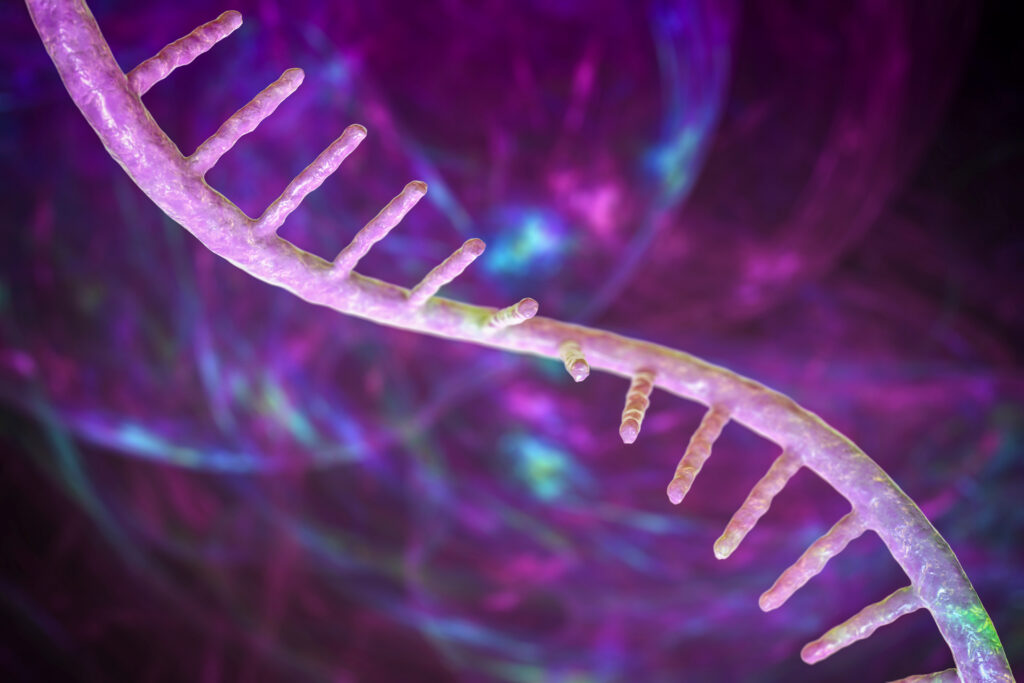
Ribonucleic acid, or RNA, is a single-stranded molecule found in all living cells that can act as a messenger. RNA carries instructions from DNA to translate genetic information into functional proteins. RNA Day’s date is a nod to the AUG (adenine-uracil-guanine) start codon. AUG acts like the capital letter at the beginning of the sentence, which signals where to start reading the genetic message to make protein.
To mark the occasion, Lela Lackey, a researcher at the Clemson University Institute for Human Genetics and an assistant professor in the Department of Genetics and Biochemistry, shares five reasons why RNA deserves attention.
RNA is the cell’s translator
DNA stores the instructions for building proteins, which do most of the work in our bodies. RNA carries those instructions so that a protein can be made. Unlike DNA, which has a double-stranded shape, RNA is single-stranded and is more flexible.
Instructions lead to many results
In humans, the same region of DNA can give rise to many different intermediate RNA forms. Because the body can mix and match these RNA versions in different ways, people can develop different traits and functions even when they share most of the same DNA. Many other organisms are less flexible in how they use their DNA, so they produce fewer variations from the same genetic information.
Molecules fold on their own
RNA molecules are inherently structured; they naturally fold into specific shapes on their own. These shapes, including hairpins and loops, help determine how the RNA functions biologically.
Some facilitate reactions
Although RNA is well known as a messenger, some RNA molecules, called ribozymes, can speed up chemical reactions. Instead of carrying instructions from DNA to make proteins, their job is to act as enzymes directly, without relying on proteins.
Start of life?
The RNA world hypothesis is a popular idea among scientists that life may have originated with RNA because RNA can both store genetic information and carry out important jobs in cells. The thought is that RNA came before both DNA and proteins. Even just as recently as this year, scientists have reported synthetic RNA machines that can self-replicate.

Lackey’s lab studies RNA structure and how that structure helps control what RNA does in cells. One experiment in the lab tests different RNA structures to see how they affect the molecule’s function.
“One of our big questions is what kinds of RNA structures are functional,” said Lackey, who is a member of the International RNA Society, a community of scientists with a wide range of interests in the molecule.