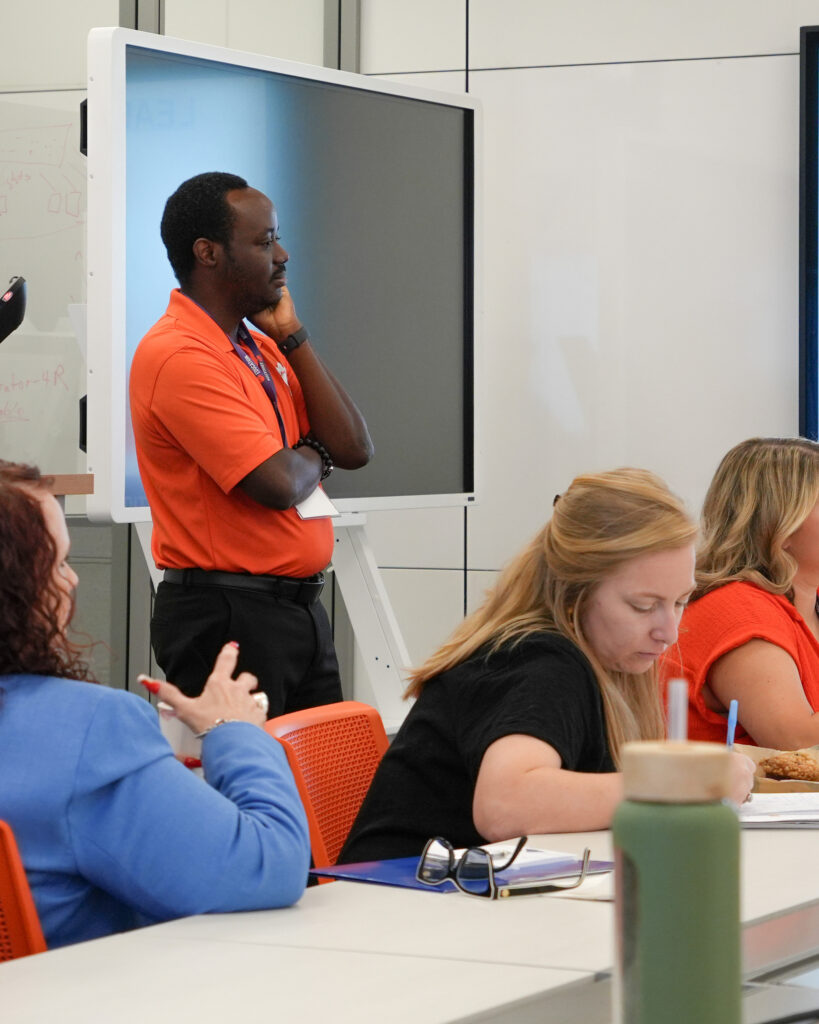
Edwin Nii Bonney serves as an assistant professor in the Department of Educational and Organizational Leadership Development at Clemson University. Bonney works to prepare current and future school leaders with the tools and knowledge to improve school systems to better serve all students and families.
Originally from Ghana, a country in West Africa, Bonney earned a bachelor’s degree in psychology and Spanish from the University of Ghana in 2013 before coming to the U.S. to earn a master’s in language teaching and a Ph.D. in educational leadership and policy studies from the University of Missouri, Columbia.
Bonney has understandably become a go-to resource for international students in the College of Education, as they often turn to him for advice and support while navigating a similar academic path. These relationships inspired Bonney to create the International Educational Scholars Research Lab, which is dedicated to mentoring and supporting Ph.D. students and early-career scholars in the study of educational problems, policies and practices in international contexts beyond the United States.
The lab equips scholars with the skills to design, conduct and lead research across diverse educational settings. Through collaborative learning, peer mentorship, and guidance from senior scholars, members develop their capacity to inquire into problems, collect and analyze data, generate knowledge, and disseminate their work through scholarly publications and presentations.
We talked to Bonney about his background, his love of teaching and how both are intermingling in the new research lab.
What is your teaching philosophy?
Every classroom sits inside a society made up of a variety of ideologies, some dominant, others pushed to the margins. Having studied in three countries and taught in two, I’m intentional about designing courses that give students mental models and lenses for interpreting the world around them by exposing them to texts and perspectives that often challenge the one dominant way of reading the world.
I build every course around collaborative discussions, student-led presentations, short reflective writing and longer research projects. These approaches allow students to critique and engage with new learning, engage with others and learn directly from the communities and practitioners whose histories, stories, and problems of practice they’re studying.
My students know up front that we may not all agree on everything, but we will adopt a learning stance which will bring us closer to understanding how others read the world. And I try to model that I’m still learning, too. I also solicit feedback from my students about their experience in my courses so that I continue to create an environment that is responsive to their needs.
Why do you love teaching?
I love teaching because of what my greatest inspirations showed me: the moment when a student who’s been perplexed by a complex idea finally sees it click because it’s been broken down into something simple and relatable.
I love being the kind of teacher students feel they can approach with a question, a struggle or even something going on outside the classroom and know they’ll get an honest, caring response. Teaching, for me, is really about learning alongside people while helping them believe they’re capable of understanding and doing more than they thought.
Who were these inspirations for you?
Two people shaped how I teach more than anyone else. The first was my fifth-grade teacher, Mrs. Emelia Ankrah. Up to that point, I saw teachers as figures of fear and discipline. Mrs. Ankrah flipped that idea for me. She was approachable and someone I could go to with questions, someone who could see what I was good at and where I needed support, and who encouraged me in those areas with kindness rather than intimidation. She became my first model of what a teacher could be. She was someone who brought out my best without being someone I needed to fear.
The second was my dad, who became a professor in his later years. From him, I learned the importance of breaking down complex ideas into simple, everyday language. He always said a good teacher doesn’t need to use complex words and terms to show what they know, but that they should be able to break down complex things so that every student can understand.

How will the Educational Scholars Research Lab improve or expand your relationships with students?
Through the lab, I’m able to build relationships with students beyond the structure of a single course or dissertation committee. We meet weekly, and over time those sessions become less about any one assignment and more about walking alongside students through their whole journey — their research interests, coursework struggles, conference goals, the job market, raising young kids as parent-scholars and sometimes personal challenges, too.
What I value most is that the mentorship goes both ways. Students bring their own questions, ideas and lived experience into the lab, and we co-develop research together rather than me simply directing their work. Several of the lab members have been first authors on published papers in top-tier journals and led conference presentations.
Is there any subject that you’re interested in and/or devote time to that might surprise people?
I like to nerd out on all things Christian biblical theology. I like to think if I was not a professor of education, I might have been a pastor. I love to understand, ask questions and make sense of the world by learning more about my faith.
What do you enjoy doing when you are not teaching?
When I am not teaching, I just enjoy being with my family. I have three kids including a 23-month-old, so they keep me busy enough. On most weekends if I’m not out with my family, I enjoy watching the English Premier League and anything related to Manchester United Football Club. 21 is coming!