If a fire broke out on a space station, 911 wouldn’t be much help, but astronauts could have something even better thanks to the work of Yuhao Xu and his team at Clemson University.
Xu, an assistant professor of mechanical engineering, is carving out a national reputation for his research into how combustion and fire work in the microgravity of space.
One of the key applications is developing new ways of suppressing fire, which is important to spacecraft safety as humankind works to establish an outpost on the moon and then set a course for Mars.
“It’s very exciting,” Xu said. “First, I feel like I’m pushing the boundary of scientific discovery. Second, it’s the human exploration of space. I know that my contribution is a very small part, but no matter how tiny that is, I am very excited to be part of it.”
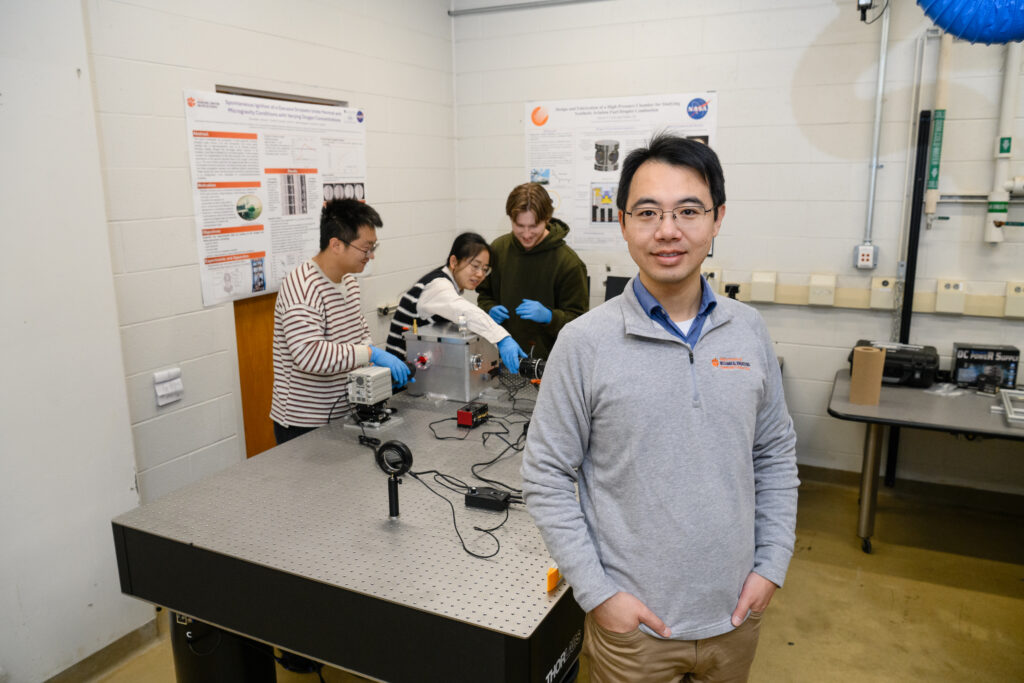
Xu is blasting into 2026 with serious fuel and combustion science. He closed out the fall semester by snagging the 2025 Thora Halstead Young Investigator Award from the American Society for Gravitational and Space Research (ASGSR).
Xu, who has been at Clemson for three years, started researching combustion in space 12 years ago as a Ph.D. student at Cornell University. He had the opportunity in 2013 to oversee experiments on the International Space Station, analyzing experiment video from Cornell and providing real-time feedback over the phone to the NASA Glenn Research Center.
The experiments provided so much data, researchers are still analyzing it and yielding new insights, he said.
The project that has Xu most fired up now is helping develop a reactor that creates fire inside water so that astronauts can recycle wastewater in space.
It is called supercritical water oxidation. The system heats and pressurizes water so intensely that a hydrothermal flame forms and breaks down the organic material in the wastewater, leaving clean water behind.
The technology is in the initial stages, but Xu said it could become a game-changer for long missions to the moon and Mars.
Xu’s research doesn’t just help astronauts. It has down-to-earth benefits, too.
By finding ways to burn fuel more cleanly and cut down on soot, his work could lead to more efficient engines, lower emissions and better air quality here on Earth.
In addition to his research, Xu serves on the governing board of the ASGSR, a role that positions Clemson at the heart of the nation’s space-research community.
Alexander Leonessa, chair of the Department of Mechanical Engineering, congratulated Xu on his success.
“Dr. Xu’s creativity and drive are helping elevate Clemson’s research profile,” Leonessa said. “His work in space-related combustion not only advances science and technology but also inspires students by giving them access to cutting-edge projects that could have an impact on this planet– and beyond.”