
Junior mechanical engineering major John Lewis spent the first half of his time at Clemson much like many students do, focused on academics, professional pursuits and social involvement. As he settled into college life, however, Lewis continued to feel drawn to the medical field and began seeking opportunities to build the clinical side of his resume. The answer turned out to be right in front of him: Clemson University Fire and EMS. Thanks to a thorough class, led by an incredible instructor, Lewis — now a nationally certified emergency medical technician (EMT) — was able to add a new task to his weekly schedule: saving lives.
The Pre-Hospital Education Program, managed by Clemson University Fire and EMS, is a course designed to give students the skills and knowledge necessary to provide medical support and transport to injured or critically ill patients. The class runs twice a year — once from the beginning of the Fall semester to the University’s spring break, and once for a 12-week period during the summer. The program is new, with Lewis’ class being the third graduating cohort since its beginning in August 2024. Nonetheless, the success the program has achieved in such a short lifespan shows great promise for its future.
Both sections of the program follow a hybrid learning model. Students build technical knowledge through a series of online modules, while also developing practical skills by attending in-person sessions. The Fall program requires four hours of in-person instruction one day per week, while the Summer program requires a seven to eight hour day, in order to offset the accelerated schedule.

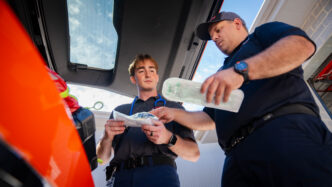
For the first half of the course, most of the students’ learning is in the classroom, running through test scenarios and reviewing important concepts. Once they have a higher understanding of how to handle a medical emergency, they begin their work in the field, performing ride-alongs with Clemson University Fire and EMS. Last year alone, the department conducted 2,176 EMS and rescue calls — an illustration of the need for an expanded and skilled workforce.
Alongside qualified professionals, these students engage with local communities — in Lewis’ case, Pickens, Greenville and Oconee counties — to gain valuable experience through real patient contacts. This hands-on involvement further enhances the students’ understanding of medicine and patient care by exposing them to authentic situations that cannot be replicated in a classroom. Lewis recalls a classmate once conducted a full resuscitation and saved a life, while others have even delivered babies.
“It’s so special to be able to bring good to these communities, especially on some of the worst days of their lives,” says Lewis.
At the conclusion of the course, students take an exam to earn validation of their in-person skills and classroom knowledge. Once they pass, Clemson University Fire and EMS holds a stethoscope ceremony to celebrate the graduates and present them with certificates of completion. From there, students are on their own to take the national exam — a 60-120 question adaptive test which, when completed, awards them a formal EMT certification. Finally, students must obtain a license for the state they plan to practice in.
Currently, the Pre-Hospital Education Program has a 96% national EMT exam pass rate, which is 20% above the state average. This impressive success is a testament to the leadership and instruction students receive under class coordinator Brandon Herrington.
Herrington, who also serves as a paramedic and driver engineer, has worked in Fire and EMS for 16 years — three and a half of those at Clemson. Throughout this experience, Herrington came to recognize the importance of involving younger people in the EMT field, and his instruction reflects this recognition.

“It’s a lot easier to transition from being in an education setting, like Clemson University, to being in a rigorous course like this,” says Herrington. “These students come in with intelligence and learning skills that add so much to the program.”
Herrington places a strong emphasis on the experiential learning piece of the Pre-Hospital Education Program — the piece that makes the course so unique and effective compared to other medical classes. By conducting demonstrations in class and coordinating ride-alongs, Herrington strives to pair his instruction with hands-on scenarios in order to further develop his students.
“Watching my students grow from having almost no knowledge of EMS to being strong, competent providers is so special,” says Herrington. “I have two daughters, and I start every class with the goal of preparing my students to be good enough that I would trust them to take care of my own kids. Seeing them reach that level brings me so much pride.”
In addition to the development of his skills, Lewis praises the relationships formed within the Pre-Hospital Education Program, including with Herrington and with fellow students.

“Sometimes I just go over to the station and eat dinner with the firefighters if I don’t feel like cooking,” Lewis jokes. “And last week, I played an intramural volleyball game with one of the girls from my class. We are all very close.”
Lewis is also involved in Clemson’s Fire and EMS internship program, which has brought him even closer to the team and built upon his knowledge from Herrington’s class. As an intern, Lewis has the opportunity to participate in additional ride-alongs and work during events, such as athletic competitions and the upcoming Death Valley Nights concert series. This work, in addition to his time in the Pre-Hospital Education Program, has truly allowed Lewis to maximize his Clemson experience and redefine his future.
“My time with Clemson University Fire and EMS has reminded me that I am not limited to one specific pathway,” says Lewis. “Even though freshman John chose mechanical engineering, which has nothing to do with medicine at all, the connections I’ve made at Clemson have given me the opportunity to discover and pursue this new passion, and I am so greatly appreciative.”
This summer, Lewis will be working as an EMT for Prisma Health Ambulance Services for nearby Oconee County, handling both 911 emergencies and interfacility transport. The confidence and competence he brings to this role can be traced back to the support he received from the Pre-Hospital Education Program under Herrington.
Meanwhile, as Herrington prepares for his upcoming Summer course, his primary goal for the future of the program continues to be growth. He plans to broaden the instructor pool by pulling in fellow paramedics and EMTs. He is also working to partner with the University to create an expanded curriculum. Beyond just developing the program, however, Herrington aspires to develop his students — both as EMTs and as individuals, capable of making an impact and representing Clemson University well.
The Pre-Hospital Education Program is open to all Clemson students. For more information or to apply for this course, visit the Clemson Fire and EMS website.