
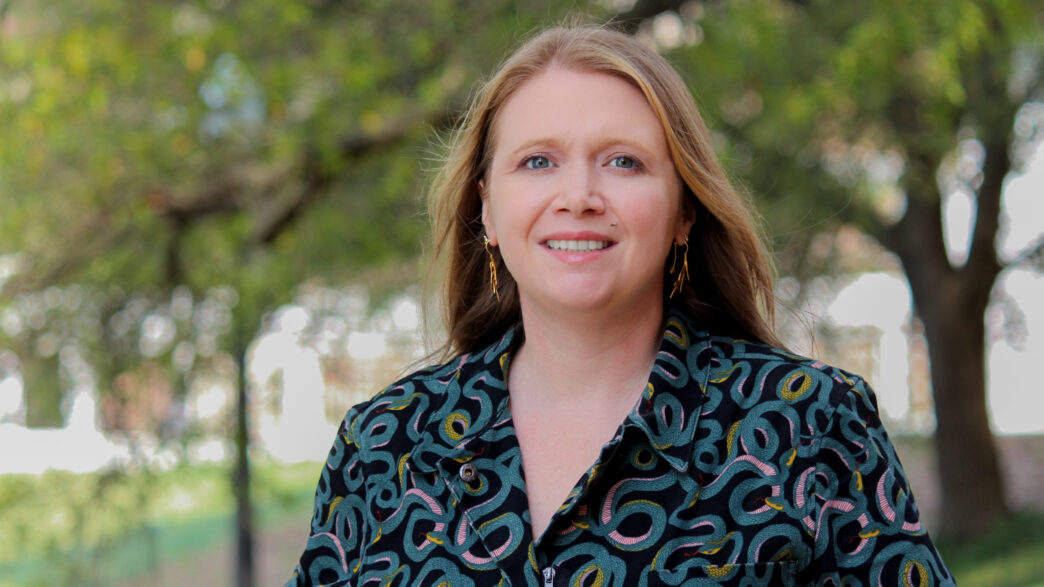
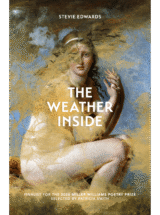
Assistant Professor of English Stevie Edwards has recently published her fourth book of poetry, The Weather Inside (University of Arkansas Press, 2026). The book was a finalist for the 2026 Miller Williams Poetry Prize.
Edwards is an accomplished poet whose work examines themes of mental health, addiction, intimate relationships and childlessness. Her previous publications include Quiet Armor (Northwestern University Press, 2023), Humanly (Small Doggies Press, 2015), and Good Grief (Write Bloody Publishing, 2012). Her 2021 poem, “Parthenogenesis”, was added to the collection of the Poetry Foundation.
She sat down to answer questions about her book and how her poetry informs her work as an educator.
This interview has been edited for length and clarity.
How did you become a poet?
I started writing poetry as a teenager. I had a really great English teacher in the eighth grade, whom I remember — Mr. Janson — and he had us put together a little booklet of some of our favorite poems. We wrote poems that were inspired by them, and I just really loved it.
I was a teenager dealing with being bipolar and having generalized anxiety disorder, but not having any treatment because my family didn’t think that was a good idea. I was dealing with a lot of intense things all the time, and poetry gave me an outlet to express that.
What do you see yourself as first, a professor or a poet?
I see myself as a poet first. A professor is a way that I can share my love of poetry with other people, and I value that, and I love encouraging young writers. But first and foremost, I think of myself as a poet.
What was the impetus behind this particular book of poetry?
Well, to some degree, I’m just always writing. So, after I write a certain number of poems, I step back and think about, well, what are some of the things that unite them, and what did the poems have to do with each other, and how can they work towards being a collection? A lot of the poems are just what I was writing, what I was living through and dealing with in my daily life.
But I guess some of the impetus towards making it a book is that I wanted to share the narrative of what it is to be a child-free woman, which is not the most accepted thing, especially in the South. I also wanted to share — or I wanted to sort of fight against — the stigmatism of talking about alcoholism and mental illness.
What is the inspiration for the title, The Weather Inside?
I have a poem called “Temperance,” and that’s the opening line of that poem, and it’s talking about sort of the weather inside the mind. So, using the weather and storms as a sort of metaphor for a turbulent mind.
What are the themes of the poems, and how do you explore those?
A lot of the poems are about the decision of whether or not to have children, which was one of the more difficult decisions I made in my 30s. My husband was initially against it, and I was not sure about it. So trying to reconcile those two things, and also doing that while, understanding that I live with mental illness, which is one, hereditary, and two, could debilitate me at any time. It is something I was thinking about.
Also, I’m about two years sober, and a lot of the poems were dealing with sort of the messiness of my youth and trying to think through the ways that alcohol played a part in the messiness of my youth.
There are other themes in it. There are some poems about living with mental illness, which I’ve talked a little bit about. I’m bipolar. I have complex PTSD and generalized anxiety disorder. Basically, I have a full medicine cabinet, and so some of the poems are about just living with that in daily life, trying not to be miserable with it and trying to actually live a joyful life. Some of them go into sexuality and gender identity. Those are other things that are explored.
How are you able to write about things that are so personal?
Well, I think one important thing is that in a poetry collection, the speaker is not the poet.
The speaker is a constructed persona, so there is a little bit of distance created by that; it’s not meant to be read as factual. But beyond that, many of the themes are things I’ve dealt with in my real life. There’s a distance between the speaker and me, but it’s not the longest distance.
I think that people being silenced — about things like mental health, and alcoholism, for example, or sexuality — causes a lot of suffering in this world. I think those stigmas against talking about these subjects hurt people and are harmful. So, if I can create a space with my writing where people feel comfortable being themselves, then that’s what I want to do.
How do you begin to try to teach poetry?
It’s tricky because I always have a mostly a craft-based focus in my intro classes, learning the different skills of poetry, but I also give poems that deal with tough subjects. We’ll be talking about imagery, but we’ll also be reading a poem that’s deeply moving.
Teaching craft is kind of teaching technical skills in a way, and that is comfortable for me, but I think the challenge is getting students to open up, which I think happens over time. Those first poems they submit to a workshop are a little more closed off, but as they get to trust each other more, they’re more willing to divulge things, and to be more open on the page.
Does there come a point where your comfort with the craft allows you to really insert your feelings more?
Yes. I think you’ve got to have the craft level, because otherwise it’s a diary entry. I do often find a lot of students who have a lot they want to get off their chest, but they don’t know how to do it yet, or they don’t know how to sculpt it. So a lot of what I do is teach the skills for how to craft their feelings or their ideas into a poem.
Is there a poem in this collection that you could point to that you wish a lot of students would read?
I have a poem called “Ode to Effexor”, which is about the experience of first going on an antidepressant. I think a lot of students are curious about mental illness. I’m actually teaching a class right now on representations of mental illness in 20th and 21st-century literature.
What was the hardest thing about writing this collection?
Knowing my mother-in-law was going to read it!
She’s a very supportive and wonderful woman. Just knowing that the people I’m close to are going to read it is always the most difficult thing for me.
Is there anything else you want to say about the book?
People might be surprised that some of the poems are funny. I know I talk about a lot of heavy subjects, but I like to use humor in my poems. And I think that’s just my natural way of processing things that are hard. I think I tend to joke about things that are difficult. A lot of the best comedians are coming from a very dark place.