
Julie Foster has learned that context means everything when discussing the number of students receiving behavioral interventions in the Cherokee County School District. That number has only increased in the last few years, and she said the district couldn’t be happier about it.
“Wait, what? We’re happy about it?” Foster said. “Yeah, at first it can be hard to explain, but when you also learn that we cut the number of suspensions from school in half, our good attitude starts to make a little more sense.”
Foster works as a multi-tiered systems of support (MTSS) coordinator in the district; these systems are a collaborative, evidence-based approach that offers support to all students. Foster works alongside the district’s lead school psychologist to coordinate behavioral-support work. Getting a clearer picture of the supports required in a school or district begins with more interventions, and those interventions lead to work that prevents contextually inappropriate behavior and extreme disciplinary action, such as suspension.
Foster said the district’s emphasis has shifted to teaching appropriate or replacement behaviors instead of merely punishing inappropriate ones. This shift in mindset is a success story for Cherokee County Schools and Clemson University, a long-time partner in this effort. College of Education researchers behind the Behavior Alliance of South Carolina (BASC) have provided pathways to success and support for lasting change in school systems since forming in Fall 2022. The South Carolina Department of Education Office of Special Education Services funds BASC at Clemson University to work directly with the state to help districts and schools across South Carolina build capacity for supporting students with behavioral needs.
BASC starts by guiding districts such as Cherokee County in collecting and analyzing data to define school needs before providing professional development and support in implementing multi-tiered systems of support. That support will continue into 2031 thanks to a contract renewal awarding researchers more than $6.5 million over the next five years. According to Megan Carpenter, principal investigator for BASC, the future of this work will allow BASC to continue to expand its reach while more effectively addressing student needs in existing partnerships that might require more support than is provided by the first tier of supports provided to all students within MTSS.
“The ultimate goal of our work is to help teachers meet behavioral needs while keeping students engaged in instruction and in school,” Carpenter said. “Meaningful change in systems takes more than a single year, and we are happy to see concrete indicators of progress among our partner districts.”
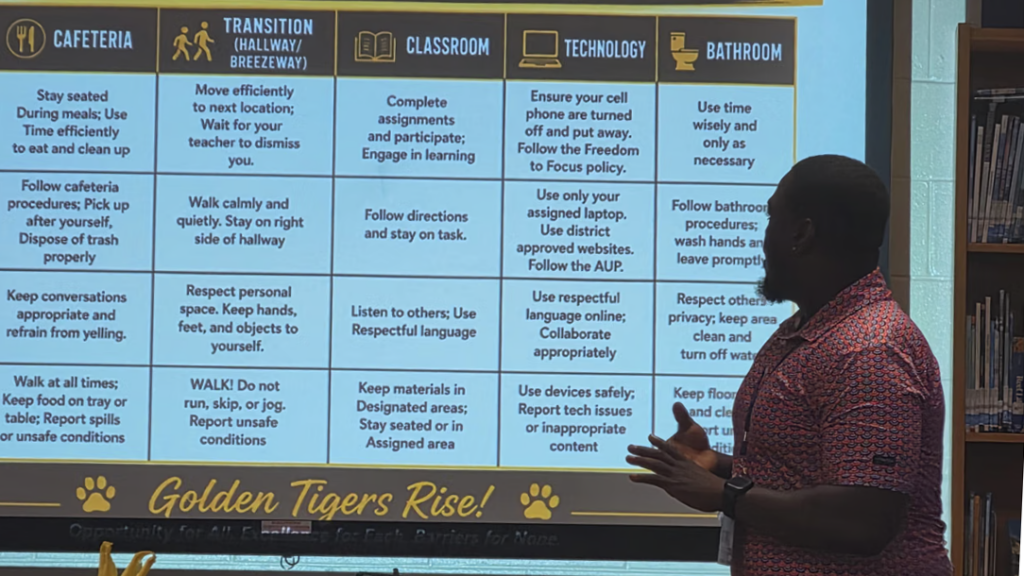
Tier 1 supports support every student and come in the form of classroom management practices, routines and procedures, schoolwide and classroom-specific behavioral norms. Foster said BASC has helped ensure that what students hear in the classroom aligns with expectations throughout the entire school. Tier 2 and 3 supports address more serious behavioral issues, but Foster said that more effective tier 1 supports have revealed that many students did not actually require intensive intervention; they only needed more consistent universal supports.
A clearer behavioral picture leads to big changes, such as reduced suspensions, and Foster said keeping students in school means educators can address the underlying behavior rather than sending students home only to encounter the same problem when they return. She identifies the shift from a traditional punitive model to proactive and preventive intervention as perhaps the biggest change she has seen.
“The support from BASC is amazing as far as giving us what we need to coach the team and then giving the team what they need to coach their staff,” Foster said. “Our teachers now feel more empowered to investigate the ‘why’ behind a behavior and address it themselves, which also keeps students from missing instruction.”
According to Carpenter, zooming out to see the effects in Cherokee happening in nearly 20 other districts in the state makes it easy to see the existing and potential impact of BASC. Through open-access professional development and other resources, Carpenter estimates the work touches 80–90% of South Carolina counties in some form.

Carpenter said the focus of BASC has shifted from one-off trainings to building long-term district capacity. The entire goal is not to be needed at all; as district leaders take over the work, researchers designed BASC to eventually phase out. Carpenter feels that BASC’s work alongside districts such as Cherokee County to build capacity has led to more districts taking notice and requesting partnerships.
Support data shows that a proven method is only growing in use. Regarding district-level support, BASC partnerships have impacted more than 200,000 students across 18 districts, with more than 1,400 hours of in-person learning and nearly 300 hours of virtual learning. Survey data of participants shows that 100% of respondents agreed that professional development provided by BASC has impacted their work.
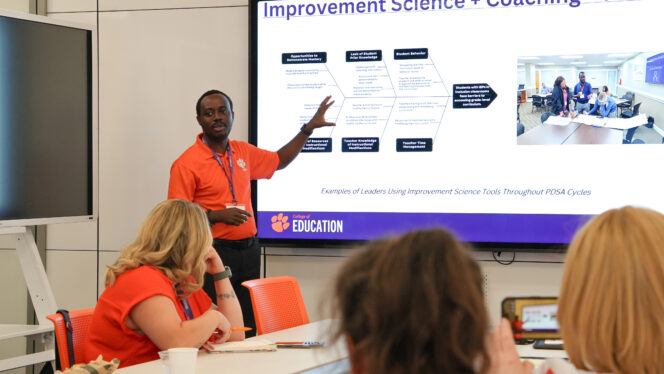
Carpenter said that the project’s use of Project ECHO (Extension for Community Healthcare Outcomes) has helped to cement professional learning for district educators and staff. Originally designed to educate and train laboratory and health care professionals on diagnostic excellence, the BASC team has applied ECHO principles to increase the knowledge and workforce capacity through distance-based professional development. ECHO provides virtual follow-up to in-person learning and has helped to foster a community of practice among and across district teams.
Project ECHO also helps to build more district-level capacity up front for new partners without adding unnecessary scheduling pressure. BASC researchers have also redesigned in-person sessions with districts to better balance content delivery and protected time for school teams to work together and build materials or plans. Participants leave these sessions with work already underway instead of a list of tasks to complete.
“We’ve really refined not just what we provide, but how we provide it,” Carpenter said. “We have found that spending more time at the district level makes it more likely there will be a support structure in place for long-term capacity. It’s really encouraging to see schools laying their own foundations for this work in actionable ways.”