
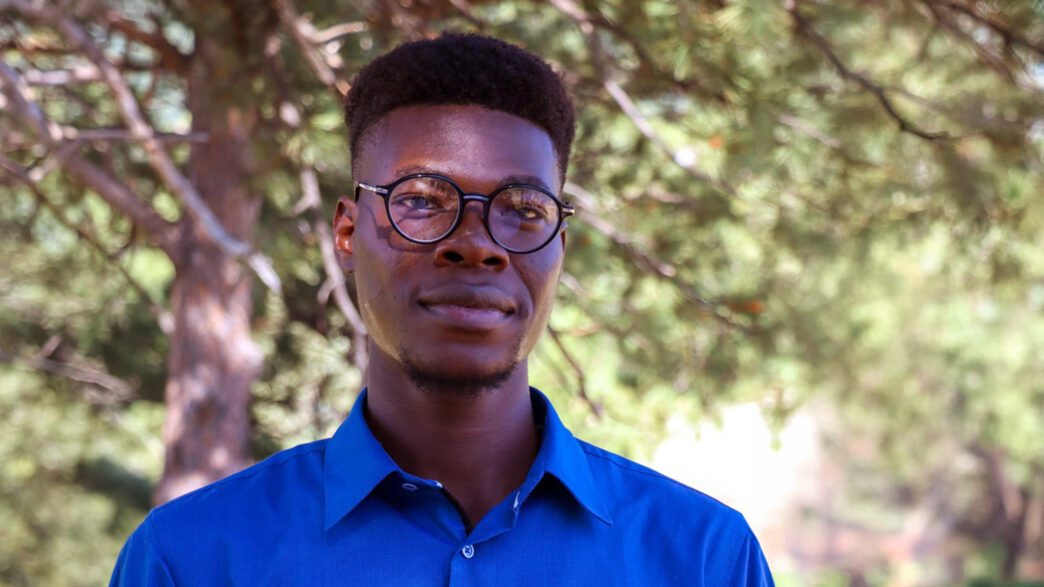
Ibrahim Oluwajoba “’Joba” Adisa Ph.D. ’24 joins the College of Education faculty this fall as an assistant professor of learning sciences with a focus on artificial intelligence and education. In addition to his roles in teaching and research, Adisa hopes this position will allow him to help frame AI as a useful tool for preservice teachers and those actively teaching in classrooms.
Adisa returns to Clemson after earning his Ph.D. in learning sciences in 2024 and pursuing two postdoctoral opportunities that allowed him to use AI in very different areas of education. The first was a human-centered AI postdoctoral fellowship at Stanford University that focused on teachers’ AI literacy, while a second with the College Boards’s GenAI Studio examined AI from an assessment perspective.
“These opportunities allowed me to see how AI can be effectively used in classrooms and taught within the discipline,” Adisa said. “Both experiences showed me that no matter the application, it is important for users and educators to find the ‘Goldilocks point’ in AI use; educators remain responsible for designing environments and processes that lead to meaningful student outcomes.”
In addition to how AI can most effectively be used as a tool for educators, Adisa also hopes to work with educators to help them understand when it should — and shouldn’t — be used in classrooms, as well as help define ethical concerns so that teachers can help their students become good stewards of new technology.
Adisa likes to think of AI as a collaborator rather than a chatbot that provides answers to prompts. For educators, Adisa has seen how powerful AI can be when used to help create workflows, teaching materials and learning opportunities for students.
Adisa acknowledges that students will resort to using AI to simply complete assignments, but instead of treating this as misconduct, he sees it as necessary pressure on educators to reconsider assignments that AI can complete trivially. Adisa sees pressure to rethink curricula, assessments and assignments as a necessary step toward creating more open-ended, authentic learning opportunities that tip the scales back in the right direction for educators and students.
“If AI does most of the intellectual work, the collaboration becomes lopsided and less useful, so as educators learn to better use it, they can pass their own learning on to students,” Adisa said. “Trust between teachers and students remains fundamental to learning, so AI will not replace social and emotional understanding or the specific classroom context.”
Adisa chose to return to Clemson as a faculty member because of both the College’s and the University’s vision for AI literacy and AI’s use in education. He said that during his campus visit, he saw how invested the members of the leadership were in preparing educators to use AI appropriately in the state.
He was also happy to return to work with familiar faculty members in a College that values partnerships with schools and districts. He said College’s relationship building with districts across the state will allow him to make connections with his work almost immediately.
“Those established relationships will allow me to begin collaborative research sooner rather than building trust from scratch,” Adisa said. “Institutional support, a clear AI vision and a collaborative community fit my work particularly well, so I am excited to get started.”