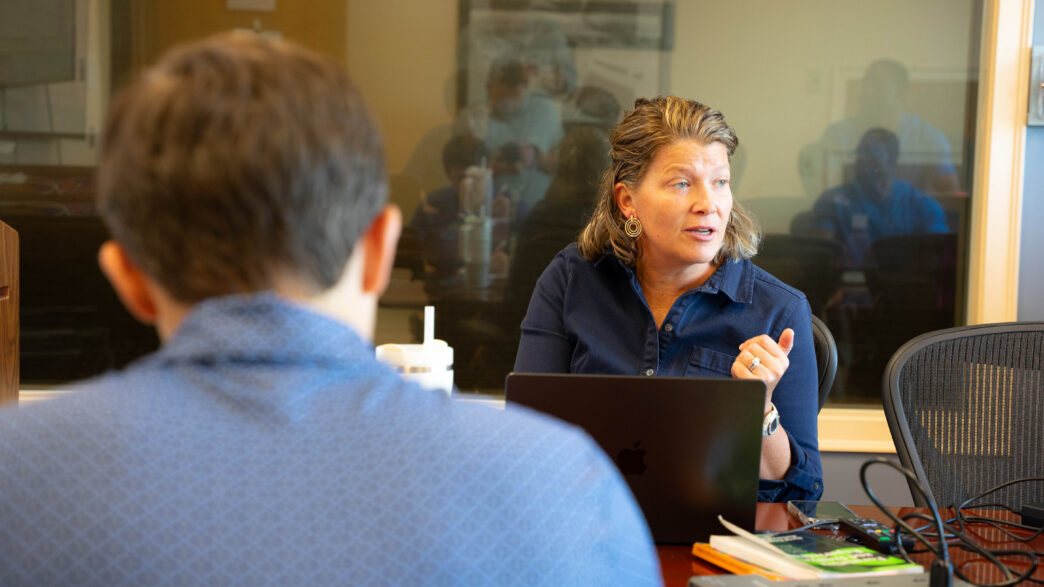
Emily Howell serves as an associate professor in the Department of Education and Human Development at Clemson University. Howell stays busy both outside the classroom, conducting research in the professional development of literacy educators, particularly those working with multilingual learners. However, Howell also brings her skills as a teacher to graduate students in the College of Education, often in Hyflex classrooms that allow in-person and online students to collaborate synchronously.
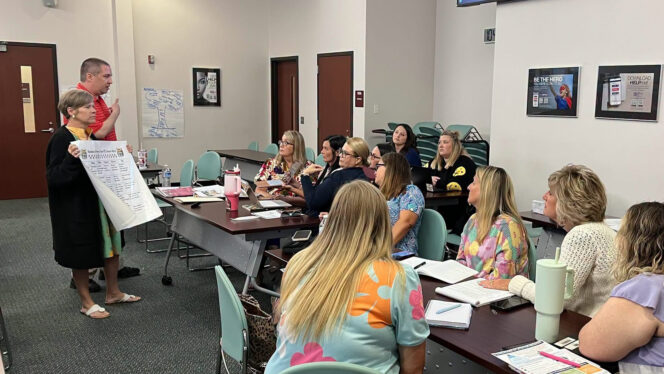
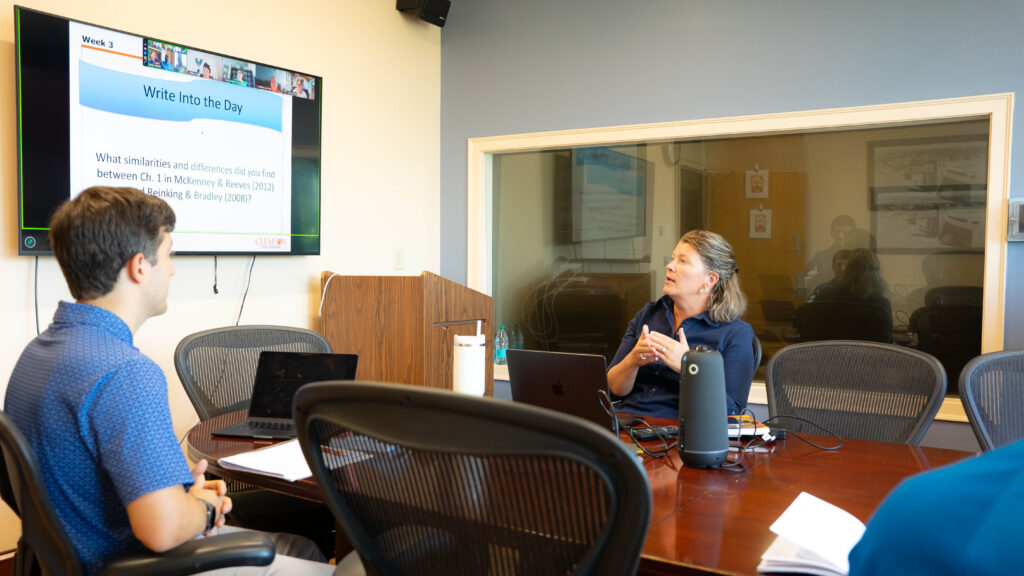
We caught up with Howell as she was conducting one such class, Design-based Research Methods, with a rapt audience both around the table and on Zoom. Howell talked to us about how research informs teaching and vice versa. We also discussed her overall teaching philosophy, why she thinks taking care of body is just as important as mind and what she does to unwind and decompress outside of work.
What is your teaching philosophy?
Overall, I am a teacher who believes in the sociocultural idea that all aspects of culture impact student learning. Thus, I meet students where they are, provide high-quality teaching and teach in multimodal ways so students can best comprehend and express themselves. I try to have students explore the literature in their field and then get them to think of how they can make one small tweak to generate new knowledge. Even a small change can have a big impact.

What is the most rewarding and most challenging aspect of teaching for you?
The most rewarding part of teaching is seeing how it changes the lives of those you teach. I’ve had students win writing competitions when teaching K-12, and I now have doctoral students who go on to get tenured positions. I’m always grateful to be a part of their journey.
It is challenging — and one of my favorite parts of teaching — to realize that to teach is also to learn. You are always charged with staying current in your field and reading broadly to integrate new ideas into your teaching. I love generating ideas and learning from others. Teaching and research are synergistic. My teaching informs my research, and my research is conveyed in my teaching. For example, I am the PI on two grant projects that use design-based research as a method, and I also teach a design-based research doctoral course.
When did you know that the field of education was for you?
I was one who loved learning everything, so I had a tough time deciding on a major as an undergraduate. I always came back to teaching others as a passion. So, tutoring student-athletes served as an assistantship for my master’s in education, and then I taught middle and high school English before pursuing my doctorate. Now I am teaching pre-service and in-service teachers.
Name an educator who inspired you to teach.
I’ve had so many great mentors throughout my career. They had in common a lifelong love of learning and pursuit of new inquiry, and the willingness to allow their students to pursue their own interests.
What tips do you have for students in the College of Education preparing to become educators?
Never lose sight of students’ own interests. That should be a starting point. Then, you can weave those interests into a broader curriculum.

What do you like about Clemson University?
I love that I work with some of the smartest, most passionate people in their respective fields of study. You can build teams and learn from one another while trying to tackle needs in the local context.
Is there any subject that you’re interested in and/or devote time to that might surprise people?
I’m a believer in the physical and mental connection. One of my lifelong passions that helps keep both my mind and body in shape is long-distance running. I ran cross-country and track and field as an undergraduate, have run a few marathons and am still running today.
What do you enjoy doing when you are not teaching?
I love spending time with my husband and two sons on the lake, taking RV trips, hiking and bike riding — they keep me on my toes with activities.