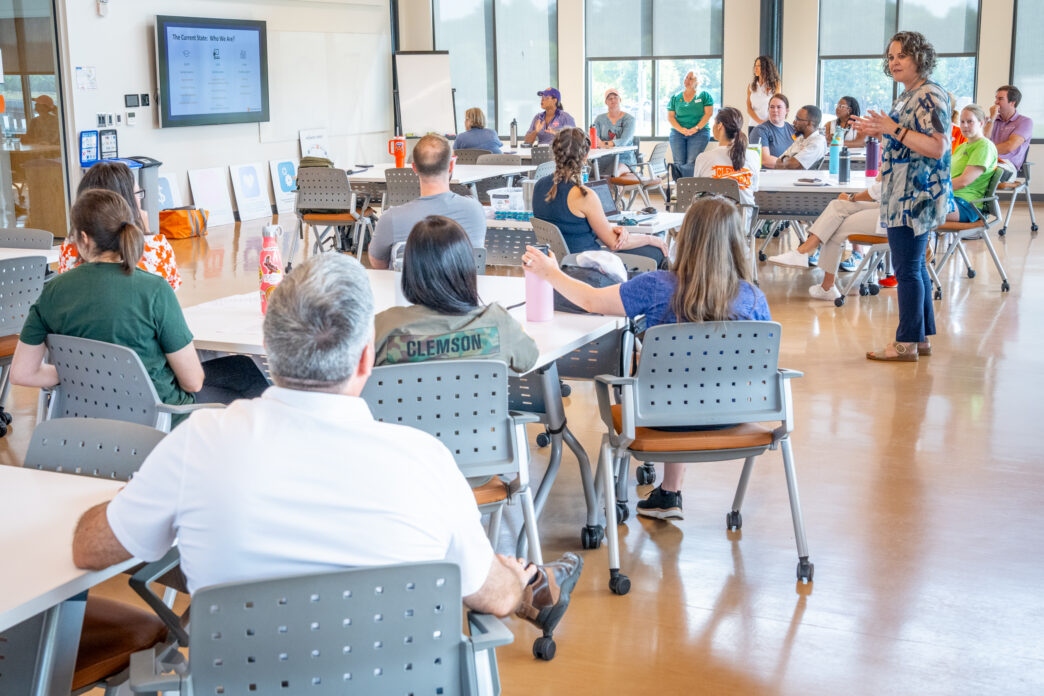
For the past 18 months, the Clemson Well-Being Council, campus leaders, faculty, staff, students, Extension partners and subject matter experts have worked together to build something foundational for our University: a systematic way to understand and prioritize the health and well-being of our entire community.
This has not been a small undertaking. It requires consensus-building, navigating priorities, change management and a deep commitment to public health practice. Building something new at the institutional level is challenging and complex, but it also creates opportunities and hope
And this month, that hope becomes action.
Earlier this week, we launched Clemson’s first-ever Community Health and Well-Being Needs Assessment — a comprehensive survey designed to assess well-being across all eight dimensions for our campus community.
This assessment is a cornerstone of our strategic commitment outlined in the Clemson Well-Being Strategic Plan and our Elevate Well-Being priorities. It gives us what every strong system needs: shared measurement, clear data and the ability to track progress over time.
Why This Matters
If we are serious about creating a culture of well-being where every member of our community feels supported and empowered to thrive, then we must understand:
- Where stress and burnout are most pronounced
- Where belonging is strong — and where it is not
- How accessible our resources truly are
- What populations need tailored support
- Which interventions are making a measurable difference
Surveys like this are not about checking a box. They are about understanding the lived experiences of our people. They allow us to identify the amplitude of challenges, reduce duplication, close gaps and prioritize investments where they will have the greatest impact. This can look like recommendations for new programming and resources; program or process improvements with existing resources to better serve the community; and/or improving access to resources we have, but the community may be unaware.
They also allow us to demonstrate accountability — to show that well-being is not just a value statement, but a measurable institutional priority.
But Here Is the Truth
The success of this effort hinges on one thing:
You.
No Chief Well-Being Officer. No council. No strategic plan.
None can replace the power of your voice.
Whole-community well-being is grounded in collective impact. That means shared agenda, shared measurement and shared responsibility. If we want tailored recommendations at the college and division level — if we want actionable insights rather than generalizations — we need robust participation across every population.
Faculty. Staff. Students. Extension colleagues across all 46 counties.
Your experience matters. Your data matters. Your perspective matters.
What I Am Asking You To Do
The survey is open through Sunday, March 29 and I hope you will:
- Take 10–15 minutes to complete it.
- Encourage your colleagues and teams to do the same.
- Share it with students.
- Talk about why participation matters.
If you are a leader, model engagement.
If you are a supervisor, create space for your team to complete it.
If you are a student, amplify it among your peers.
This is how culture shifts — not through mandates, but through participation.
The Bigger Picture
From the beginning of my role, I have believed Clemson needed a systematic survey and assessment process — not just for today, but for long-term institutional health. A true public health approach requires data, iteration, and continuous quality improvement.
This assessment is the first step in building that system.
It will not be perfect. It will not answer every question.
But it will give us a shared starting point. And from there, we build.
Because at the end of the day, this work is not about dashboards or key performance indicators. It is about people. It is about you.
You matter. We care. And we are doing something about it.
Now we need you to join us.