With a few taps or clicks, we can have nearly any restaurant meal delivered to our door. But for restaurants and beverage companies, convincing us to add a fountain drink remains a challenge.
That problem became the focus of the 2026 48HR REPACK Student Design Competition, an international competition that challenges students to solve real-world packaging problems for industry partners. This year’s design prompt, developed by The Coca-Cola Company, asked teams to reimagine the fountain beverage experience for the food-delivery era.
Inspired by the nostalgia of classic Coca-Cola experiences, four Clemson University students set out to tackle the problem. Their solution, “A Glassic Taste,” earned first place and the Sponsor’s Choice Award.
The winning team included Ava Goff, a graphic communications student; Blake Peeler and Shayar Joshi, packaging science students; and Andrew Tuz, an architecture major. Guided by packaging science faculty member Haley Appleby, the team had 48 hours to develop, prototype and pitch its concept. Joshi, Goff and Tuz are Clemson National Scholars, members of the University’s most selective university-wide merit scholarship program.

Solving a delivery dilemma
As food delivery grows, consumers are less likely to add beverages to their orders because they often already have drinks at home. Teams had to develop a delivery experience compelling enough to change that behavior while ensuring beverages arrived tasting freshly poured. Solutions also had to be sustainable, manufacturable and practical for both restaurants and consumers.
After a night of brainstorming and rapid prototyping, the students decided to reinvent the fountain cup itself.
“We wanted to create something consumers couldn’t get by just opening their refrigerator at home,” said Joshi, a rising senior. “We asked ourselves how we could make ordering a fountain drink feel intentional and special again.”
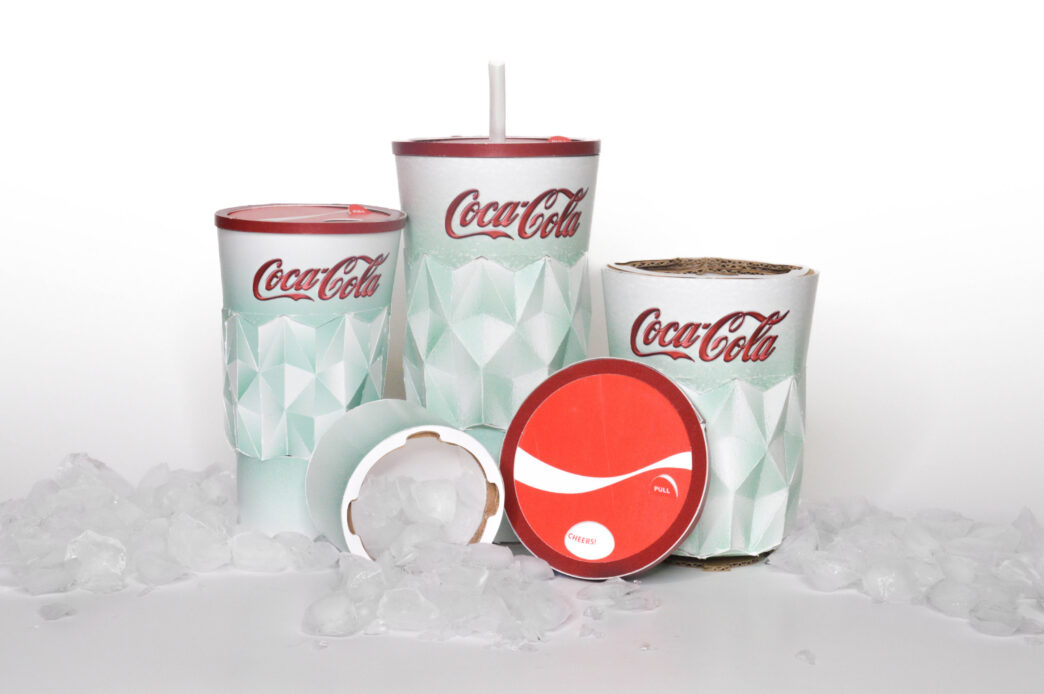
The resulting design drew inspiration from the iconic mint-green Coca-Cola glass bottle and vintage soda-shop culture while incorporating modern functionality. The prototype featured a locking lid to prevent leaks, a tamper-evident seal and a textured grip inspired by ice and frosted glass.
Perhaps the design’s most innovative feature was a separate ice compartment beneath the beverage chamber. During delivery, the ice remains isolated from the drink, keeping it cold without diluting it or reducing carbonation. Once the beverage arrives, consumers unlock the lower compartment and add the ice themselves.
The students also prioritized sustainability. The cup was constructed entirely from paperboard and corrugated materials and paired with a paper straw, minimizing plastic use and simplifying recycling. Its locking, modular components allowed consumers to reuse the cup, extending its life and reducing single-use waste while maintaining a premium delivery experience.
From concept to prototype
Both Appleby and Joshi credited the team’s success to its interdisciplinary makeup. Graphic communications student Ava Goff led the package graphics and branding, while architecture major Andrew Tuz and packaging science student Blake Peeler focused on structural development. Joshi contributed to graphics and produced the team’s video presentation, though team members frequently crossed disciplines as they refined and tested the design.
“Packaging challenges don’t exist in isolation. Our students brought expertise in structural design, branding and user experience, allowing them to approach the problem from multiple angles. That’s exactly how products are developed in industry,” Appleby said.
Students relied heavily on Clemson’s facilities in the Harris A. Smith Building, using cutting tables, printers, computer labs and other specialized equipment to create full-scale prototypes.
“It was huge having access to those facilities,” Joshi said. “We were able to create realistic packaging prototypes instead of just sketches. Having those resources available made a big difference.”
Appleby said the team’s polished prototype reflects the value of Clemson’s hands-on approach, even as artificial intelligence transforms the design process.
“What set this team apart was the level of refinement they achieved,” Appleby said. “The team developed a sophisticated structural design, thoughtful graphics and delivered a fully functional prototype. Many universities don’t have the facilities or resources that allow students to move from concept to prototype at this level. AI can generate concepts, but students still need to understand whether those ideas can actually be manufactured, shipped and used by consumers.”
Learning beyond the classroom
For Joshi, who also competed in last year’s competition, experiences like the 48HR Repack Challenge are already paying dividends professionally. He credits participation in the competition with helping him secure co-op and internship opportunities in packaging design.
“Competitions like this give you perspective on the entire design process,” Joshi said. “You’re not just thinking about the package itself. You’re thinking about consumers, sustainability, manufacturing and everyone who interacts with the product.”