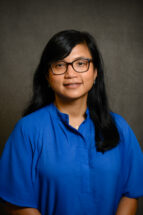
Clemson University chemist Thao Tran Dominy is part of the seven-member planning committee for Chemistry 2050: A Roadmap to the Future, a National Academies of Sciences, Engineering and Medicine workshop examining how chemistry and chemical engineering can drive future advances in energy, quantum computing, and materials and manufacturing.
The workshop, which will be held in Washington, D.C., and virtually August 5 and 6, brings together experts from academia, government and industry. Chemistry 2050 will ask what the chemical sciences landscape could look like in a quarter century and what actions the community should take now and over the next decade to create new capabilities.
Tran Dominy’s selection reflects the growing visibility of Clemson’s research in fields closely aligned with the workshop. Committee members are framing the workshop’s central questions, have identified speakers and developed guiding questions for panel and breakout discussions.
Contribution to community
“I feel like this is my job — to contribute to the bigger community,” Tran Dominy said.
The workshop’s three focus areas are energy, quantum computing and materials and manufacturing.
“We’re at an inflection point right now because the existing materials infrastructure and technology are approaching their limits. Making incremental improvements is no longer going to cut it. That creates an opportunity to rethink how we move the field forward,” she said.
Advances in energy could make electrified chemical processing, carbon capture and new approaches to fuel production more practical. Quantum computing could shorten molecular design and synthesis timelines, while chemistry will be essential to developing the materials needed for quantum devices. Advances in materials and manufacturing could enable alternative feedstocks, more circular chemical systems and production methods that move beyond the limitations of existing materials and infrastructure.
Must work together
Tran Dominy said the scale and complexity of the issues require researchers, companies and government agencies to work together earlier in the research and development process.
“None of us can answer these questions on our own. We need to engage academia, government and industry in the conversation, learn from one another, and work toward shared goals,” she said. “We have to get together.”
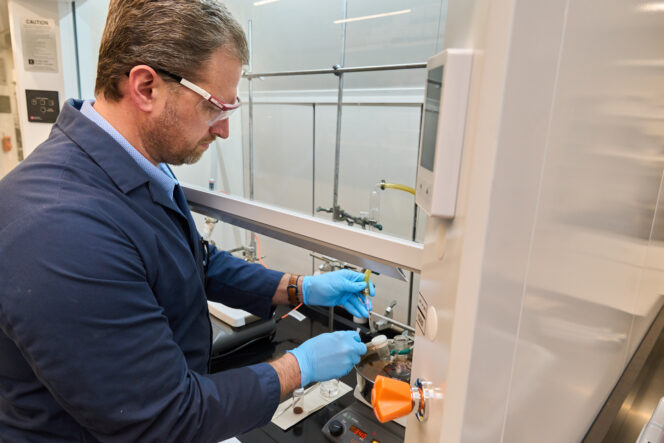
Tran Dominy is an associate professor in the Clemson Department of Chemistry. Her lab studies quantum and functional materials, using chemical bonding, electronic structure, synthesis and advanced characterization to address challenges in quantum information science and energy technology.
She is a 2025 National Academy of Sciences Kavli Fellow, and her honors include an NSF CAREER Award and a Beckman Young Investigator Award.
Chemistry 2050 is organized through the National Academies’ Chemical Sciences Roundtable and sponsored by the National Science Foundation and the U.S. Department of Energy Office of Science. It will be held Aug. 5 and 6 at the National Academies’ Keck Center in Washington, D.C. Virtual participation is also available. Registration is available through the National Academies event page.