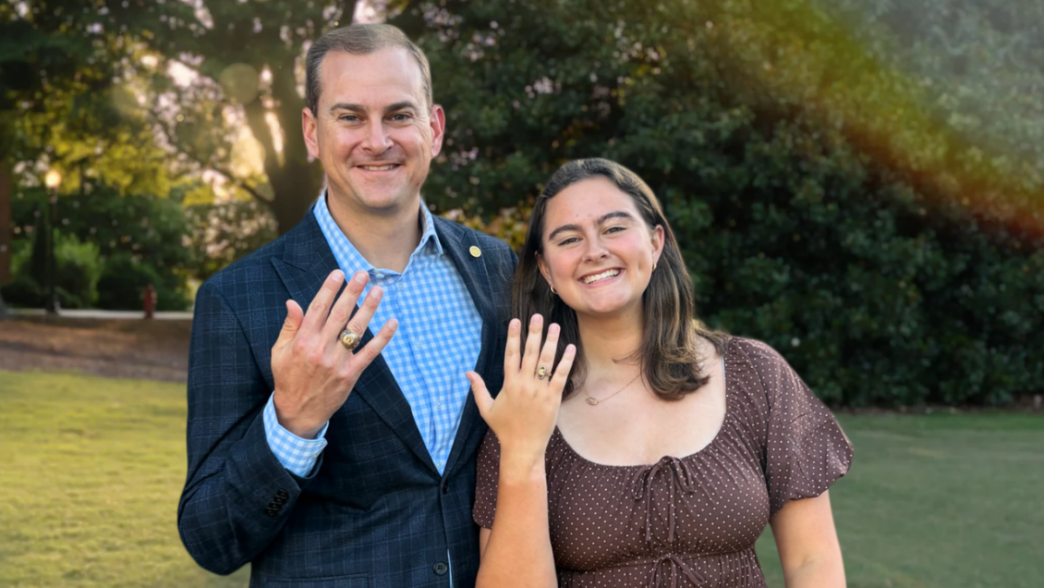
Meet Andy Hogue, 2003 graduate of the Clemson University Department of Communication and associate dean in the College of Arts and Sciences at Baylor University.
For South Carolina native Andy Hogue ’03, the decision to attend Clemson University was a natural one – he felt he had always been part of the Clemson Family. His parents were alumni and his older sister was a student when he arrived. Later, his younger sister followed in their footsteps, and now his daughter is carrying on the family tradition.
When Hogue arrived at Clemson as a communication major, he did not expect to pursue academia as a profession. But as his studies progressed and research opportunities became available, he discovered a passion for learning that changed the trajectory of his life.
“My professors inspired my curiosity,” said Hogue, “and I learned the value in asking important questions about the world. The prospects of a career in the academy emerged as an outflow of that. I simply wanted to keep asking questions and spark for someone else what my professors had sparked for me.”
Hogue said Andy Billings, a professor of communication at the time, made a lasting impression. He remembers Billings as a gifted teacher and highly productive scholar who cared deeply about his students. Hogue joined Billings as an undergraduate researcher and learned how to run a successful research enterprise, frame a question, gather evidence and pursue an answer.
During his time as an undergraduate student, Hogue identified strengths and passions he had not yet explored. Unique research opportunities and communication coursework provided regular opportunities to hone his skills in public speaking, writing and research. Looking back, he said those skills have been essential to his work as both an educator and scholar.
After Clemson, Hogue earned a master’s degree in church-state studies and a doctorate in political science from Baylor University. His career took him to Whitworth University in Spokane, Washington, before he returned to Baylor in 2011. He now serves as associate dean in the College of Arts and Sciences, director of the Office of Engaged Learning and teaching professor of political science.
At Baylor, he received the Master Teacher Award, the highest honor bestowed by the university for teaching, in recognition of sustained excellence, proven knowledge, effective methodology and a passion for teaching and learning. Only 30 Master Teacher designations have been awarded in the school’s 181-year history.
Even now, Hogue’s connection to the University remains strong. He is actively involved with the College of Behavioral, Social and Health Sciences, remains close to his Clemson roommates and is experiencing the University in a new way – as a parent. According to Hogue, seeing his daughter thrive as a student has deepened his appreciation for the University.
“Throughout my life and career, I have noticed that the lasting affinity alumni feel toward Clemson is rare,” said Hogue. “At Baylor I have three other faculty colleagues who attended Clemson at the same time I did and lived within a few hundred yards of each other. We did not know each other as students, but we share the same fondness for the University all these years later.”
When he advises students in his current role, Hogue encourages them to take time for self-reflection. He asks them to consider four questions: 1) What am I learning about the world and myself? 2) What am I doing with my time? 3) Who am I becoming? 4) How might the world be better because of the first three?
Hogue credits Clemson with nurturing his curiosity, expanding his skillset and providing a clear sense of purpose that has guided him throughout his life. He continues to lead students with the hope that those questions spark curiosity and connect day-to-day life – coursework, activities and obligations – to a larger purpose.
The Department of Communication is in the College of Behavioral, Social and Health Sciences (CBSHS). Established in July 2016, CBSHS is a 21st-century, land-grant college that combines work in nine disciplines – communication; nursing; parks, recreation and tourism management; political science; psychology; public health sciences; sociology, anthropology and criminal justice – to further its mission of “building people and communities” in South Carolina and beyond.