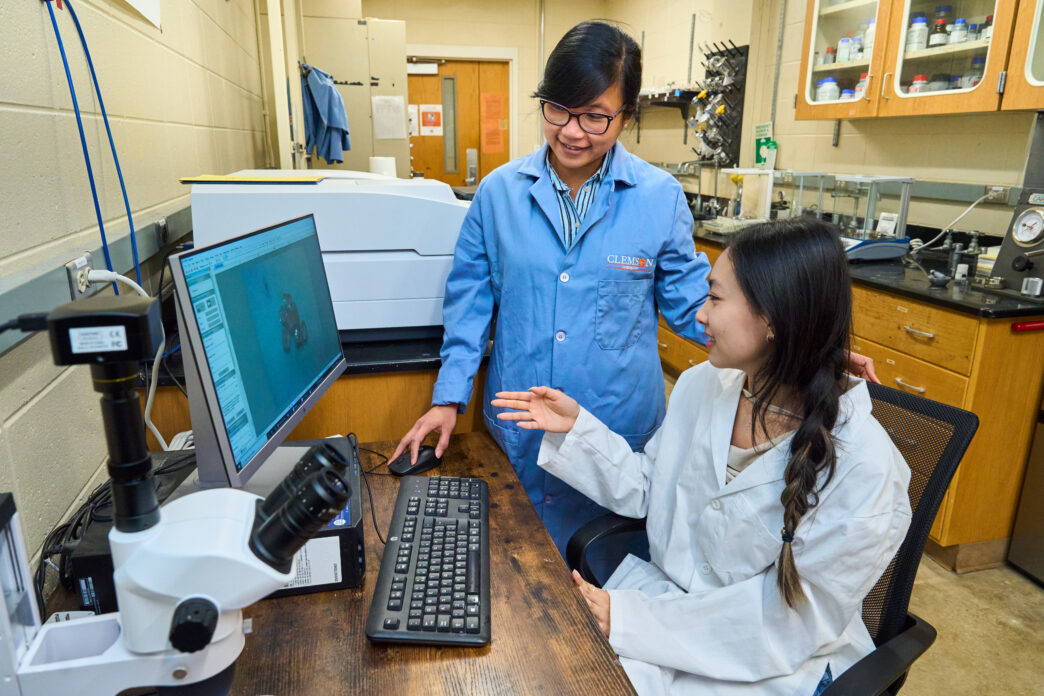
When Thao Tran Dominy’s research group learns something new about a material, the discovery often leads to another question to be answered. For the Clemson University chemist, that is part of the point.

“We are very good at making the problem worse,” she said, laughingly. By that, she means the work uncovers new layers of complexity and new questions worth pursuing.
That curiosity is one reason Tran Dominy has received the 2027 American Chemical Society’s Harry Gray Award for Creative Work in Inorganic Chemistry by a Young Investigator. The award recognizes creative and impactful work and includes a $10,000 honorarium.
The award honors a body of research rather than a single discovery.
“Thao is a creative young investigator who has done groundbreaking research on lanthanide materials. I was delighted, but not surprised, when I received word from ACS that she had won ‘my award.’ I am so proud of her,” said Gray, the Arnold O. Beckman Professor at Caltech who is widely recognized as a pioneer in bioinorganic chemistry and inorganic photochemistry.
The award was established with an endowed fund from Gray and his friends and colleagues.
Understanding behavior
Tran Dominy’s group investigates how chemical bonding and electronic structure give rise to quantum properties in materials. The goal is to understand how a material behaves at a fundamental level and, over time, how that understanding might let scientists control its properties.
In one line of work, her team has found that putting electrons slightly into antibonding states may encourage more unusual quantum behavior. The idea sounds counterintuitive because antibonding states can destabilize a system. But Tran Dominy said the effect can depend on the degree of change. A small shift may produce a desired response, while pushing too far could cause the material to decompose or lose the wanted properties.
The discovery points to a broader challenge in materials science: identifying the precise chemical conditions that produce a desired behavior. Tran Dominy compares the complexity of a material to a symphony. Many elements and interactions contribute at once, making it difficult to isolate one cause.
“Scientific discovery is all about digging deeper. We can’t just be satisfied with the superficial layer. We have to keep going,” she said.
Fundamental science
Tran Dominy said her research is fundamental science, creating understanding that could help scientists rethink how materials work and, in the longer term, develop new technologies.
The award’s namesake, Harry Gray, is among the scientists that Tran Dominy admires. She met him at a symposium and remembers how he asked incisive questions in a supportive, lighthearted way. After her selection for the award, Gray sent a personal note congratulating her.
This is not the first award Tran Dominy has received. She has won the Camille Dreyfus Teacher-Scholar Award, the Beckman Young Investigators Award from the Arnold and Mabel Beckman Foundation, a National Science Foundation CAREER Award and was named a Kavli Fellow by the National Academy of Sciences.
Tran Dominy said the honor is gratifying, but recognition is not the purpose behind her work.
“Doing science is a reward in itself,” she said. “The goal is to do good science.”