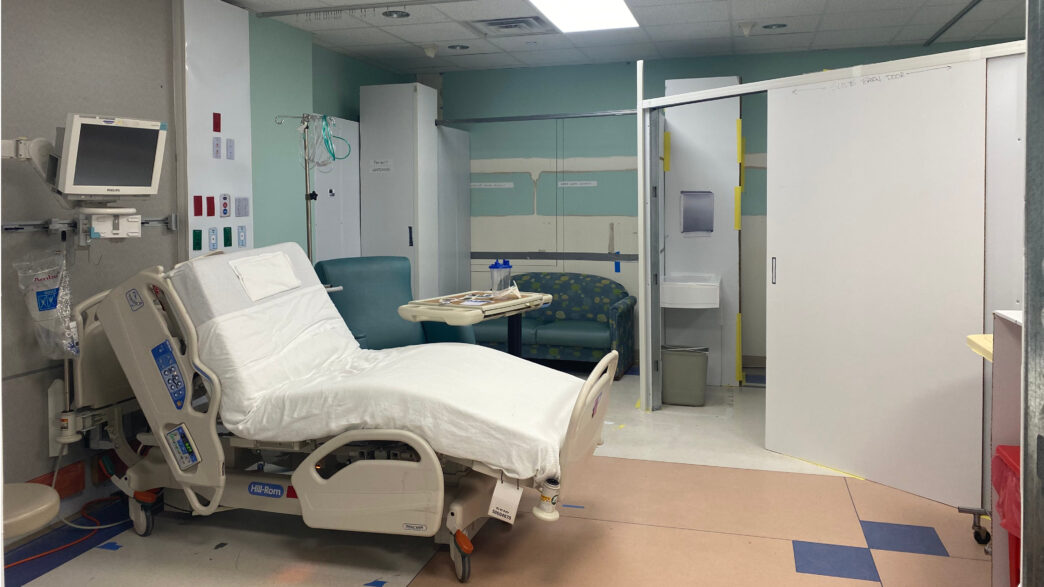
When you walk into a hospital room, you may notice the bed, the monitors and maybe the window. What you don’t see, but what healthcare workers experience daily, is that the room’s layout can impact your recovery.
A new study by Clemson University’s Center for Health Facilities Design and Testing, recently published in the Health Environments Research & Design Journal (HERD), reveals how different aspects of a patient room can impact patient safety, recovery and the effectiveness of nurses, doctors and other clinicians.
“The patient room is arguably the most critical space in the hospital, because that’s where the patient care is delivered and its design is replicated hundreds of times in a hospital. Given that a hospital will last more than 50 years, it is important to get the design right,” said Anjali Joseph, director of the Center for Health Facilities Design & Testing and lead researcher on the project.
Can design heal?
Joseph and her team’s work began when Indiana University Health (IU Health) reached out for help designing standardized rooms throughout the new Adult Academic Health Center in downtown Indianapolis.
“Having known David Allison and Anjali Joseph’s work over the past decade to advance evidence-based design, bringing Clemson University’s Center for Health Facilities Design and Testing expertise was obvious,” explained James Mladucky, vice president of Design & Construction at Indiana University Health.
IU Health’s design team had already developed room sizes and the position of the windows. But they needed assistance in creating a standardized layout that could adapt to the rapidly changing needs of the patient and clinical team.
“Architects are great at reading designs and floor plans, but clinical teams don’t have a sense of how it’s really going to work until they are in the room. They’re much more tactile and sensory, and they need to experience these spaces,” Joseph explained.
To ensure that the room layouts met the needs of clinicians and patients, the IU Health team collaborated with Joseph’s team to design, build and evaluate full-scale room mock-ups.
When floor plans aren’t enough
Nurses, therapists, physicians, facility managers and architects collaborated to develop patient room design options through three iterative design and testing phases.
Throughout the study, participants were asked to perform tasks as they would in real-world patient care scenarios.

Across each scenario, clinicians consistently favored rooms with bathrooms on the exterior wall near the foot of the bed, as it improved mobility, sight lines and access to the patient during urgent care situations.
“This layout gave staff more room to work with the patient, kept pathways clear and increased patient visibility from the nurses’ station and corridors,” said Joseph.
One of the project’s partners, Christi Cornelius, the Director of Operations, Project Planning and Operations at Indiana University Health, felt the project strengthened staff confidence in the design of the new hospital.
“Our highly skilled clinicians practice evidence-based medicine every day at Indiana University Health. Partnering with Clemson University allowed us to apply evidence-based design to shape the future inpatient room design,” Cornelius shared. “Involving frontline caregivers in testing real patient scenarios gave us confidence that the design truly supports safe, efficient and patient-centered care. This collaboration not only strengthened the design process but also extended our academic mission into the creation of the new hospital. I’m excited to continue this research through post-occupancy evaluations.”
Designing for the next fifty years
According to Joseph, hospital rooms built today will most likely serve patients for over half a century, making thoughtful, evidence-based design more than a matter of efficiency; it becomes a matter of compassion.
“Once you design these spaces, they’re going to be there for the next 50 years,” explained Joseph. “If they’re not designed correctly, on an everyday basis, it’s going to cause stress for the staff and suffering for the patients.
The study demonstrates that iterative design processes involving caretakers, clinicians and families can lead to meaningful change in our medical care.
“All of us at some point have been in a hospital or have been with a family member… You want to feel safe, you want sunlight, you want to look out a window. The space is more than just a room; it is a place to help you heal.”
Joseph’s study earned a Silver Touchstone Award at the American Society for Health Care Engineering (ASHE) Planning Design and Construction (PDC) Summit in Atlanta in the spring of 2025. It supports IU Health’s academic mission and the creation of a new hospital, but for Joseph, the study is a part of something larger: healthcare environments designed not only to treat illness but to actively support healing through every step of the healing journey.