
Growers, researchers and agricultural professionals looking to stay at the forefront of agronomic crop production in South Carolina will learn the latest research-based information during the 2026 Clemson University Pee Dee Research and Education Center (REC) Agronomic Field Day on Sept. 3.
Attendees can choose to participate in a guided field tour and/or an outdoor self-guided walking expo.
The field tour will cover topics including cotton establishment, grain sorghum yield potential, peppers, pollinators and more.
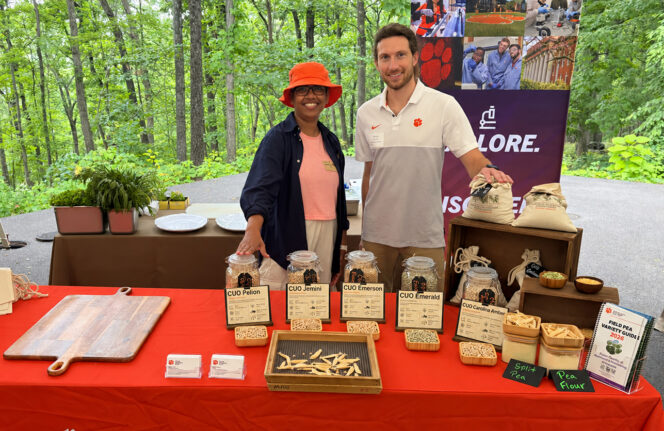
The expo will include tables and booths featuring demonstrations and information on research and services available to producers and other stakeholders. Participants can browse the booths at their own pace to view demonstrations, review materials and visit with staff.
This is an outdoor event and will be held rain or shine. Plan accordingly with light clothing, comfortable shoes, sunscreen and bug spray.
What to expect
Riding field tour
Simultaneous cover crop and cotton establishment
Eric Billman, U.S. Department of Agriculture research agronomist, will address the advantages and disadvantages of planting cover crops directly with or into growing cotton.
Cover crop biomass at termination: Does the amount matter for soil health and crop production?
Rongzhong Ye, a soil scientist, will discuss how to manage cover crops to improve soil health, enhance soil fertility and nutrient use efficiency, and support crop production in sandy soils. Previous research shows cover crop benefits vary with weather, species and management, but crop yields were consistently linked to the amount of cover crop residue returned to the soil, suggesting increasing cover crop biomass may help improve yields, build soil health and reduce fertilizer needs.
Ye and his team designed an experiment to address how the soil and crops respond to increased cover-crop residue inputs. This demonstration has two fields, one for corn production and one for cotton production. A cereal rye-hairy vetch mixture at six seeding rates for corn production, and vetch at six rates for cotton were planted. Soil health attributes and crop performance are monitored. The decomposition of cover crop residues and nutrient release patterns are also quantified. This study can help growers learn how to balance cover crop benefits with fertilizer needs and seed costs.
Research efforts to improve grain sorghum’s yield potential
Richard Boyles, Clemson plant breeder and geneticist, will talk about work he’s doing with grain sorghum to increase yields.
Green fruit anthracnose of peppers: Correct identification and management
Almagir Rahman, Clemson plant pathologist, will discuss how to detect and manage green fruit anthracnose in peppers.
Places for pollinators
Ben Powell, Clemson Extension associate and director of the Apiculture and Pollinator Program, will talk about the benefits of pollinator gardens, apiculture basics and new threats to South Carolina beekeepers.
Cotton agronomy research trials
Michael Jones, Clemson Extension cotton specialist, will talk about the official cotton variety trials held at the REC and performance potential of new extra-long staple hybrids.
Insect management in corn
Francis Reay-Jones, entomologist and Integrated Pest Management program coordinator, will discuss ongoing field research examining efficacy of transgenic corn hybrids expressing Bt toxins in managing fall armyworm and corn earworm.
Reay-Jones and other scientists are also examining how the survival of corn earworm has increased over time on some Bt corn products due to the development of resistance and what can be done to mitigate it.
In addition, stink bug, a key pest of corn, will be discussed. A research trial was conducted this year on the use of a UAV to apply insecticide to manage stink bugs. The goal of the trial is to evaluate several application rates to determine optimal coverage around the primary corn ear where stink bugs feed.
Is summer a good time to talk about the winter crop? An opportunity to rotate summer crops will a cool-season oilseed crop canola
The long-term goal of this project, led by John Park, senior scientist in cotton genetics and brassica oilseed crops breeding is to establish sustainable and economically viable canola production systems in South Carolina by developing efficient double-cropping systems that integrate cool-season canola with summer cash crops, including cotton, corn and other economically important crops.
Breeding smarter crops: Cotton for reduced regrowth and peanut and wheat for reduced immunoreactivity
Cotton producers will learn about new germplasm Sachin Rustgi, molecular breeder, and his team intend to release soon. Lines developed from the germplasm offer a unique combination of traits, including clustered bolls, reduced to no regrowth after defoliation, bacterial blight resistance and sustained or improved yield and fiber quality compared with check varieties. Together, these attributes have the potential to improve crop management while maintaining the productivity and quality expected by growers.
In addition, Rustgi will address efforts to develop wheat with reduced immunoreactivity through conventional breeding. Reduced-allergen peanut lines through crossbreeding are also being developed.
Butterbean and pea breeding at the Pee Dee REC
Jenna Hershberger, vegetable breeder and geneticist, will talk about current research she is conducting at the Pee Dee REC to improve heat tolerance in butterbean.
Self-guided walking expo
This expo will include booths staffed by experts who will have information about:
Pee Dee nutrition research opportunities and recipe tasting
This demonstration will be led by Hannah Wilson, assistant professor of community nutrition in the Department of Food, Nutrition and Packaging Sciences. Wilson will introduce attendees to nutrition and health research Clemson is leading in the Pee Dee and other regions of the state, complementing the Pee Dee’s agricultural research to support South Carolinians in the food consumption and health sectors of the food system.
Phenomics research for crop improvement in South Carolina
Trevor Rife, assistant professor of phenomics and crop improvement, and Blake Wilson, mechanical engineer, will discuss new phenomics tools they are developing to improve plant breeding and genetics research for the crops needed to feed a growing global population.
Florence County GIS
Reggie Sanders, director of Florence County Geographic Information Systems, will be on hand to talk about digital mapping and spatial data usage in Florence and Darlington Counties.
Clemson Integrated Pest Management Program
Igor Sulzbacher Schardong, Clemson IPM associate coordinator, will be present to share information regarding the Clemson IPM program, whose mission is not about eradicating pests entirely, but about achieving a harmonious balance.
Clemson Extension water resources
This booth will include information on ponds and hands-on demonstrations related to pond management. Stop by and talk to water resources agents to learn about aquatic plant identification, pond weed management information and more.
Clemson Regulatory Services
Representatives from Clemson Regulatory Services will be on hand to provide educational resources and information about licensing and the Regulatory Services programs listed below.
They will also have items to give away and specimens of invasive insects for folks to examine.
Information will be available for:
- Fertilizer Regulatory and Certification Services
- Organic Certification Program
- Agricultural Service Lab
- Pesticide Regulation
- Invasive Species Program
- Cotton Boll Weevil Program
- Nursery and Dealer Licensing Program
Harvest Hope Food Bank will operate a food drive during the field day. Go to Field Day 2026 for list of needed items.
Event details
– Date: Sept. 3
– Registration: 8:30 a.m.
– Welcome: 9 a.m.
– Tours and Presentations: 9:30 a.m. – noon
– Cost: Free
– Lunch: Noon
– Pesticide credit will be offered. Participants must scan a QR code to receive credit. The code will be made available after the tours and must be scanned on Sept. 3.
– GPS Location: Clemson Pee Dee Research and Education Center, 2200 Pocket Road, Darlington, S.C. 29532
– Contact: Jonathan Windham at 803-427-3144 or jwindha@clemson.edu
The Pee Dee REC would like to extend sincere thanks to Arbor One Farm Credit, the Sorghum Checkoff, the South Carolina Corn Board, South Carolina Farm Bureau and the South Carolina Soybean Board for their continued support of this event.
A special thanks to Altman Tractor Co., Carolina Agri Power LLC, Coastal Pond Solutions, Dillon Tractor & Implement Co. and Sparrow & Kennedy Tractor Co. for their part in making this event a success.