

A new NASA-funded mission led by Clemson University physicist Stephen Kaeppler aims to better understand how energy trapped in the Earth’s magnetic field interacts with Earth’s upper atmosphere.
The $2.8 million mission, called the Ion-Neutral Coupling During Active Aurora-2 (INCAA-2), will send four sounding rockets into the auroral zone above Alaska in early 2028. The rockets will be launched from Poker Flat Research Range near Fairbanks, one of the world’s premier sites for auroral research.

The project strives to answer a long-standing question: how energy from the sun, carried by solar winds, interacts with the Earth’s magnetosphere (which shields the planet from dangerous solar and cosmic particle radiation) and dissipates in the ionized part of the earth’s atmosphere called the ionosphere (30 to 50 miles above the Earth’s surface) and the neutral part of the atmosphere called the thermosphere (which is about 50 to 600 miles above the Earth’s surface).
At the center of the study is a phenomenon known as Joule heating, a key mechanism by which energy is transferred and dissipated in the upper atmosphere. Scientists have long known that Joule heating depends on the interplay between electric fields, atmospheric winds and conductivity, but they don’t know how these factors evolve over time and altitude.
“We know energy is coming in from the magnetosphere, especially during auroral activity, but quantifying exactly how it’s dissipated and how it evolves is still a major challenge,” Kaeppler said.
Premidnight aurora sector
The mission will focus on the premidnight aurora sector, where previous studies have shown especially strong energy dissipation and some of the fastest upper-atmospheric winds.
The team will launch two pairs of rockets roughly 30 minutes apart. Each pair will include one payload that releases vapor tracers and another equipped with scientific instruments.
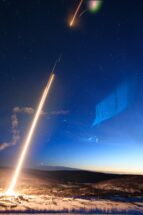
The tracers act like dye in water, allowing the scientists to track atmospheric wind patterns by observing how the released material moves in the air. The instrument payloads will measure electric and magnetic fields, electron density and atmospheric composition. The researchers will also employ ground-based instruments as well.
“By combining these datasets, we can estimate how much energy is being deposited and how it changes over time. Launching multiple rockets lets us move beyond a snapshot and observe the system evolving,” Kaeppler said.
Weather indicator
While auroras are known for the light shows, they can also be indicators of powerful space weather that can cause disruptions to communication systems.
When large amounts of energy are deposited at altitudes around 100 kilometers, the area known as very low Earth orbit, the atmosphere can heat and expand. This increases drag on satellites, sometimes causing them to lose altitude more quickly than expected.
The mission is a collaboration between Clemson, NASA Goddard Space Flight Center, the Aerospace Corporation and the University of Alaska at Fairbanks, which owns Poker Flat and will provide the ground-based observation.
Clemson-built components
Back in Clemson, the Department of Physics and Astronomy’s machine shop and the College of Engineering, Computing and Applied Science Machining and Technical Services research support center will build components for the rocket payloads. Students will help with the design, testing and analytics.
“This is how I was trained,” Kaeppler said. “It’s a fantastic experience for students.”
Kaeppler said scientists want to be able to better predict space weather.
“We want to be able to forecast these events, but first we have to understand them,” he said.