
Editor’s Note: The Clemson University Sandhill Research and Education Center (REC) proudly marks its centennial, celebrating 100 years of advancing agricultural innovation, environmental stewardship and community engagement in South Carolina. Since its founding in 1926, the Sandhill REC has served as a vital hub for research, education and outreach, supporting farmers, landowners and industry partners through science-based solutions and practical expertise.
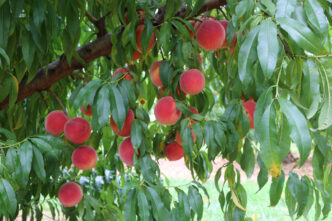
Peach season is underway in South Carolina. Across the state, roadside stands, farmers’ markets and grocery stores are filling with fresh local peaches.
What many consumers don’t realize is that just a few decades ago, much of the Southeast’s peach industry faced an uncertain future.
Young orchards were dying before growers could recover their investment. Microscopic soil pests weakened trees. Peach Tree Short Life syndrome devastated orchards across the region. By the 1990s, Southeastern peach acreage had declined by more than half.
For growers, the challenge wasn’t producing more peaches. It was keeping peach trees alive long enough to remain profitable.
That’s why scientists at Clemson University’s Sandhill Research and Education Center began searching for a solution.
Solving a problem in the soil
On the sandy, nematode-infested soils of Sandhill REC near Columbia, researchers had a unique opportunity to study the same conditions growers faced across the Southeast. The center’s combination of sandy soils, peach production history and persistent nematode pressure made it an ideal proving ground for new ideas.
When Clemson pomologist Greg Reighard arrived at the Sandhill REC in 1985, addressing Peach Tree Short Life became a priority. Rather than relying solely on greenhouse studies, Reighard and collaborating scientists established long-term field trials at the Sandhill REC and the USDA Southeastern Fruit and Tree Nut Research Laboratory in Byron, Georgia.
The goal was straightforward: find a rootstock that could help peach trees survive the challenges growers faced every day.
A rootstock forms the lower portion of a grafted tree, including the roots and lower trunk. The fruit-producing variety, known as the scion, is attached above it. Though consumers rarely see it, the rootstock plays a critical role in disease resistance, tree vigor and environmental tolerance.
At the time, growers primarily relied on two rootstocks. Nemaguard resisted root-knot nematodes but was highly susceptible to Peach Tree Short Life. Lovell offered some tolerance to Peach Tree Short Life but remained vulnerable to root-knot nematodes and often struggled on replant sites.
Scientists needed something better.
Their search eventually led them to a breeding line, B594520-9. In field trials, trees from this line consistently survived longer and maintained greater vigor than standard rootstocks under Peach Tree Short Life conditions. They evaluated seedlings from surviving trees, confirming resistance to root-knot nematodes in greenhouse studies and exceptional survival in field trials.
In one long-term Sandhill REC trial, Guardian® selections achieved survival rates exceeding 90% after eight years, far outperforming traditional rootstocks grown under the same conditions. The scientists also documented reduced bacterial canker, no significant cold injury and vigorous tree growth.
“These traits are critical for young peach orchards to protect against the PTSL syndrome,” Reighard said.
From dozens of promising candidates, one tree ultimately emerged with the combination of characteristics sought. That tree became the Guardian® BY520-9 mother tree.
A solution that spreads across the Southeast
Guardian® rootstock was released to growers in 1994. Its rapid adoption reflected the confidence growers gained from years of field-tested results under conditions that mirrored those in their own orchards.
Over time, Guardian® became the dominant peach rootstock across much of the region. More than 50 million seeds have been sold, and an estimated 90% of peach trees planted in South Carolina and Georgia are grafted onto Guardian® rootstock.
For growers, the benefits were clear.
Hyder Farms in Landrum, South Carolina, grows much of its 170 acres of peach trees on Guardian® rootstock. Grower Matthew Hyder said the farm has been pleased with the results.
“Trees grown on Guardian rootstock are stronger,” Hyder said. “We see a lot of growth and the yields are good.”
To protect the integrity of the material, Guardian® BY520-9 received U.S. Plant Variety Protection No. 9400013, the first protection granted to a seed-propagated tree in the United States. Licensed nursery production and strict labeling requirements helped ensure growers received authentic planting material.
The rootstock’s success eventually extended beyond the Southeast, attracting international interest and generating royalties that supported continued research and Cooperative Extension programming.
Lasting impact
More than 30 years after its release, Guardian® remains one of Clemson’s most influential contributions to the peach industry.

Its success demonstrates the value of long-term field research conducted under real production conditions. The same sandy soils that once exposed some of the region’s biggest orchard challenges became the proving ground for a solution that reshaped peach production across the Southeast.
Clemson scientists are now working on the next generation of Guardian®, building on research that began decades ago at Sandhill REC.
This summer, millions of peach trees across the Southeast are growing on Guardian® rootstock. Most consumers will never know its name. Yet every basket of peaches sold at a roadside stand, farmers market or grocery store reflects the lasting impact of research that began decades ago on the sandy soils of Sandhill REC.
Estimated reading time: 5 minutes