Most students hope college will prepare them for a career. Tristan Lawrence used his time at Clemson University to start one.
While earning his master’s degree in plant and environmental sciences, he conducted research that could help farmers across the Southeast and built a future that will keep him at Clemson long after graduation.
Originally from Kansas City, Kansas, Lawrence moved to Greenville, South Carolina, during middle school. When it came time to choose a college, Clemson offered something few places could: rigorous academics paired with a tight-knit, supportive environment.
“Clemson stood out because of its reputation as the state’s premier agricultural school,” Lawrence said. “The sense of community, the campus atmosphere and the energy around Clemson Football made it the ideal place for me to grow.”
That connection only deepened during his undergraduate years. After earning his bachelor’s degree in plant and environmental sciences in 2018, Lawrence made a decision familiar to many Clemson students: he came back.
He returned to Clemson as manager for Dil Thavarajah’s Pulse Quality and Nutritional Breeding Program. In 2022, he qualified for the Employee Tuition Assistance Program and decided to pursue a master’s degree as a non-traditional student. He will graduate in May with his master’s in plant and environmental sciences.
“After learning I qualified for Clemson’s Employee Tuition Assistance Program, it made continuing my education an easy decision,” Lawrence said. “I’ve been able to apply what I learn through my work to my studies, which has made the experience incredibly valuable.
“Clemson’s experiential learning approach allows students to go beyond the classroom and gain experience that prepares them for their careers.”
Research with real-world impact
At Clemson, learning doesn’t stop at lectures and for Lawrence, that made all the difference.
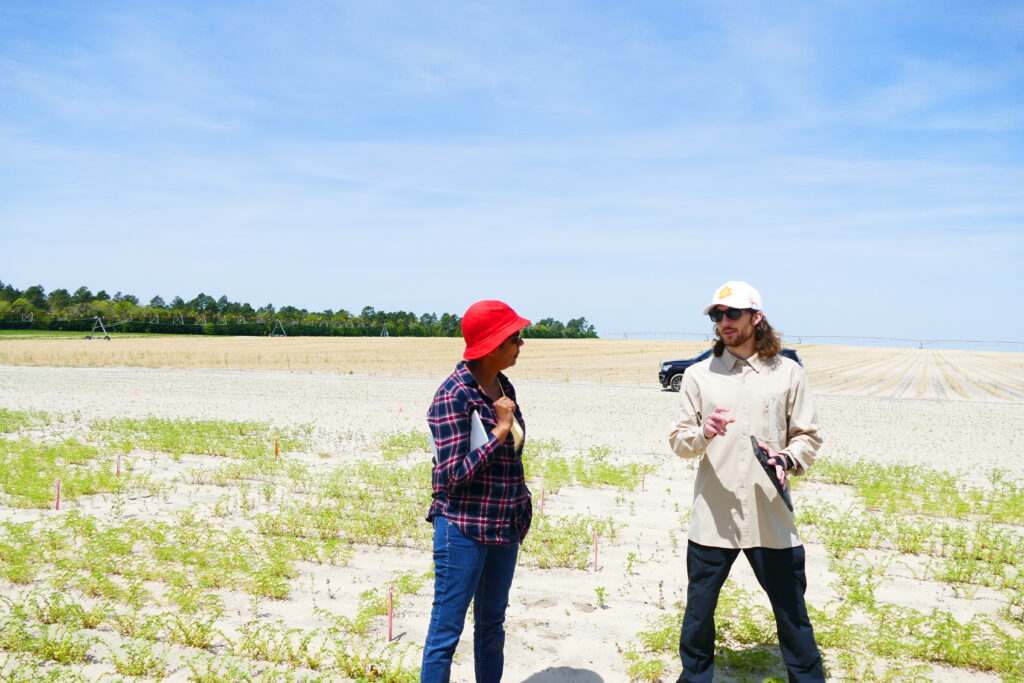
Under the Carolina sky, his classroom often stretched far beyond four walls, unfolding instead across rows of vibrant green field pea plots at the Clemson Calhoun Farm near the main campus and plots at WP Rawl Farms near Pelion, South Carolina.
Early mornings carried the scent of fresh soil as he moved between test rows, notebook in hand, tracking differences in plant vigor and growth. He learned to read the land as much as the data, each plot telling its own story.
It was here, in the fieldwork and changing seasons, that research became real, transforming lessons from lectures into living, breathing results rooted in the ground beneath his feet.
While working in the research plots, Lawrence found himself immersed in activities that breathed life into his studies.
Field peas are widely grown in the Pacific Northwest, where most commercial varieties are developed. In South Carolina, however, adoption has been limited due to a lack of locally relevant research.
Lawrence’s work is helping bridge that gap. His research offers some of the first region-specific recommendations for growing field peas in the Southeast. Through his studies, he determined that late January is the most effective planting window for field peas in South Carolina.
“We’re working to give farmers a viable cool-season crop instead of leaving fields fallow,” Lawrence said. “The hands-on experiences I’ve had as a Clemson student have made the science real and showed me the direct impact of our work in the field.”
Lawrence was also a member of a group of scientists who developed five lines of field peas that will soon be released to the public for growing in South Carolina.

A path shaped at Clemson
In addition to field work, Lawrence was also involved in other areas during his graduate studies. One task involved helping direct agronomy and organic management webinars.
These free webinars were held to help educate people about the benefits of growing organic produce. They featured experts from across the U.S., Canada and India who covered a range of topics related to organic agriculture and nutritional breeding.
He also co-authored several research papers, an experience that significantly shaped his academic and professional development. Collaborating with faculty and fellow researchers deepened his understanding of his field.
Designing studies, analyzing data and refining manuscripts for publication strengthened his skills in critical thinking, scientific writing and peer review.
This experience also strengthened his ability to communicate complex ideas clearly and work effectively in a team, ultimately preparing him for future research and enhancing his credibility within the academic community.
Just as impactful as the hands-on learning experiences were the people who guided him along the way.
Lawrence credits a network of Clemson mentors for helping shape both his academic path and his future ambitions. Faculty members like Thavarajah, Guido Schnabel, Emerson Shipe, Christopher Saski and Paula Agudelo were more than instructors; they were trusted advisors, collaborators and champions of his growth.
Through programs like the Pulse Breeding and Cultivar Development program and the Clemson Fruit Pathology Program, those mentors provided not only technical expertise but also encouragement and perspective.
“Graduate classes helped me understand both the big picture and the complex details of plant breeding,” Lawrence said. “Seeing what I learned in class come to life in real-world research has been incredibly rewarding.”
He was also a member of Thavarajah’s Vegetable and Pulse Quality and Nutrition Team. His role as a non-traditional student consisted of overseeing and maintaining all research fields, collecting data, analyzing the nutritional quality and content of samples, and “crossing” varieties for biofortification and increased nutritional content.
That blend of mentorship and experiential learning became the foundation for his success, culminating in research that is already helping farmers rethink how they use their land during the winter months.
“Coming back as a non-traditional student, it was really important for me to see how what I was learning in class actually played out in the field,” Lawrence said. “Being able to manage Dr. Thavarajah’s Pulse Quality Breeding program gave me that chance every day. It made what we were learning feel real. Having already seen how it all connects and makes an impact will help me as I go into my career.”
Still, for Lawrence, the Clemson Experience is about more than academic achievement. It’s about relationships formed, lessons learned and a community that continues to shape who he is becoming.
Looking ahead
As he looks toward the future, with interests ranging from crop improvement to emerging technologies like drones, one thing remains clear: Clemson didn’t just prepare him for a career; it gave him a place to grow roots. And this is where he will remain, at least for now.
“I will continue working with Dr. Thavarajah as the Clemson Pulse Breeding Program manager while I start my own pulse crop seed company,” Lawrence said.