They are exquisitely tuned engineering masterpieces that howl down the straightaways at more than 200 mph and corner with feline agility, making a roller coaster feel like a Sunday drive.
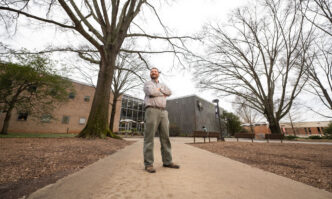
Formula 1 race cars are some of the fastest and hardest-cornering vehicles on the planet, and Clemson University alumnus Austin Dollar is in the business of making them perform at their absolute peak.
“I see a certain beauty in race cars that is really difficult to explain to people, and that makes it fun, being able to work with that and influence it,” Dollar said.
This Tiger is one example of just how far and how fast– literally– one can go with Clemson engineering degrees.
He turbocharged his career by earning master’s and Ph.D. degrees in mechanical engineering at Clemson. Dollar now works as the F1 power unit performance technical specialist at GM Motorsports in Concord, North Carolina.

Cadillac, a General Motors brand, joined the Formula 1 grid as a new team in 2026 and is racing with Ferrari power units while the GM team, including Dollar, develops its own for 2029.
Dollar’s work includes studying how the car uses its hybrid electric energy and helping integrate GM’s F1 power unit. While they never take the wheel, what Dollar and his colleagues do behind the scenes shows up in the performance of the car on race day.
“That is one of the things that I love about this job–what you do has a visible impact,” Dollar said.
For students wanting to break into motorsports, take note: Dollar said it requires a strong understanding of how racing works, along with specialized technical knowledge.

“When they are able to bring that into the car in a concrete way–that is what really impresses and is a game changer sometimes in the way that we do things,” he said.
At Clemson, Dollar studied under mechanical engineering professor Ardalan Vahidi.
Vahidi said Dollar contributed significantly to multiple projects focused on the optimal control of automated vehicles for improved energy efficiency. He received the International Federation of Automatic Control Young Author Award and the prestigious Chateaubriand Fellowship, supporting eight months of doctoral research in France.
“Among the many talented graduate students I have had the privilege of mentoring at Clemson, Austin distinguished himself through an exceptional combination of intellectual independence, rigor, creativity and perseverance, making him an asset to any team he joins,” Vahidi said.

Dollar’s research at Clemson taught him to look at the whole vehicle and figure out how its different systems can work together to get the best result, an approach he now uses in racing.
Clemson, he said, was a good setting to think creatively.
“It’s a place where you can be calm and do good work,” Dollar said. “You have the resources that you need to do good research.”
Dollar hails from Davidson, North Carolina. His first step out of high school was to Purdue University, where he earned his Bachelor of Science in mechanical engineering.
He then launched his career at GM. When Dollar first started, he helped develop a new type of engine controller for production gasoline engines.
The experience introduced him to an area of engineering he wanted to explore more deeply, leading him to Clemson for graduate school.
Dollar finished his Ph.D. in 2021 and then returned to GM, this time in motorsports. He began by working mainly with NASCAR and later helped develop simulation tools used across several racing series.
Now his focus is on Formula 1, not a hobby, but it has similarities, Dollar said.
“Working in this big team feels like something I would do for fun, which is great for me and keeps me motivated and creative,” he said.