What began as an unusual problem for a South Carolina grower has quickly escalated into a coordinated, multistate scientific effort to combat a newly arrived agricultural threat.
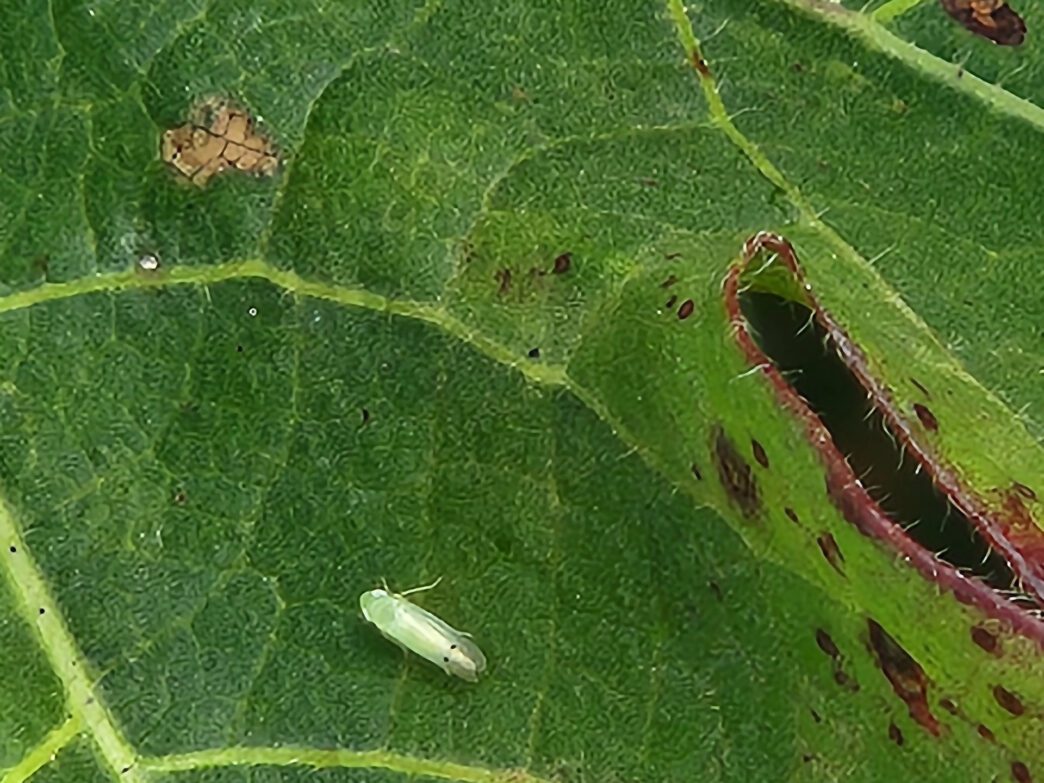
In Summer 2025, Glenn Quattlebaum noticed something unusual in his hibiscus plants: Leaves were curling, discoloring and declining rapidly. Within days, the cause became clear. A tiny invasive insect, the two-spot leafhopper, was attacking his plants.
“I had never seen them before,” Quattlebaum said. “The damage appeared quickly. It was a clear reminder of how fast an invasive species can establish itself before anyone realizes what’s happening.”
Small pest with big consequences
Though only a few millimeters long, the pale green two-spot cotton leafhopper poses a significant threat to agriculture. Native to Asia, the insect feeds on plant sap, causing a condition known as hopperburn, which leads to yellowing, curling leaves and eventual plant decline.
Since its detection in the southeastern U.S., the pest has raised alarms across multiple industries, including cotton and vegetables such as eggplant and okra, as well as ornamental plants such as hibiscus. Growers face reduced crop quality, shipment rejections and potential yield losses.
Rapid response takes shape
After Quattlebaum and other growers reported the infestation, affected plants were sent to a diagnostic lab for confirmation. That initial sample became the catalyst for a broader scientific mobilization.
Clemson University scientists, led by entomologist Zee Ahmed, quickly organized a rapid-response framework designed to detect, study and manage invasive pests more efficiently.
“This grower basically handed us the problem and said, ‘Find a solution,’” Ahmed said.
The response expanded across state lines and disciplines, involving field surveys, genetic analysis and early insecticide trials. Within months, the team issued a national alert and began developing practical tools for growers, including scouting guides and pest management strategies.
“Every step filled a gap,” Ahmed said of the effort, which now includes researchers, Cooperative Extension Service agents and industry partners across the region working through a unified platform.
A cross-industry challenge
Experts say the insect is particularly challenging because it moves easily between crops and regions. Ornamental plants like hibiscus can act as reservoirs, allowing populations to grow before spreading to agricultural fields.
“Managing the two-spot cotton leafhopper requires a broader, more holistic approach than any single commodity can take on its own,” said Francis Reay-Jones, Clemson’s integrated pest management coordinator.
Clemson Extension agents are now actively monitoring the pest across South Carolina. Urban horticulture agent Carmen Ketron emphasized the importance of early detection.
“The two-spot cotton leafhopper is just one example of how quickly invasive species can establish if we’re not watching closely,” she said.
Meanwhile, cotton and vegetable specialists are assessing potential impacts across other crops. Early observations show the pest has already caused measurable yield loss in some cotton fields, while its effects on vegetables such as eggplant and cucurbits remain under investigation.
Why speed matters
Clemson entomologists, Tom Bilbo and Jeremy Greene, said the urgency stems from the insect’s biology.
“This is a pest we’re taking seriously because it has already shown it can affect cotton here in South Carolina,” Greene said. “Last year, the insect established in selected cotton fields and caused measurable yield loss. That infestation didn’t come solely from ornamental hosts. Some of that movement was almost certainly weather‑aided migration from farther south.
“As we enter the 2026 season, our biggest questions are whether the insect overwintered successfully somewhere in the state and how soon it will establish in cotton again. It’s a clear reminder that invasive species can arrive through multiple pathways and create real consequences if we’re not prepared.”
The scientists are watching ornamentals closely because what is established in ornamentals can move into nearby vegetable systems.
“The two-spot cotton leafhopper was a significant problem for many okra growers and homeowners late last summer, but its pest status in other vegetables in South Carolina, such as eggplant or cucurbits, is not yet known,” Bilbo said. “We haven’t detected this pest in the field yet this year, so it may not have overwintered. But we’re staying alert. Even if it didn’t overwinter, it can reinvade South Carolina through the ornamental trade, long-range migration or other means.”
“Early detection and correct identification will be important for protecting vegetable systems before problems develop,” he added.
Even if populations do not survive winter conditions, experts warn the pest can easily reinvade through trade or migration.
“Invasive species are increasing, and so is the pressure on us to respond faster and smarter,” Ahmed said.
Building a model for the future
Beyond addressing TSCL, researchers are focused on something larger: creating a repeatable system for future invasions.
The rapid-response framework emphasizes early detection, rapid communication, coordinated research and delivering practical solutions directly to growers.
In April 2026, nearly 100 participants from universities, federal agencies and industry groups met to align strategies, highlighting priorities such as monitoring, resistance management and unified outreach efforts.
The initiative is already gaining national attention. A related project, supported through the Southern IPM Center, includes developing diagnostic templates, sampling protocols and best management practices. This project also includes launching a practitioner-focused website as a centralized hub for TSCL identification and reporting.
Looking ahead
As the Southeast continues to face increasing pressure from invasive species, researchers say collaboration across crops, industries and state lines will be essential.
“Invasive species don’t follow crop boundaries, and our response shouldn’t either,” Ahmed said.
For now, the fight against the two-spot cotton leafhopper continues, but the system built to combat it may prove even more valuable.
“Because the next pest is likely already on its way,” Ahmed said.
For more information on the framework, read Two-spot cotton leafhopper: Researchers build rapid-response framework for new invasive pest in Entomology Today online.
Estimated reading time: 5 minutes