South Carolina agricultural experts have confirmed the first detection of a new invasive insect species in the state: the two-spot cotton leafhopper.
Also referred to as the “cotton jassid,” the insect was first identified at the Clemson University Edisto Research and Education Center in Blackville. The insect migrated north from Florida, where it was initially detected in the U.S., and through Georgia.
Researchers are debating a common name for this new species, with some emphasizing that the term “jassid” simply means “leafhopper” in another language. The insect could potentially pose a serious threat to crops, particularly those in the Malvaceae plant family, such as cotton and okra.
“Because this insect affects multiple crops beyond cotton—including okra, sunflowers, eggplants and others—the name ‘cotton jassid’ is too host-specific,” said Jeremy Greene, entomologist and associate department chair for Clemson University’s Department of Plant and Environmental Sciences.
For a common name, Greene recommends and prefers “two-spot leafhopper.” An official name will be forthcoming from a committee at the Entomological Society of America.
Damage and detection
Both adults and nymphs feed on the underside of leaves, causing significant damage that reduces photosynthesis and overall plant health.
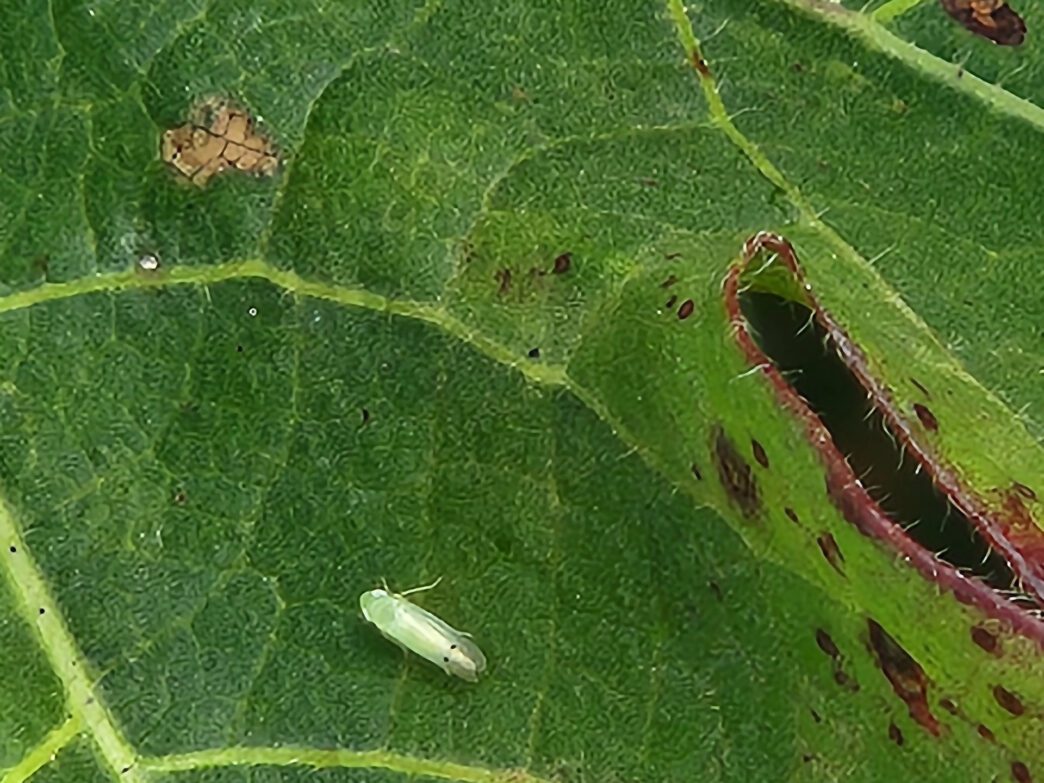
Early signs of infestation include yellowing of leaf margins, progressing to red and eventually brown.
Management and reporting
Although the insect has only recently been confirmed in South Carolina, researchers are rapidly learning about its behavior and control methods. Some insecticides have proven effective, while others have not. Data generated thus far have been essential to obtain special label uses – Section 2(ee) – for several insecticides for this species.
“Optimal timing for treatment remains under investigation,” Greene said. “Ongoing research will help determine if and when intervention is necessary.”
Two-spot leafhoppers are small, slender, pale green insects. They are just several millimeters long. The adults have transparent wings with a black spot near the tip of each forewing. When disturbed, two-spot leafhoppers move sideways and will jump. Adults will fly away.
Producers are encouraged to report sightings, especially in areas west of Interstate 77 and Interstate 20, where the insect has not yet been widely documented. Initial detections have already been reported across much of South Carolina’s Coastal Plain.
To report detections or seek guidance, producers should contact the local Clemson Cooperative Extension office or the entomology team at the Edisto Research and Education Center.