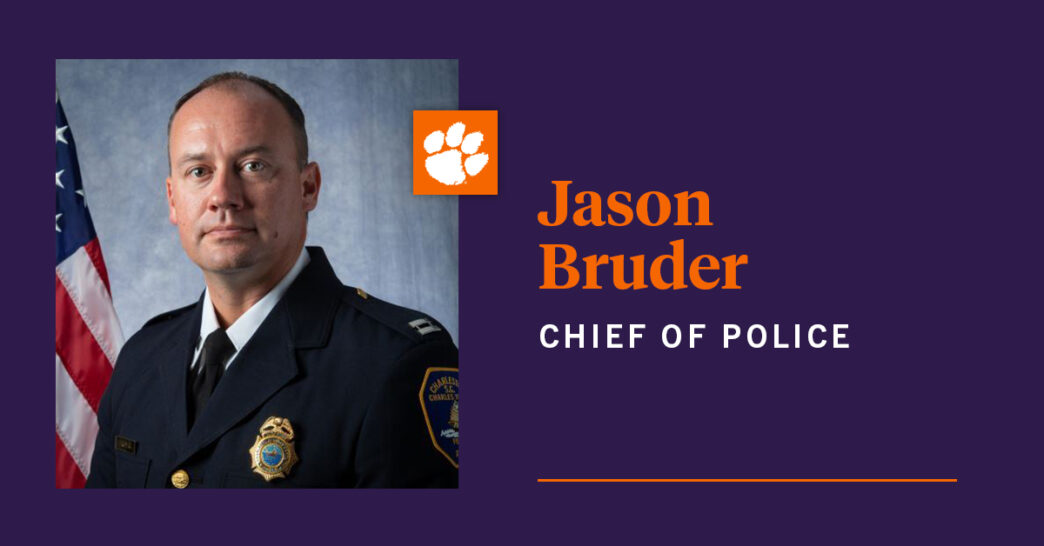
Jason Bruder, a 2002 Clemson graduate, has been tapped to lead the Clemson University Police Department (CUPD) as the University’s next Chief of Police. Bruder returns to Clemson after 23 years with the Charleston Police Department (CPD).
“I am excited to welcome Jason Bruder back to Clemson as our next Chief of Police,” said Associate Vice President for Public Safety Kimberly Spears-McNatt. “Jason is an experienced and dedicated law enforcement officer with a proven track record of leadership, community engagement and finding solutions that make his community safer. I have no doubt that he will do an outstanding job leading CUPD.”
Bruder, who mostly recently served as Captain of the Investigations, Data and Intelligence Division, joined CPD – the largest municipal police department in the state – in August 2002, shortly after completing his degree in computer science from Clemson. He began his career as a Patrol Officer and worked his way through the ranks, culminating in a promotion to Captain in 2020.
He has since commanded the Special Operations Division, the Patrol Division and the Community-Oriented Policing Division prior to assuming his current role. He was named CPD’s Commander of the Year in 2023. Other previous assignments include Patrol Commander, Chief of Staff for the Office of the Chief of Police and School Security Response Team Commander.
“I am excited for the opportunity to serve Clemson University, and as a member of the Clemson Family myself, I look forward to working with students, faculty and staff to ensure a safe community,” Bruder said. “It is truly an honor and a privilege to lead the Clemson University Police Department. My vision is a community-engaged, trustworthy department that provides the best environment for learning, supports the student experience and is reliable even in the most difficult circumstances.”
Bruder served as assistant to the Chief of Police and Deputy Chiefs, which included representing department leadership at law enforcement and government agency functions, community partner meetings, City Council and subcommittee meetings, and organizing the development of the department’s current strategic leadership plan.
The Community-Oriented Policing Division achieved several successes under his leadership, including Narcan® distribution and education that led to a significant reduction in overdose deaths in 2024 and the creation of a grant-funded Crisis Response Team with an embedded mental health clinician.
In 2013, Bruder created the School Security Response Team, the first of its kind in the country. The initiative comprised 18 officers focused on violence prevention and crisis response for public and private schools, supplementing the department’s 15 school resource officers.
Bruder served as the chair of the Charleston County Criminal Justice Coordinating Council, guiding numerous stakeholders towards improved utilization of the jail and the effectiveness of the criminal justice system. This led to the development of two community-driven strategic plans.
Bruder has also advised and presented to national law enforcement groups on a variety of topics, including the American Society of Evidence-Based Policing, International Association of Chiefs of Police, National Council of State Legislators, and the University of South Carolina School of Law’s Excellence in Policing and Public Safety Program.
His appointment as Chief of Police serves as a full-circle moment for Bruder, who began his law enforcement career as a part-time Student Police Officer with CUPD in 1999. He was named CUPD’s Student Police of the Year in 2000. Bruder went on to serve as a 911 Telecommunicator from November 2000 until his graduation from Clemson in May 2002.
Bruder earned a Master of Science degree in Homeland Security Management from Long Island University in 2009. He also graduated from the 97th session of the Police Executive Research Forum Senior Management Institute for Police and Session 279 of the FBI National Academy, while participating in the Law Enforcement Advancing Data and Science (LEADS) program from the National Institute of Justice.