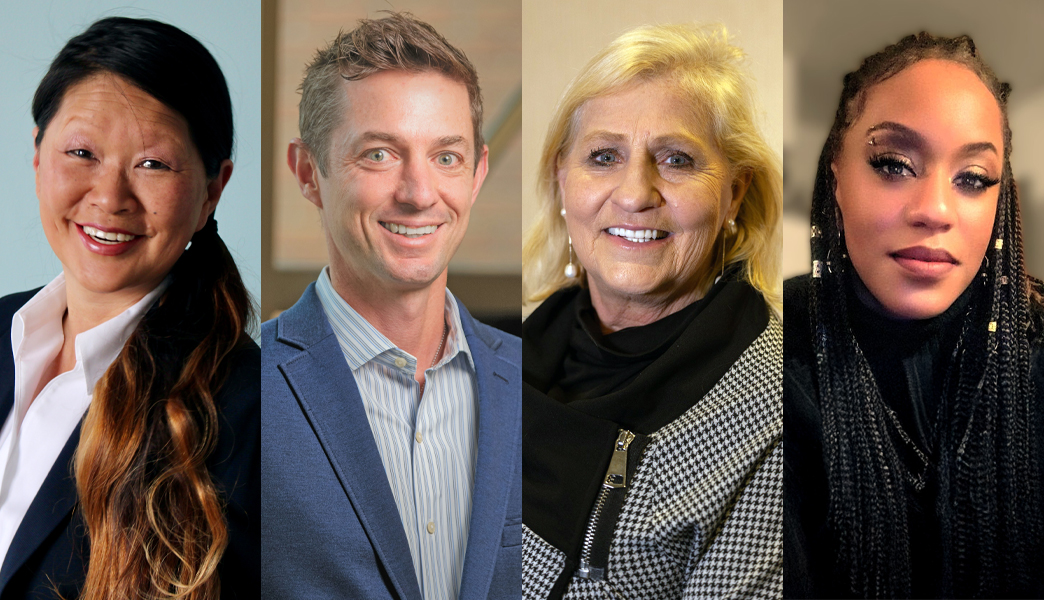
If you want to study human trafficking networks, you can build graphs, diagrams, and Markov models all day– or you can work with the people who actually lived it.
A team led by Clemson University’s Tom Sharkey has done both, and the insights from survivors were indispensable in correcting assumptions, shaping research questions and improving its real-world usefulness.
In a research project spanning seven years so far, the survivors have never sat quietly on the sidelines. They have questioned, corrected, and challenged their colleagues at every turn, helping redefine how the team approaches its work.
The project is now entering its final year, and researchers are taking stock of what they have accomplished.
Teresa Forliti, a trafficking subject matter expert and survivor, said she wants the research to help those who have exited the life and are looking for purpose and direction.
“We’re bigger than what happened to us, and we’re going to move forward, and we’re not going to let it happen to anyone else,” Forliti said. “That’s what we’re all about.”
Sharkey, an industrial engineering professor, started working with social scientists, other engineers, and trafficking survivors in 2018 to help assemble the team.
What the members built together is something uncommon in trafficking research: models, tools, and insights shaped by people who know exactly how trafficking networks operate because they have been inside them.
Feeling valued
The goal is to give nonprofits, law enforcement and policymakers a clearer picture of how trafficking works. By showing trafficking as a system, and not a series of bad choices, the research aims to reduce harm, cut isolation, and help people find real paths out of exploitation.
“It’s gone really well,” Sharkey said. “We really took the time to set up the foundation for long-term success. We all feel valued, and we really are viewing things differently because of who we have brought together.”
Mikki Mariotti, a survivor-centered practitioner on the research team and the director of The Family Partnership’s PRIDE program, said that the team members learned from each other and that the project confirmed how essential lived experience is in every stage of research.
“Most importantly, our collaboration made the final model more accurate and useful for real-world application,” she said. “I now use the video summarizing some of our research to train my staff, and we also use it during instruction with social work programs at area universities. It helps translate complex ideas into practical learning.”
In addition to the video, the team has also produced a toolkit designed to help survivors evaluate and shape research collaborations. The team has also published a peer-reviewed paper that documents the value of survivor co-creation in human trafficking research.
The National Science Foundation has funded the team’s work.
Because the research centered on deeply personal and often painful experiences, the team was intentional about creating an environment where survivors felt safe and supported.
Safe space
Tonique Ayler, who leads the meditation after each team meeting, said researchers created an atmosphere that made it safe for survivors to tell their stories, if they choose.
“At times there were some hard situations, like giving examples of how cruel traffickers can be– some of the punishments they put on girls,” she said. “But you are not what happened to you. As a team, everyone is really considerate of your feelings and they are acknowledged and not just pushed aside.”
One way survivors shaped the research was explaining a simple truth that academics had underestimated: victims are often forced into many crimes, not just selling commercial sex.
Traffickers may pressure them to sell drugs, steal, commit fraud or do whatever else keeps the money flowing. The early engineering models didn’t include any of that, and survivors changed that.
They also required the team to dump ideas and labels that didn’t match real life. If a term was wrong, the survivors said so.
If a category didn’t reflect actual trafficking dynamics, it got scrapped. They protected accuracy by refusing to let the research fall into tidy but misleading boxes.
Some course corrections were blunt. When the team asked a question about daily earnings, survivors stepped in to explain that trafficking doesn’t run on eight-hour shifts. It runs all day, every day. The question itself proved why their voices were essential.
A powerful example
Kevin Taaffe, chair of Clemson’s Department of Industrial Engineering, said the project stands out for both its impact and the care the team took in handling an extremely sensitive subject.
“This work shows how industrial engineering can be applied to some of society’s most difficult challenges,” Taaffe said. “Dr. Sharkey and his collaborators approached this research with rigor, humility and respect, and it’s a powerful example of how Clemson research can make a difference well beyond campus and across South Carolina and the nation.”
You can read more about the team’s work in “Realistic Computational Modeling of Human Trafficking Requires Lived Experience Experts,” which was published in September in the Journal of Human Trafficking. Co-authors were Sharkey, L. Martin, Ayler, K. Barrick, Forliti, J. Friedman, K. L. Maass, Mariotti, C. Nelson & B. Tezcan.
The toolkit was co-authored by Ayler, Fortli, Friedman, Mariotti and Nelson.
Additional notes:
Academic researchers who worked on this project include Yongjia Song of Clemson University, Lauren Martin of the University of Minnesota, Kayse Maass of Northeastern University, and Kelle Barrick of Research Triangle Institute.
Additional survivor-centered researchers include Joy Friedman and Christine Nelson.
Clemson alumni that have contributed to the project include Daniel Lopes da Silva, Leiney Grace Bryant, Kemonte Yow, Eliza Macaulay, and Michael Clark. Current Clemson students that have contributed include Xiaowei Guo, Taylor Redmon and Azaveshe Daniyan.