Jannah Holmes was one year old when her godmother bought her a popup book. Her favorite part of the book was the crocodile that popped up.
It fascinated her. So much so that from an early age, Holmes knew she wanted to pursue a career working with the ancient creatures. The oddity in that is Stokes grew up in Halesowen, just outside Birmingham in the United Kingdom, where the only chance at seeing a crocodile is at a zoo.
Holmes, in her second year as an undergraduate student at Bath Spa University, is studying wildlife conservation where she hopes to eventually work in crocodile conservation.
“Because there are no crocodiles in Europe, I’ve always been like I know what I want to do but I don’t know how to get there because I don’t know any of the techniques and I wouldn’t know how to handle a crocodilian,” she said.

That was until she attended a European Croc Network meeting where she learned there would be an alligator workshop sponsored by Clemson University for network members, most of whom were early-career professionals. The five-day event gave members an opportunity to gain hands-on experience learning proper techniques for safely catching alligators in the wild, tagging them, performing biopsies, identifying their sex, learning how to flush the stomach and learning how drone technology can assist in studying one of nature’s top predators.
For most of the nine attendees, it was a once-in-a-lifetime opportunity they won’t soon forget.
How it began
Miriam Boucher, a Clemson doctoral student and graduate research assistant at Clemson’s Baruch Institute of Coastal Ecology and Forest Science, attended the European Croc Network meeting last year with support from a Clemson graduate travel grant. At the meeting, Boucher presented some of her dissertation research on ingested microplastics in alligators.
In talking to some of the early-career professionals in attendance, Boucher noticed their passion for crocodilians, despite most having only been involved in data-based projects. What was lacking for them was the opportunity to be in the field where they could build basic proficiency in field work and learn what techniques are applied.
Boucher saw it as an opportunity to use the partnerships and facilities, along with the expertise at Clemson, to create a learning opportunity for the early-career professionals in Europe.
Upon returning home, she shared her thoughts on hosting a workshop with Jim Anderson, director of the Baruch Institute and the James C. Kennedy Waterfowl and Wetlands Conservation Center, and Thomas Rainwater, research scientist at the Tom Yawkey Wildlife Center.
With their support, she reached out to other Clemson collaborators, including the South Carolina Department of Natural Resources and the Nemours Wildlife Foundation, both of which were willing to assist. With the buy-in she needed, Boucher reached out to Phoebe Griffith, a postdoc researcher based in Berlin, Germany, who also helps run the European Croc Network.
“The goal was to try to create an opportunity that is free for participants with no program fees, but they cover their cost of attendance,” Boucher said. “Clemson provided support for that. The ECN subsidized the meals and some of the other things for participating costs.”
Let’s catch some gators
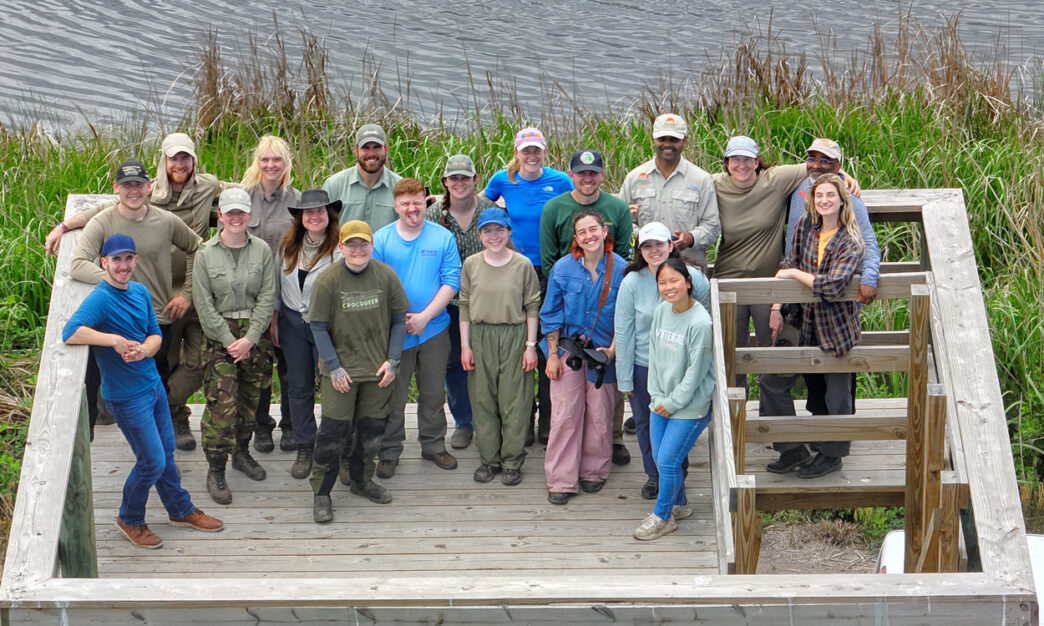
The nine participants in the inaugural workshop were Holmes, Griffith, Amy Stout (U.K.), Ellen Sharkey (U.K.), Josh Barwick (Wales), Cristian Pizzigalli (Italy), Hayley Sprawling (U.K.), James Szewczyk (U.K.) and Mona Hederich (Germany).
The group was housed in the cottages at Baruch Institute, located in Georgetown, South Carolina, on Hobcaw Barony, a 16,000-acre tract of undeveloped land owned by the Belle W. Baruch Foundation.
Anderson welcomed the participants, followed by introductions to crocodilian techniques; safety tips for working in the field and an equipment overview prepared them for the next steps.

At the Yawkey Wildlife Center, the group put their newly learned skills to work, catching alligators (some for the first time), taking samples, marking them and releasing them.
“They are such cute swamp puppies as I have heard them referred to on social media,” Griffith said. “Just seeing up close how to correctly and safely handle them for both the animal and folks around and how they’ve got that totally down here was incredible to see.”
For Pizzigalli, an Italian who is set to start a postdoc position at Cibio, a research center in biodiversity and genetic resources in Portugal where he completed his doctorate, it was his first live interaction with an alligator. He was the first to catch one.
“During my Ph.D., I collected a lot of non-invasive samples,” Pizzagalli said. “That was a cool part of my Ph.D. project. I didn’t get to catch crocodiles, but I collected fecal samples. It doesn’t sound great, but you can get a lot from those. But I’ve done it in cool places in West Africa.
“These were exactly the type of techniques I would like to acquire. You can answer a lot of questions with invasive samples. Then, you really need to put your hands on crocodiles. I learned how to capture and handle crocodilians without stressing them, and safety measures which are very important because I will be working with a team that has no experience in West Africa. We work in very remote areas where it’s very difficult to get first aid. If something happens to you, you need to drive like three days to reach the first village.”
Holmes, the youngest and the only undergraduate on the trip, had never seen a crocodilian in the wild.
“It was absolutely amazing, literally the best day,” she said. “It was such a wonderful experience, something I’ve always dreamed about doing. I never knew when I’d get a chance to do it. It was amazing to feel the force of the gator. It increased my confidence that this is something that I can do, not just something that I dreamed of doing. I now know how to do it.”
But as amazing as it was to catch her first alligator, the highlight of the day for Holmes was when each of them took turns, bravely and without hesitance, peeking inside a den and looking into the eyes of a mother alligator whose hatchlings were nearby.

“I think one of my favorite parts of the week was when we had our team dinner at the end of Monday night and we all cooked in the cottages at Baruch and sat down and had dinner together,” Boucher said. “We were able to talk about the day and talk about the experiences that we were having. We could just learn about each other and figure out what people want to do next. I think the field stuff is exciting, but I think the times that we have outside of that to brainstorm or joke or create some human connections are what will make this even more valuable.”
At the South Carolina Department of Natural Resources’ Santee Coastal Reserve, Morgan Hart, alligator project leader with SCDNR, gave the group an overview of its alligator management program, before they were off to catch more alligators.

James Szewczyk, a reptile keeper at the Drayton Manor Zoo in the U.K., was one of the few attendees with previous experience handling crocodilians. He joined the European Crocodile Network when he was 15. He has been able to work in Africa with Nile crocodiles and in Florida with alligators.
Not only was he able to share some of his experience with the others, but there were also learning opportunities for him, as well.
“I think it’s been great seeing people develop, seeing their skills develop,” Szewczyk said. “Even seeing myself develop as a teacher and learning and conveying techniques that I’ve learned, things I shouldn’t be doing either and holding me accountable has been a huge thing. I think it’s phenomenal and it fills me with so much joy seeing everyone just throwing hooks. It’s absolutely great.
The group also visited Nemours Wildlife Foundation, a private conservation organization in Yemassee. Clemson doctoral student Akshit Suthar shared a presentation on how drone technology can be applied to crocodilian research.
The participants gained hands-on experience pumping an alligator’s stomach before taking turns flying a drone and taking overhead pictures of the marshlands and alligators.

Well worth the trip
From the moment she arrived in South Carolina, one thing that blew Holmes away was the amount of wildlife that was present. It was a stark contrast to what she was accustomed to in the U.K.
“It’s amazing to see how much wildlife there is here, how humans and nature are so much closer in proximity than in the U.K.,” she said. “In the U.K., we just have pockets of nature and parks. You’ve got acres and acres here, which is fantastic. I’m very jealous of the gators that get to live here. My family loves birds so I’m excited to go back and tell them all the interesting species I’ve seen here.”
But more importantly, when she returns to Bath Spa University, she’ll have bragging rights that few others, if any, can claim – she wrangled a few gators.

The same goes for the other Europeans, who will have some good stories to tell at the next European Croc Network meeting.
“It’s great to see the Network develop and expand, giving Europeans who have very little opportunity to work with crocodiles, whether it’s in a zoo or even in the wild because in Europe there are no crocodiles at all, a chance to get hands-on with them,” Szewczyk said. “It’s a privilege.”
Growing up in Canada, Boucher also didn’t have opportunities like this. So, she was more than happy to help provide that experience for her new European friends.
“I met somebody at the beginning of my career who helped me do that,” she said. “For me, it’s kind of a big full circle moment in the sense that we should act as a ladder for other people in the field and not aim to rise above and stay there. We should be creating a foundation for others to pull other people up.
“For me, that was important and a goal that I had at Clemson. I had the ability to do that with my undergraduate students at Clemson through the Creative Inquiry program and also mentorship opportunities within our graduate school. But being able to take people from outside the Clemson community and do this is just amazing. It means a lot to me.”