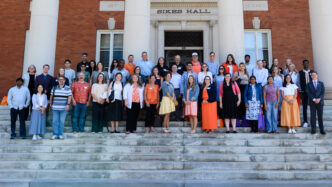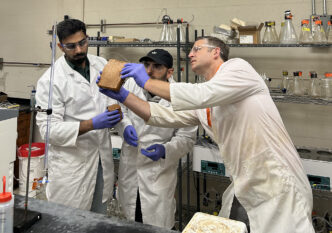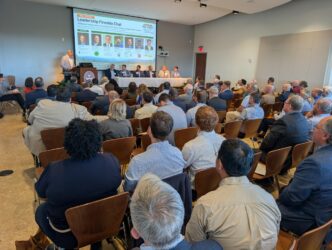

The Forest Products Innovation Corridor launched Sept. 9–11 in Greenville, bringing together forest landowners, manufacturers, researchers, investors, policymakers and economic development leaders from across the Southeast to address declining markets for pulpwood and paper mill products.
The Clemson University-led initiative aims to connect the region’s forest resources with emerging markets in mass timber, biofuels, biomaterials, renewable energy and other forest-based products.
“The corridor’s regional scope in the Southeast brings different strengths to the effort—from forest resources and communities seeking new markets to research, advanced manufacturing, innovation, economic development and investment capacity,” said M. Soledad Peresin, director of Clemson’s Wood Utilization + Design Institute (WU+D), which hosted the conference and is home to the initiative.
That challenge looks different across the corridor. In communities that have lost industries that once anchored their economies, the immediate need is to rebuild durable markets and economic opportunity.
“Over the last 20 years or so, the city has lost the seaport, the steel mill and now the paper mill,” said Jay Doyle, mayor of Georgetown, South Carolina. “Millions and millions of dollars have come out of the economy. At one time, every family had somebody who worked at one of these places.”
Doyle said those closures have left Georgetown with legacy families who lost their incomes and a community searching for new economic opportunities—an example of the market disruption affecting forest-dependent communities across the region.
He believes FPIC could help connect Georgetown’s forest-products heritage with emerging markets, technologies and investment through a broader regional network spanning South Carolina, Georgia and North Carolina.
He is already exploring opportunities involving cross-laminated timber, biomass energy, biofuels and other wood-based products.
Georgetown illustrates one side of the challenge FPIC is designed to address: Traditional markets for pulpwood and low-value wood are shrinking. At the same time, forest-dependent communities need new outlets for their resources. Elsewhere in the corridor, communities with strong manufacturing, research and innovation ecosystems can help develop, demonstrate and commercialize the next generation of forest products.
That regional approach was on display when the corridor convened more than 100 leaders at its launch. Discussions and presentations focused on how the Southeast can create more value from its forests and build the markets needed to keep those forests working.
FPIC is anchored by WU+D and built in collaboration with the University of Georgia’s Warnell School of Forestry and Natural Resources and NC State’s Department of Forest Biomaterials.
“The Southeast has the forest. Now it needs the connection,” Peresin said.
That connection has become increasingly important as traditional markets for pulpwood and low-value wood continue to weaken.
Nick DiLuzio of Forisk told attendees that demand in pulpwood markets had fallen by 23% over the past decade, with most of the decline occurring over the last five years. Growth in sectors such as oriented strand board and wood pellets has not offset the contraction in pulp demand.
Forisk is tracking 35 mill closures or capacity reductions across the United States and Canada between 2025 and 2028, representing approximately 21.5 million tons of lost capacity. Pulp and paper account for roughly 14 million tons of that reduction, according to figures presented during the convening. Those figures should be confirmed against the final Forisk presentation before publication.
The consequences extend beyond mills.
When a mill closes, landowners may lose a nearby market for timber. Loggers and trucking companies may lose customers. Rural communities may lose jobs and investment. And landowners may begin to consider alternatives to forest management, including selling their property for development, solar farms or data centers.
“Landowner economics drive active management,” Scott Jones, president and CEO of the Forest Landowners Association, said during the closing session. “Active management is driven by durable markets, and durable markets help forests remain forests.”
The Southeast’s forests provide more than timber. They support clean water, wildlife habitat, carbon storage and rural economies. But those environmental benefits depend in part on landowners having a reason to keep forests as forests.
FPIC’s founders believe the South’s abundant forest resources, strong manufacturing base, major research universities, entrepreneurial companies and growing need for new materials, energy sources and construction products make it an ideal region for growing the forest products industry.
Greenville represents a complementary part of that regional equation. Sam Konduros, president and CEO of the Greenville City Economic Development Corporation, sees a parallel between FPIC’s mission and Greenville’s own economic transformation.
“Greenville was built literally by the textile industry,” Konduros said. “That industry collapsed to some degree, going offshore. We kind of reinvented ourselves and took a multigenerational industrial workforce, pretrained them, educated them.”
Today, Greenville has a diversified manufacturing economy that includes automotive, aerospace, biotechnology, medical technology and advanced manufacturing.
“The city itself is kind of an innovation hub for industry,” Konduros said. “To take an industry like forestry and paper mills and kind of reinvent it into products in the future is exciting.”
Konduros believes Greenville can play an important role in FPIC’s innovation and commercialization network, linking Clemson, regional manufacturers, technology companies and economic-development organizations.
That role complements forest-dependent communities such as Georgetown and underscores why the corridor’s regional structure is central to its potential.
“If you really do look at the Piedmont areas of North Carolina, South Carolina and Georgia, there’s kind of this natural artery of industry,” Konduros said. “An interstate collaborative approach is going to be stronger on a federal basis—the ability to pull in major grants and do things in a bigger way.”
The challenge is not simply generating ideas. It is proving that those ideas can work at a commercial scale.
During innovation pitches on the first day of the convening, companies presented technologies involving biomass, bioenergy, biomaterials and bioproducts. Their presentations illustrated the range of possible markets, from biochar and renewable fuels to lignin-based materials and other products derived from forest resources.
But presenters and panelists repeatedly returned to the same obstacles: high capital costs, uncertain demand, a lack of demonstration facilities, limited customer awareness and the difficulty of navigating the path from laboratory research to commercial production.
For companies developing new wood-based chemicals and materials, the cost of building a plant can be a major barrier. Investors want to see reliable feedstocks, proven technology, customers and predictable markets before committing capital. Customers, meanwhile, often want to see that a product has been consistently manufactured at scale.
FPIC aims to overcome these challenges by connecting innovators with university expertise, industry partners, public-sector tools, investors and potential customers. It can also help identify gaps in the regional ecosystem and develop demonstration projects that reduce risk.
Doyle is already thinking about how that work could affect Georgetown. He is exploring whether locally sourced wood could be used in new developments, including affordable housing, sound barriers, emergency shelters and mass-timber construction.
“We’re talking about locally sourced to locally manufactured wood,” Doyle said. “If we could actually build these projects out of working forest and working-manufactured timber products, it would be fantastic.”
Policy will be part of the effort. Participants discussed the role of building codes, product standards, procurement policies, tax incentives, power-purchase agreements and other public-sector tools in creating durable demand.
Jackson Morrill, CEO of the American Wood Council, described the development of cross-laminated timber as an example of how long that process can take. The product had to be tested, certified, incorporated into design specifications, and ultimately recognized in building codes. The process took roughly a decade.
The lesson for FPIC is that commercialization requires sustained coordination.
The convening also examined how the Southeast could learn from other regions.
Antti Asikainen, chair of the Finnish Forest Bioeconomy Panel and executive vice president for research at the Natural Resources Institute Finland, described Finland’s experience responding to major changes in the pulp-and-paper sector. Finland used a broad, collaborative process involving government, universities, forest owners, industry and finance to consider how the country could move toward higher-value products and a more diversified forest bioeconomy.
Orlando Rojas, Canada Excellence Research Chair in Bioproducts and scientific director of the Bioproducts Institute at the University of British Columbia, urged participants to think about forest materials according to what they can do—not merely what they are.
Cellulose, lignin, hemicellulose and other biomass components can be used in advanced materials, environmental technologies, energy storage, biomedical systems and other applications, he said.
The same market-centered thinking emerged during discussions of mass timber.
Melinda Lehman, vice president of innovations at Britt, Peters & Associates, challenged participants to consider mass timber not only as a structural material but also as an experience. Her presentation focused on how people feel in wood buildings and how that human experience could help create demand for mass timber in the built environment.
The event concluded with a call to move quickly from conversation to implementation.
FPIC leaders Peresin; Todd Petty, dean of the University of Georgia’s Warnell School; and Jingxin Wang, head of NC State’s Department of Forest Biomaterials, outlined the need to identify near-term priorities, establish partnerships and build a pipeline of projects and demonstrations.
The contrast between places such as Georgetown and Greenville reflects the regional model FPIC is intended to build: connecting forest resources and communities that need durable markets with research, manufacturing, innovation, capital and commercialization capacity across the Southeast.
Rather than centering the effort in a single community, FPIC leaders aim to connect those different strengths across South Carolina, Georgia and North Carolina and build a pipeline of projects that can move from resource to innovation, demonstration, market, capital and scale.