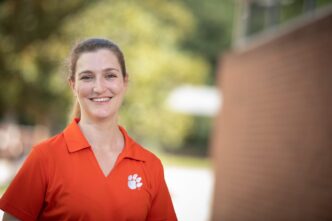


Delphine Dean joined the Clemson faculty in 2005, the same year that the Creative Inquiry (CI) program started. So it shouldn’t be surprising that she was an early adopter of CI and that she has continued to be one of the most active faculty mentors in the program.
Dean is the Ron and Jane Lindsay Family Innovation Professor and chair of the Department of Bioengineering. She has mentored more than 30 projects over the past 20 years, many of which have had a global impact. She said in her experience, there are really two types of CI projects — those that are developed by faculty members who want to collaborate with colleagues in other disciplines to try something new and those that are initiated by students.
In one of her earliest CI projects, students in an instrumentation and imaging class she taught wanted to continue to work on a project to develop a low-cost neonatal incubator that they had started in her class. Around the same time, she got a call from a colleague at the Medical University of South Carolina that she says was “serendipitous.” The colleague was taking a trip to Tanzania to conduct surgical training, and he asked Dean if any engineers might want to join the trip to help improve conditions at the neonatal ICU there.
“I was like, ‘I have some students who are interested in that!’” she said.

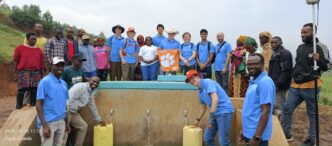
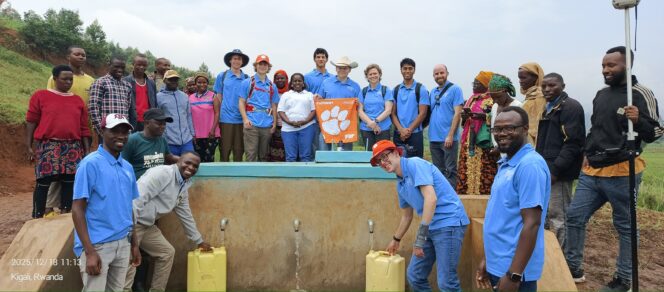
Dean and her students took that trip to Tanzania, which led to a partnership with Arusha Technical College and ultimately the Designing Medical Technology for the Developing World CI project. That project has been running since 2009, with students developing devices such as low-cost diabetes test kits and basket-woven neck braces for injuries.
When the world shut down in 2020 due to the COVID-19 pandemic, Dean faced the challenge of how to continue to engage her students in research from afar. Her students worked on designing a hood that doctors could use on COVID patients to protect medical staff from infection during the intubation process. Students created something out of materials they were able to access at home or at their local hardware store, such as shower curtains, PVC pipes and HEPA filters, and they recorded videos of their tests on the hood. Their designs ended up being implemented in several area healthcare facilities.
That project sparked the idea for the Clemson COVID Challenge, which took place that summer, administered in partnership with CI. Students from across disciplines worked through the summer on COVID-related research projects and held a competition to pitch their projects to faculty and industry judges. The competition was open to students from colleges and universities across the state, so its impact was felt well beyond Clemson.
“Some of the projects that students come up with are amazing,” said Dean. “They have very out-of-the-box ideas.”
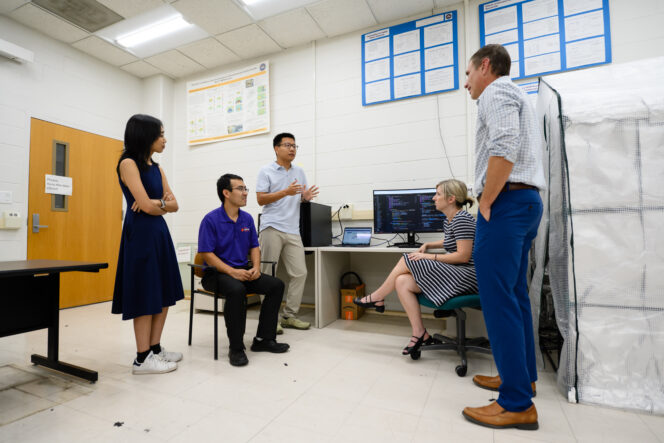
Dean’s entire department has embraced CI. Students can use up to six credit hours of CI research towards their technical elective requirement, and she said the vast majority of their undergraduates participate in CI or some other kind of undergraduate research. Dean also said that everyone on the bioengineering faculty who are based in Clemson or Greenville are involved with CI.
“We have eight faculty members who work in Charleston, and they’re very jealous,” said Dean. She said the Charleston faculty do offer a Summer CI project to get students to work with them during the summer months, and some of them are involved in remote joint mentoring during the semester.
Other CI projects in Bioengineering
- Engineering Nanobiomaterials for Delivery of Cancer Therapy — Led by Angela Alexander-Bryant, associate professor of bioengineering, this project is working to develop innovative drug delivery systems to advance cancer treatment. Using micro- or nano-scaled drug delivery systems could allow for more targeted treatment directly to tumor sites and minimize harm to healthy, non-cancerous cells.
- The REDDI Lab (Research and Education in Disease Diagnosis and Intervention) — The REDDI Lab is Clemson’s first CLIA certified laboratory, established in Fall 2020 to manage the University’s COVID-19 testing during the global pandemic. Students in this CI get experience with a variety of diagnostic testing methods, data analysis techniques and professional practices within a clinical lab setting. Mentored by research assistant professor Austin Smothers and assistant professor Carolyn Banister along with Delphine Dean.
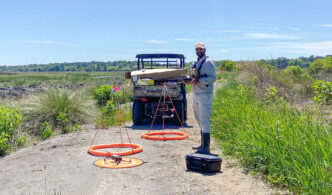
- Remote Human Movement Analysis — This CI looks at developing new technologies for analyzing human movement in natural settings outside of the lab or a medical office. One example is developing technology to measure gait as a way to detect Alzheimer’s disease and other health issues that affect walking and movement. Mentored by assistant professor Reed Gurchiek and doctoral student Haley Hentnik.
“Bioengineering is a very interdisciplinary field, and CI is a very good mechanism for faculty to start those kinds of projects,” she said. “CI lets you do things that are just hard to do if you don’t have that structure in place. I think it’s great for the student experience, and it feeds into the research enterprise in ways that we don’t talk about as much. We’ve gotten preliminary data that has helped get us grants, high impact publications, win awards, all from CI projects. It definitely helps build our research capacity.”
Dean said CI is something that sets Clemson apart from other universities in terms of undergraduate research and experiential learning.
“CI is a huge selling point when you talk to students. This is an experience that they will not get at other places. Other schools do have undergraduate research, but it’s a lot less student-driven. Students have a lot more intellectual ownership of these research projects.”
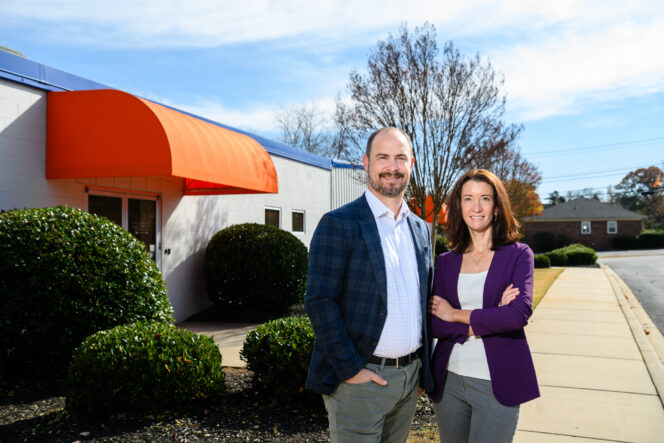
Delphine Dean, bioengineering department chair
She said CI is also a part of her recruitment of new faculty to come to Clemson.
“CI is part of the reason I have stayed at Clemson,” she said. “I got here the year CI started, and I can see the difference it has made over the years.”
This story is part of a series focused on long-standing projects and faculty mentors who have been involved with Creative Inquiry + Undergraduate Research since nearly the beginning of the program. For more information, visit clemson.edu/ci.