Two Clemson University teams finished in the top 10 among all U.S.-based competitors in the Bloomberg Global Trading Challenge, including a fourth-place national finish, placing Clemson among the nation’s top-performing programs in the global competition.
A total of 25 Clemson teams competed in the challenge, placing the University among the top three U.S. institutions nationally for participation and ahead of hundreds of peer institutions worldwide. Overall, 382 colleges and universities from 49 countries fielded teams.
Clemson’s results stood out not only for participation, but for performance. Two Clemson teams finished in the top 36 globally among 2,394 teams, with one team ranking in the 99.2 percentile worldwide. Six Clemson teams placed in the top 91st percentile globally, and nearly one-third of Clemson’s teams ranked in the top 84th percentile nationally.
Among U.S.-based competitors, Clemson teams earned several top-tier placements, including a fourth-place national finish by the team Paw-sitive Gains and a 10th-place finish by Wall Street Women. Additional Clemson teams placed solidly within the top 100 nationwide.
For many students, the challenge provided a first opportunity to apply financial theory in a live-market simulation using professional-grade tools.
Farrell Shoemake, a freshman from Elgin, South Carolina, and captain of Paw-sitive Gains, said the experience transformed his understanding of how financial markets operate.
“The experience was amazing,” Shoemake said. “It was mentally challenging but taught me a lot. I really enjoyed checking our portfolio every week and navigating through different problems that came up.”
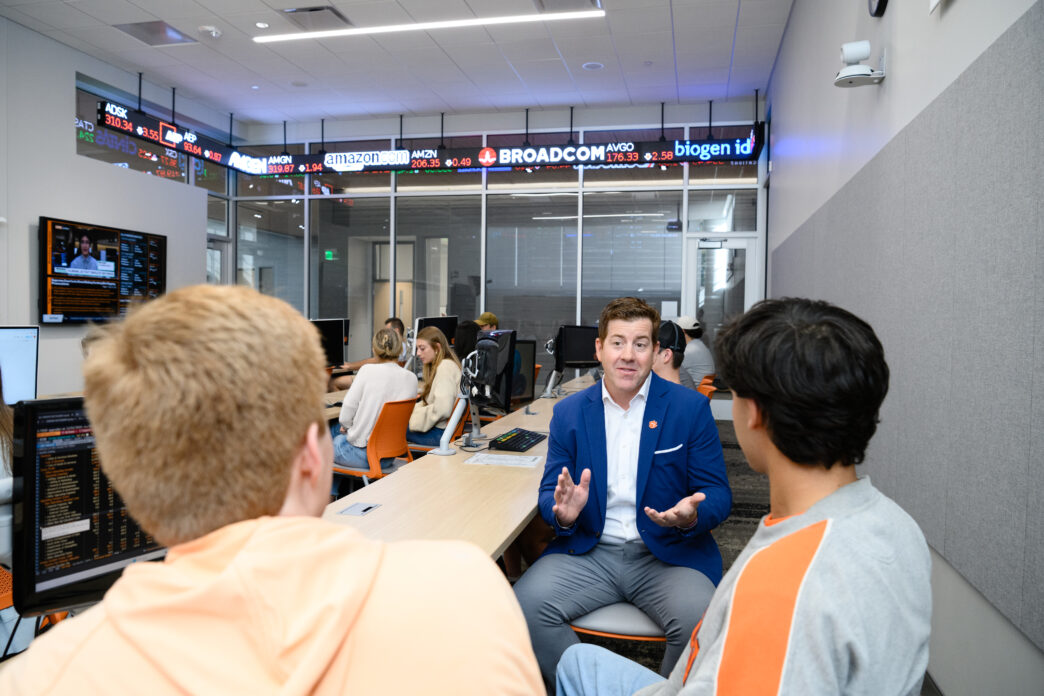
Shoemake, who plans to double major in financial management and accounting, credited Clemson’s Melvin and Dollie Younts Trading Room — part of the Department of Finance in the Wilbur O. and Ann Powers College of Business — and its Bloomberg terminals with enabling his team’s success.
“My group used the Bloomberg terminals for the entire challenge,” he said. “They have so much information and really helped our team achieve such a strong finish.”
Shoemake’s team included Parker Springer, Charlie O’Connell and Julia Rubino.
Faculty leaders attribute Clemson’s strong showing to its emphasis on experiential learning and early exposure to industry tools. Many participating students were first-semester freshmen who earned Bloomberg certification through coursework connected to the Younts Trading Room, part of a strategic initiative designed to prepare students for professional roles in finance and investment management.
“Throughout the Bloomberg Global Trading Challenge, the 25 freshman teams I advised demonstrated exceptional dedication, teamwork and discipline,” said Michael Howley, director of the Melvin and Dollie Younts Trading Room and advisor to the teams. “They gained hands-on experience in portfolio management, risk, profit and loss, and the impact of macroeconomic forces, while learning the importance of competing as a team rather than as individuals — much like a real Wall Street trading desk. In a short time, they built a solid foundation in trading and financial markets that should serve them well in future coursework and their careers.”
Isabella Graves, a freshman business major from Charleston and captain of Wall Street Women, said the challenge strengthened her ability to evaluate risk and make informed decisions.
“I would describe the experience as enriching and helpful,” Graves said. “I learned so much about risk, fluctuation and how quickly things can change in the market.”
Graves also emphasized the role of faculty support and facilities in preparing students for success.
“The teachers in the College of Business helped me so much throughout the challenge,” she said. “The trading room was key to our success through the advanced technology and Bloomberg terminals.”
Graves captained a team that included Kallie Osmussen, Winna Beth Bannister and Lilly Mullin.
The Bloomberg Global Trading Challenge simulates live market conditions, requiring student teams to manage a theoretical $1 million portfolio using real-time financial data. By competing against peers worldwide, Clemson students gain practical experience navigating market volatility, evaluating risk and developing disciplined investment strategies — experiences that mirror expectations in today’s financial industry and contribute directly to long-term career readiness.