The College of Science is highlighting some of its Ph.D. students in honor of National Dissertation Day, which is April 26.
Abby McNamee didn’t set out to study environmental contamination.
When she joined chemistry professor Julia Brumaghim’s lab at Clemson University, the sixth-year Ph.D. student was interested in the lab’s human health-related research.
A project that started out looking for ways to prevent DNA damage morphed into her dissertation study after McNamee and Brumaghim recognized an opportunity to help limit health risks and environmental damage from radioactive materials.

McNamee’s project has an interdisciplinary focus and involves the study of N-heterocyclic thiones and selones. Heterocyclic compounds are cyclic organic compounds containing carbon and at least one other atom — such as nitrogen, oxygen or sulfur. The compounds have a wide range of potential uses, from drug development to crystal engineering.
One promising application is the potential to use the compounds as a sulfur- and selenium-containing antioxidant to prevent DNA damage caused by metals. A collaboration in her department led McNamee to explore a potential application in environmental remediation of radioactive iodine.
McNamee uses the compounds’ halogen-bonding properties to sequester the radioiodine. At the Savannah River National Laboratory (SRNL) near Aiken, South Carolina, radioactive iodine has been found in the soil and groundwater.
McNamee and Brumaghim collaborated with researchers at SRNL on a project to determine whether they can use these sulfur- and selenium-containing compounds to remove radioiodine from the waterways. Radioiodine can accumulate in the thyroid glands of people who drink contaminated water and cause thyroid cancer.
Sulfur-containing antioxidants are already in medical use, including as a medicine to help thyroid health. McNamee modifies these existing compounds to improve their use in specific applications. She can manipulate different branches of the material to change its crystal structure or the way it interacts with other materials.
Complex challenge
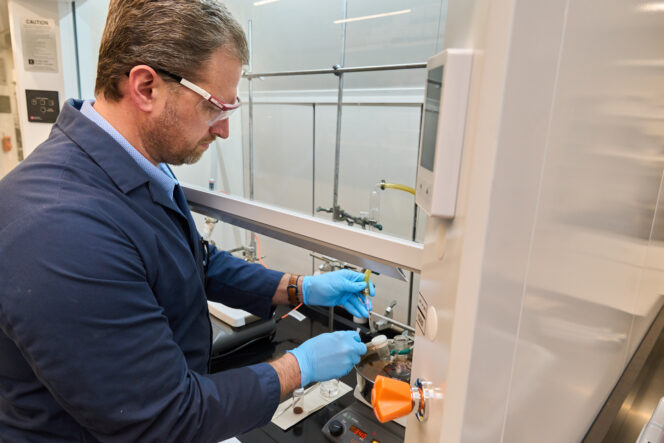
Removing radioiodine from the environment remains a complex challenge, but McNamee said she enjoys testing whether her compounds can successfully remove contaminants.
“I might be running a DNA gel in the morning and setting up a synthetic reaction in the afternoon or measuring out different compounds to try to do some crystallization studies,” McNamee says.
Brumaghim said McNamee is a wonderful graduate student with whom to work.
“She is self-directed and enthusiastic about her research,” Brumaghim said. “She has also served as an ambassador for the department and the college to prospective students and donors. She has won several departmental and college awards for her teaching and service. She gets the job done, and almost always goes above and beyond with a smile.”
McNamee received her undergraduate degree in biochemistry from Georgia Southern University, where her research experience inspired her to pursue graduate school.
She expects to complete her Ph.D. in Spring 2027 and hopes to pursue further collaboration and research at the SRNL or pursue a career in the life and environmental sciences.
She said one of her favorite aspects of her time at Clemson has been mentoring undergraduate students as part of a research team.