South Carolina springtime is typically marked by rain, storms and other severe weather. This year, however, conditions are much drier.
The lack of rainfall is affecting the state’s fescue industry.
Data from the National Oceanic and Atmospheric Administration show South Carolina has received 1.24 inches of rain this month. That is 3.04 inches below normal, making it the third-driest March since 1895.
Tall fescue, a common forage crop in the state, is now entering harvest season. Clemson University Cooperative Extension Service scientists say growers should adjust their strategies for the dry conditions.
Liliane Silva, a Clemson Extension forage-livestock systems specialist based at the Edisto Research and Education Center near Blackville, and Christopher LeMaster, a Clemson area livestock and forages agent in Gaffney, said growers can take several steps to manage the situation.
“For a cool-season grass like tall fescue, which relies on spring moisture for the bulk of its annual forage production, that rainfall deficit is a primary concern for the upcoming hay season,” Silva said.
The South Carolina hay season typically runs from late April or early May through October, depending on the forage crop used. Early fescue hay cutting, in mid- to late April, is important because higher temperatures and late-spring maturity reduce forage quality and digestibility.
Tall fescue is the predominant forage crop used for grazing and hay in the Upstate and Piedmont regions. It is valued for its durability, its ability to grow in lower-fertility soils, and its capacity to recover after summer dry periods.
In addition to drought conditions, producers are facing a 50% increase in fertilizer and fuel costs.
“When input prices are high and projected yields are low due to weather-related challenges, management strategies must be adjusted to focus on efficiency and stand persistence,” LeMaster said.
Harvesting and clipping strategies
In a dry spring, there is rarely a single correct answer for when to harvest. Silva and LeMaster suggest two strategies based on timely rainfall and well-managed hayfields.
One option is early harvesting. LeMaster said many producers are choosing to harvest fescue now, even with lower yields.
“This effort aims to capture the nutritional quality of the forage before it becomes overly mature,” he said. “Recent high temperatures have pushed much of the state’s cool-season grass into the reproductive stage, producing seedheads, which decrease hay quality by increasing lignin in plants.”
Lignin is a compound that makes plant cells hard and woody.
Another strategy is mowing or clipping hayfields. This process returns plants to a vegetative state, allowing for some regrowth before summer heat intensifies. It can also help recycle nutrients and build organic matter, but growers should monitor how much material is left behind.
“Depending on current growth, heavy residue lying over the cut plants could shade the crown and hinder regrowth once we start getting rain,” Silva said.
Both strategies rely heavily on timely rain. Growers should not harvest or clip if the fescue is drought-stressed and there’s no rain in the forecast. This could cause the plant to draw on its energy reserves from its roots, compromising the stand’s persistence. In extreme heat and drought conditions, the best answer may be to do nothing.
Cutting height and management strategies
Harvest height is even more critical during these drought conditions, and herbicide application should be held off until appropriate rainfall is received.
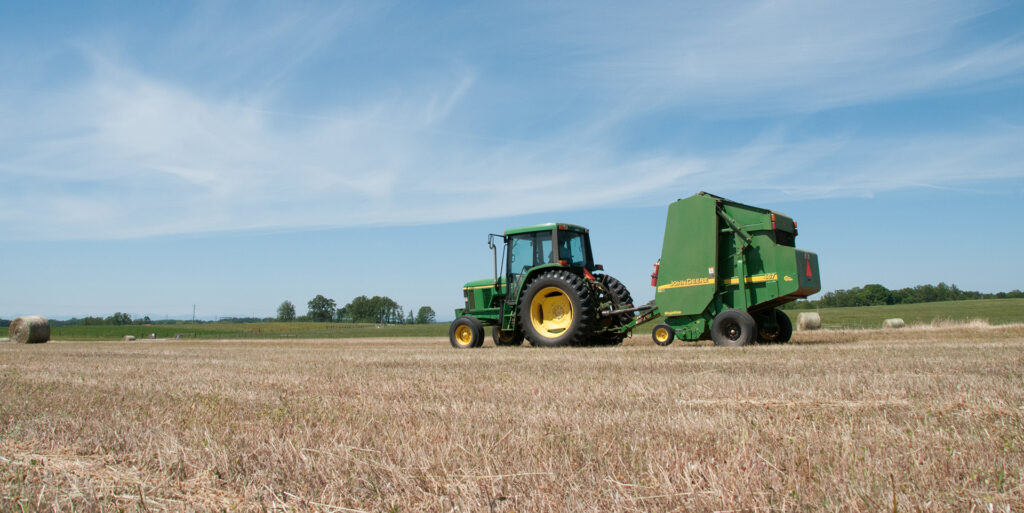
Mowers should be set to maintain adequate leaf area, so plants retain sufficient leaf area and do not deplete their energy reserves. When harvesting, growers should avoid cutting below the recommended 4-inch stubble height for fescue.
For clipping pastures, mowers should be set high enough to remove stems while leaving most leaves intact, if the goal is to control seedhead occurrence.
“The leaves are the ‘plant factory,’ producing energy to support plant recovery and growth after defoliation,” Silva said.
Many producers are delaying herbicide applications due to dry conditions, which can reduce effectiveness.
“Given current prices, waiting for better growing conditions may be the most cost-effective choice,” she added.
Growers should evaluate weed pressure, species and herbicide options on a case-by-case basis and consult their local Extension agent for guidance.
The economic reality
Production costs are rising as input prices increase and yields decline due to weather conditions. Growers should calculate the cost per bale and determine appropriate pricing.
Local hay prices are reflecting higher fertilizer and fuel costs, as well as lower-than-average yields across the region.
Clemson Extension encourages growers to contact their local agents for help evaluating their individual operations.