My dream is to help solve real-world problems in agriculture.
Johanna Wesche
Johanna Wesche is making waves in the world of agricultural science with her groundbreaking research on sustainable disease management in fruit crops.
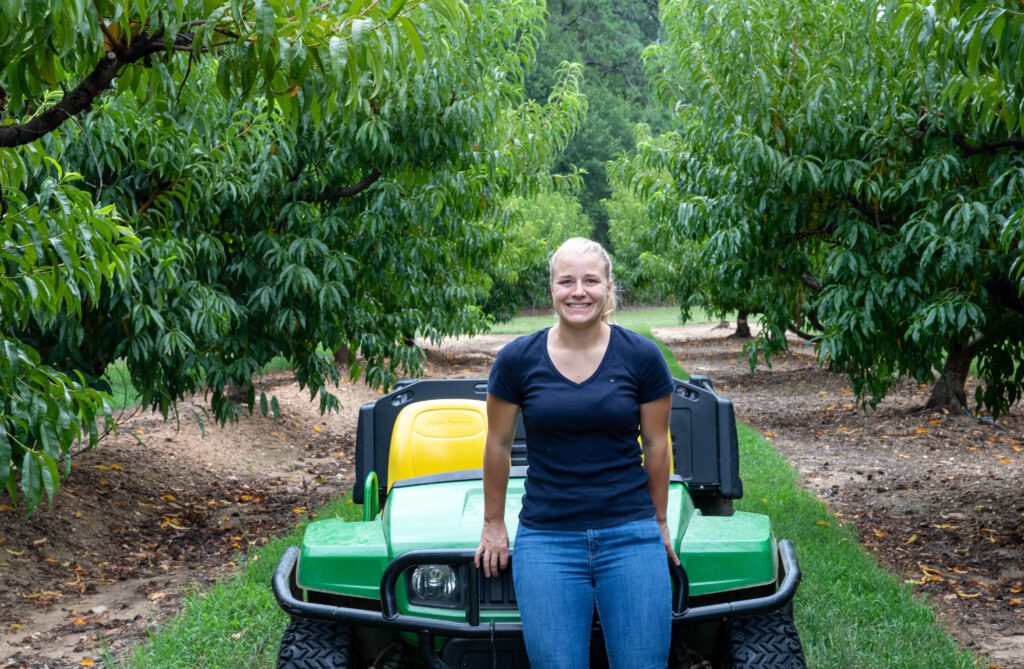
Wesche is from the village of Gross Laferde in Lower Saxony in northern Germany. She will complete her graduate studies at Clemson University in August after studying under the mentorship of Guido Schnabel, a plant pathologist in the College of Agriculture, Forestry and Life Sciences (CAFLS) Department of Plant and Environmental Sciences.
She is preparing to take the next step in her academic career by transitioning into a postdoctoral position. Her long-term goal is to lead a research and Cooperative Extension Service program and establish a lab dedicated to developing science-based solutions for growers.
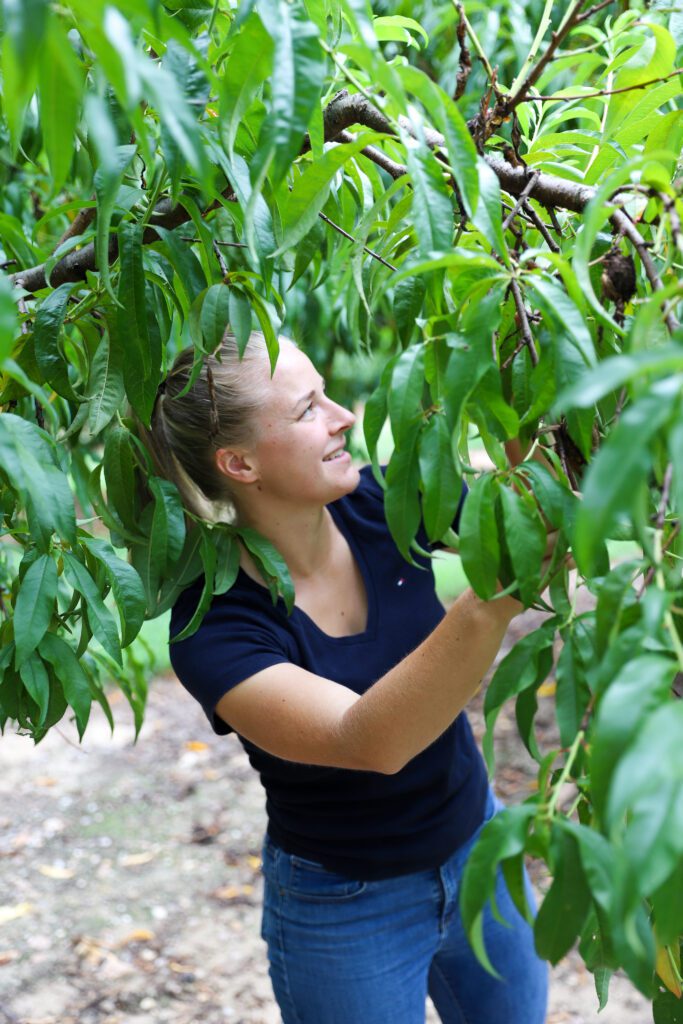
“My dream is to help solve real-world problems in agriculture,” Wesche said. “I want to continue working in academia where I can combine research, teaching and outreach to make a meaningful impact.”
At Clemson, Wesche honed critical skills to serve her well in her future endeavors. She credits Schnabel for helping her become a stronger scientific writer and more effective communicator.
“He taught me how to focus my ideas and structure impactful research,” she said.
Schnabel praised Wesche’s approach to her doctoral program.
“Johanna is extremely dedicated to her work and soaks up knowledge and advice like a sponge,” Schnabel said. “Her time management and technical skills are excellent. She is a student who likes to talk about her project and looks forward to the weekly one-on-one meetings with me.”
Wesche also took courses in scientific and grant writing under Elizabeth Cieniewicz, plant pathologist and assistant professor of plant virology, also in the Department of Plant and Environmental Sciences, and Anthony “Tony” Keinath, plant pathology professor and researcher, and Clemson Extension plant pathologist. These courses helped her gain confidence in writing grant proposals.
Her research focuses on integrating biological fungicides into integrated pest management (IPM) programs for fruit crops like peaches and strawberries.
One of her most significant discoveries was finding that the man-made fungicide propiconazole and the natural fungicide Howler EVO (which comes from helpful bacteria) work better when combined. This mixture allows farmers to use less of the chemical fungicide but still get the same strong protection against plant diseases. Howler EVO is made from the helpful bacteria Pseudomonas chlororaphis strain AFS009.
“This is a big step toward more sustainable fungicide use,” Wesche explained. “We found that Howler EVO actually suppresses the expression of the target gene for DMI fungicides in the pathogen, which means even lower doses can be effective.”
Her work offers practical benefits for growers, especially those facing increasing regulatory and market pressures to reduce pesticide use. Biological fungicides, she noted, are exempt from residue limits and are often more environmentally friendly and safer for farmworkers.
“Growers need effective alternatives as regulations tighten and consumer expectations shift,” Wesche said. “Biologicals can help fill those gaps, especially when used strategically with synthetic products.”
While biological fungicides are not always effective under high disease pressure, Wesche’s research provides valuable insights into how they can be integrated into spray programs to maximize their benefits.
Her findings are especially timely as initiatives like the European Green Deal and the Accelerating Sustainable Pest Management: A Roadmap for California push for reduced pesticide use, and the re-registration of key fungicides like captan and thiram remains uncertain.
As she looks ahead to the next phase of her career, Wesche remains committed to helping growers navigate these challenges.
“I want to continue building partnerships with stakeholders and developing tools that support sustainable agriculture,” she said.
Journey to Clemson
In May 2021, as the world grappled with the grip of the COVID-19 pandemic and international travel remained restricted, Wesche found an unexpected path to Clemson University.
At the time, she was pursuing her master’s degree in Germany, specializing in fruit crops and plant pathology. The International Society for Horticultural Science had planned its peach symposium in Greece, but pandemic conditions forced the event online — a twist of fate that would change her academic trajectory.
Among the speakers were Schnabel and other Clemson scientists, Kensjia Gasic and Juan Carlos Melgar, who presented their latest findings on peach cultivation and pathology. Their presentations struck a chord.
“These fascinating talks piqued my interest,” Wesche said. “I decided to learn more about the Clemson Peach Program and contacted Dr. Schnabel.”
A Zoom meeting followed and within a month Wesche was enrolling in CAFLS’s Plant and Environmental Sciences doctoral program.
Now, several years later, Wesche says the experience has exceeded expectations.
“My Clemson experience has been invaluable,” she said. “I’m grateful for the opportunity to come here and earn my doctorate.”