
When Stonebridge Oil Solutions faced growing concerns about Ohio’s aging oil wells and the environmental risks associated with saltwater injection, the company turned to Clemson University’s Master of Science in Data Science and Analytics (M.S. DSA) program for answers rooted in data.
What followed was a collaboration that merged advanced analytics with real-world energy operations—equipping Stonebridge with new tools to prioritize well plugging, inform public policy discussions and support workforce development across Appalachian Ohio.
Addressing a Growing Environmental Challenge
Ohio is home to thousands of conventional oil and gas wells, many of which are nearing the end of their productive lives. At the same time, the rise of horizontal shale drilling has significantly increased the volume of wastewater requiring disposal through Class II Saltwater Injection Wells (SWIW).
Community concerns have mounted over the potential for injected fluids to migrate underground and interfere with nearby older wells. Reports of increased water production in conventional wells, localized environmental impacts and regulatory pressure have intensified scrutiny of injection practices.
Stonebridge, which is deeply involved in well operations, environmental risk mitigation and well-plugging strategy, recognized that traditional oilfield experience alone would not be enough to evaluate these complex, data-heavy challenges.
“We understood that we needed analytical rigor to assess injection-production interactions and to prioritize which wells posed the greatest environmental and operational risks,” said business consultant Dorinda Byers.
That need aligned with the applied learning mission of Clemson’s M.S. DSA program. The program, housed in the Department of Management within the Wilbur O. and Ann Powers College of Business, is an online degree developed cooperatively by Clemson’s School of Mathematical and Statistical Sciences and Department of Management. It provides students with advanced knowledge in statistics, mathematics, computer science and business management.
Turning Fragmented Data into Actionable Insight
Over the course of the project, Clemson students were tasked with assembling and integrating large volumes of fragmented regulatory and operational data, including injection permits, annual and quarterly disposal reports, brine hauler logs and oil and gas production data for surrounding vertical wells.
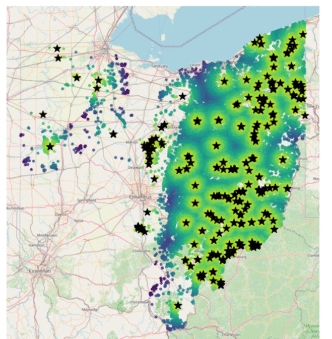
Working with messy and inconsistent state datasets, the students built an integrated data model and conducted geospatial analyses examining wells within a seven-mile radius of injection sites—the longest known distance of documented interference.
“The students impressed us with their technical skills, curiosity, and ability to manage messy, inconsistent state datasets,” Byers said. “They approached the problem with a balance of data science discipline and real-world logic—always asking how analytical patterns connected to operational decisions on the ground.”
Using technologies such as R and Python, the team performed statistical modeling, time-series analysis and geospatial analysis, while developing integrated Tableau dashboards to evaluate whether increases in injection volumes, rates or pressures correlated with production anomalies in nearby wells.
At the beginning of the project, Huntley Oliver, who graduated in December 2024 with his M.S. in Data Science and Analytics, assumed a project management role within his team.
“While my primary strength is in mathematics, other team members had very strong skills in data mining, cleaning, and database consolidation,” he said. “I coordinated team progress, led meetings, and developed periodic presentations to update both the client and Dr. Tripp on our progress.”
For Oliver, the experience mirrored the realities of professional data science work.
“The focus of this particular project made it especially impactful. Not only was it a real-world engagement, but it also required us to source, clean, and structure data in an authentic industry context,” Oliver said. “Now that I am working professionally as a data analyst, I recognize how critical that hands-on experience was in preparing me for the professional field.”
As the project evolved, he also developed data visualizations in Tableau and built the machine learning model used to predict future financial opportunity areas for Stonebridge based on historical contract award values tied to well plugging in Ohio.
“One of the most valuable takeaways from this experience was gaining a comprehensive understanding of the analytics project lifecycle, from data acquisition and preparation to delivering actionable insights,” Oliver said. “This mirrors the work I now do every day with my current project team.”
Informing Policy and Public Discussions
The timing of the project proved significant.
Ohio lawmakers recently advanced Senate Bill 219, the first comprehensive overhaul of oil and gas law in more than a decade. The legislation establishes a protected Oil and Gas Resolution and Remediation Well Plugging Fund, streamlines regulatory processes and prioritizes plugging orphan wells located near injection wells.
Clemson’s analysis strengthened Stonebridge’s ability to participate in these policy discussions with evidence rather than conjecture. The dashboards and models illustrated which wells may be nearing end-of-life and how injection-related interactions should factor into plugging priorities.
With Ohio cataloging more than 20,000 orphan wells yet plugging only a few hundred annually, data-driven prioritization has become critical to accelerating remediation while protecting groundwater and communities.
The project also supported conversations tied to the Safe Wells, Strong Futures Initiative, a regional effort focused on workforce development for well plugging and environmental remediation. Insights from the Clemson analysis contributed to a $2.8 million grant application to establish Ohio’s first dedicated well-plugging training program serving Appalachia.
Bridging Environmental Stewardship and Economic Opportunity
Beyond regulatory impact, the project helped Stonebridge validate a new business strategy: the creation of Dead Well Services, an analytics-informed end-of-life well management unit.
By identifying clusters of high-risk wells—particularly those located near injection sites—the students’ analysis helped quantify market demand for well plugging and environmental remediation services.
Plugging orphan wells is not only an environmental imperative; it represents a substantial economic opportunity, with billions of dollars in potential market activity as federal and state funding for remediation increases.
The Clemson teams also uncovered an important intersection between environmental risk and workforce shortages. Many of the high-priority wells identified through geospatial modeling were located in counties facing severe shortages of trained oilfield workers.
This alignment highlighted the need to pair analytics-driven prioritization with targeted workforce training, ensuring that regions with the greatest environmental risk also have the skilled labor required to address it.
“Stonebridge was an outstanding client to work with,” Oliver said. “The project was both professionally rewarding and meaningful, as it supported an initiative with a positive real-world impact in plugging old, orphaned oil wells. Their team was highly engaged throughout the process, providing valuable industry insight and responding promptly to questions, which greatly enhanced our learning experience.”
Experiential Learning with Real-World Consequences
For Clemson students, the collaboration offered an opportunity to apply advanced analytics to a problem with immediate environmental, regulatory and economic implications.
The project required more than technical proficiency. Students had to interpret operational realities, understand regulatory frameworks and translate complex statistical findings into clear visual narratives for executive and policy audiences.
“What makes our M.S .in Data Science and Analytics program a strong fit for a project like this is that we combine statistical modeling, programming and business decision-making in the same curriculum,” said John F. Tripp, assistant professor of information systems and instructor for the project. “The students didn’t just run models. They had to understand how injection wells affect production operations, how regulators think about risk and how executives prioritize investment.”
For Oliver, the project played a pivotal role in launching his career.
“Collaborating with Stonebridge and participating in the Clemson DSA program played a significant role in launching my career in data science,” he said.
Looking Ahead
As Ohio accelerates its well-plugging efforts and injection oversight continues to evolve, Stonebridge plans to build on the Clemson teams’ foundation.
“The initiative will implement a comprehensive rig-hand training program to train, certify and mobilize the next generation of workers while also upskilling the current workforce, first responders and regulators,” Byers said. “This initiative will elevate safety, improve compliance and expand Ohio’s growing oil and gas orphan well plugging sector.”
For Clemson’s M.S. DSA program, the collaboration underscores the broader value of university-industry partnerships.
By combining analytical discipline with operational insight, students helped quantify risks that are often discussed anecdotally in the energy sector. In doing so, they supported environmental stewardship, informed policymaking and catalyzed new business innovation.
As communities across Appalachia grapple with aging infrastructure, workforce shortages and environmental protection, data-driven solutions developed through partnerships like this one may prove essential to building safer wells—and stronger futures.