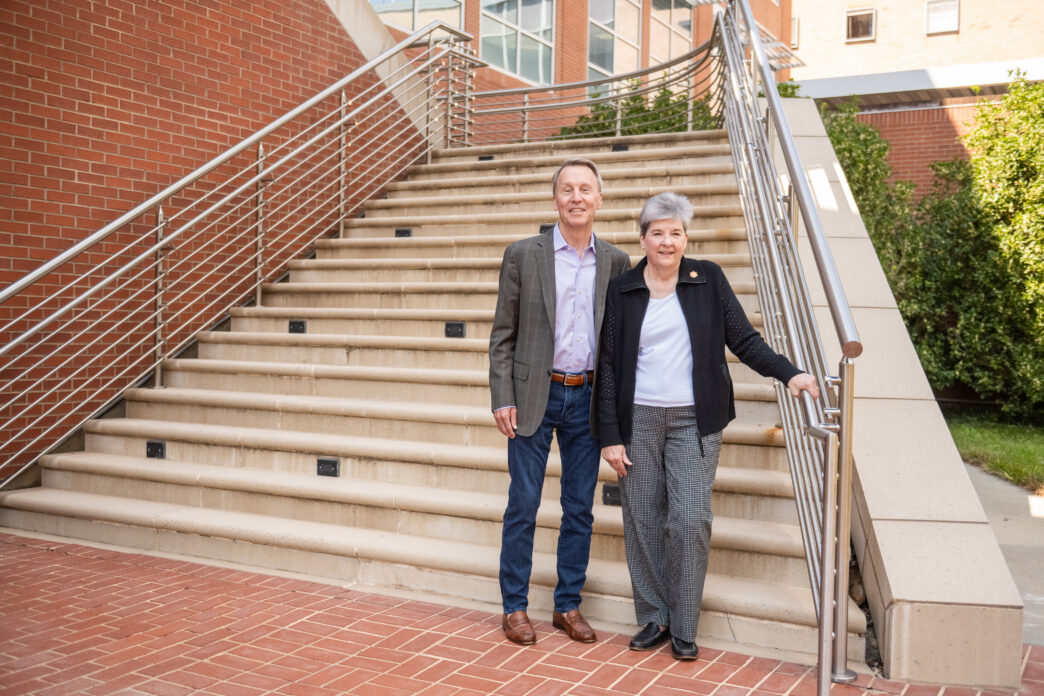
Jeff and Karen Camm’s latest gift to the Clemson University School of Mathematical and Statistical Sciences is all about making an impact.
The gift establishes the Jeff ’84 and Karen ’82 Camm Endowed Professorship in Data Science and Decision Intelligence, a way for the couple to recognize the professors and University that shaped their lives, while directly benefitting students in Clemson’s growing data science program.
“Faculty are the difference makers,” said Jeff Camm, professor, and Inmar Chair in Business Analytics and former associate dean of business analytics at Wake Forest University. “I had some phenomenal faculty in both the math department and the business school. As I rose through the ranks in my own career, I saw how much of an impact the Clemson faculty had on me. Over time, as my own students started telling me how I’d influenced them, it really drove that home.
“We wanted to give back in a way that recognizes faculty excellence because faculty are the ones who change students’ lives.”
Jeff Camm
The Camms previously funded an applied mathematics lecture series at Clemson. The inaugural Camm lecture is April 8 and features Peter Frazier, the Eleanor and Howard Morgan Professor of Engineering at Cornell University.
Investing in Clemson’s future
“Jeff and Karen Camm embody what makes Clemson so very special. Their story began here, and they are choosing to invest in Clemson’s future because of their transformative experience with exceptional faculty,” said Cynthia Young, dean of the College of Science. “As Jeff and Karen know well, great faculty are at the heart of a great university. This endowment ensures that Clemson students for generations to come will learn from leaders at the frontiers of data science and decision intelligence.”
Jeff grew up in northern Kentucky and earned his undergraduate degree in mathematics from Xavier University in Cincinnati, initially planning to teach high school math and coach track and cross country. But a statistics professor who knew about Clemson’s innovative management science program — an applied, joint effort between the mathematics department and the business school, supported by a major National Science Foundation grant— encouraged him to visit Clemson.
“When I visited, all the Ph.D. and master’s students were working on real problems. They were working with Milliken and other companies on actual projects. That made all the difference to me,” he said. Because of the management science program’s balance of mathematics, business and hands-on problem solving, Jeff decided to pursue a Ph.D. at Clemson.
Karen, who grew up in Ninety Six, South Carolina, originally enrolled at Clemson as a computer engineering major at a time when schools were actively recruiting women into the field. She soon realized she did not like engineering and switched to mathematics, a subject she had always enjoyed, with a minor in management science. Karen also marched in the Tiger Band.

After Clemson, Jeff joined the faculty at the University of Cincinnati’s business school, where he spent 31 years in the quantitative analysis department that, like Clemson’s management science program, emphasized applied work and close ties to industry. He worked with major companies, including Procter & Gamble, on redesigning supply chains. He also founded a center for business analytics and co-authored several textbooks.
In 2015, he moved to Wake Forest University to help launch its master of science in business analytics program.
While Karen looked for a job after graduating with her bachelor’s degree in December 1982, she took a class on microcomputers at a technical college. The college hired her to teach computer classes using “portable” computers, which weighed about 25 pounds and were made of metal. Later, after moving to Cincinnati, she taught assembly line workers personal computer classes at Ford Motor Company.
Solving real-world problems
To Jeff, the professorship marks a sort of full-circle moment. The management science program that attracted him no longer exists, but the new data science and analytics program integrates data science and statistics to solve real-world challenges.
“Clemson’s program is structured so students learn to ask, ‘What decisions are we trying to make, and how does the data help?’” Jeff said. “That’s powerful preparation whether they go to industry, government or academia.”
Colin Gallagher, the Emily Peek Wallace ’72 Director of the School of Mathematical and Statistical Sciences, said endowed professorships allow Clemson to attract and support top-tier faculty that enhance research, teaching and the University’s reputation nationally and internationally.
“Gifts such as the Camms’ enhance our ability to offer students a cutting-edge education,” he said.
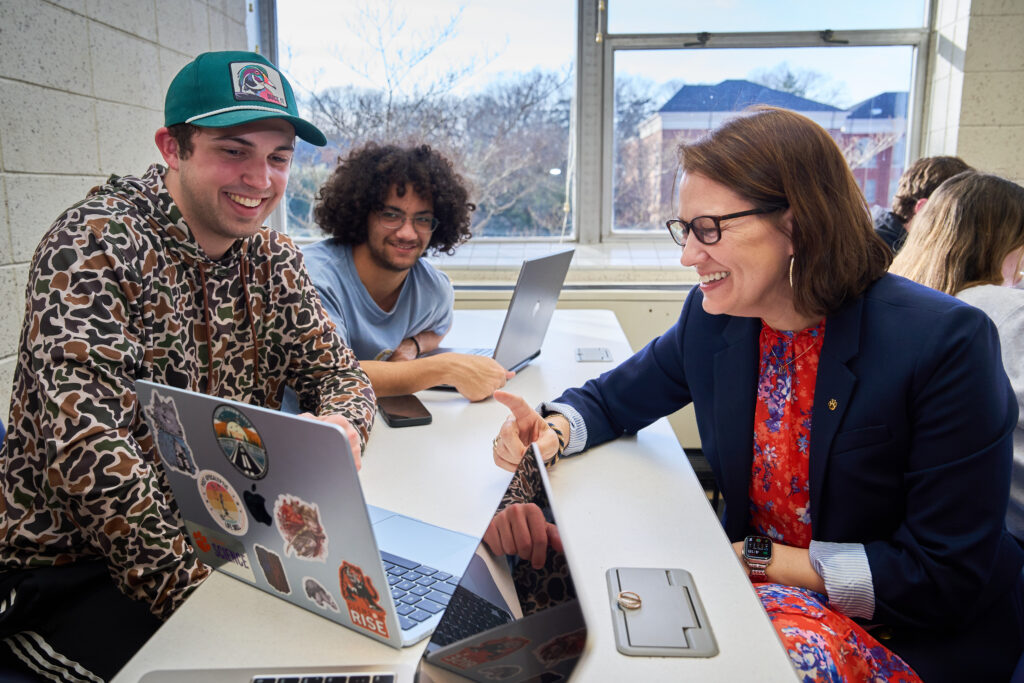
Ellen Breazel, assistant director of data science, program development and industrial relations, said data science encompasses machine learning and artificial intelligence and is a rapidly changing field. Students need to learn to properly use AI so they get good answers that will help them make good decisions.
“AI is a tool, not a solution,” she said. “More than ever, people need to be able to question what comes out,” she said.
Gallagher said he expects the person hired for the endowed position will be doing research on how to best use modern tools for decision intelligence. The future endowed professor will also be in a position to strengthen partnerships with industry that can provide learning opportunities and career pathways for students.
“It feels right to give back to the place that started everything for us and to help students who are trying to figure out how to use what they’re learning in the real world,” Karen said.