When Nikolas Berg began his master’s degree in the Agricultural and Applied Economics Program at Clemson University, he wanted to refine his soft skills such as reading and writing.
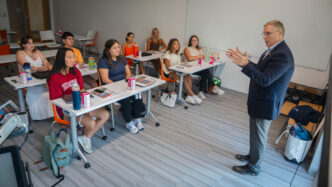
But more than anything, Berg wanted to overcome his lifelong fear of public speaking. Two years later, Berg is set to receive his master’s after teaching two undergraduate courses, each with roughly 100 students.
“Being able to accomplish that while coming into the master’s program with a fear of public speaking was a big milestone for me,” Berg said.
Berg, who came to Clemson as an undergraduate student from El Paso, Texas, recalled how terrifying it was to stand before students on that first day of teaching. Then, he reflected on what it was like presenting his work in front of classmates and professors, as well as at conferences. In 2024, Berg won first place in the master’s poster competition at the College of Agriculture, Forestry and Life Sciences Graduate Research Symposium.
“It definitely was not to the extent of walking in front of 100 people for the first time,” Berg said. “I was prepared at least a little bit for that first day, but it was still insane. It was probably the craziest thing I’ve ever done. If you ask my students, many of them who took that first class with me and are still taking classes with me this summer, they will probably tell you that I’m a completely different person from that first day. They probably could tell I was terrified to be standing up there. I feel like I’m a lot more comfortable as I progress in this role.”
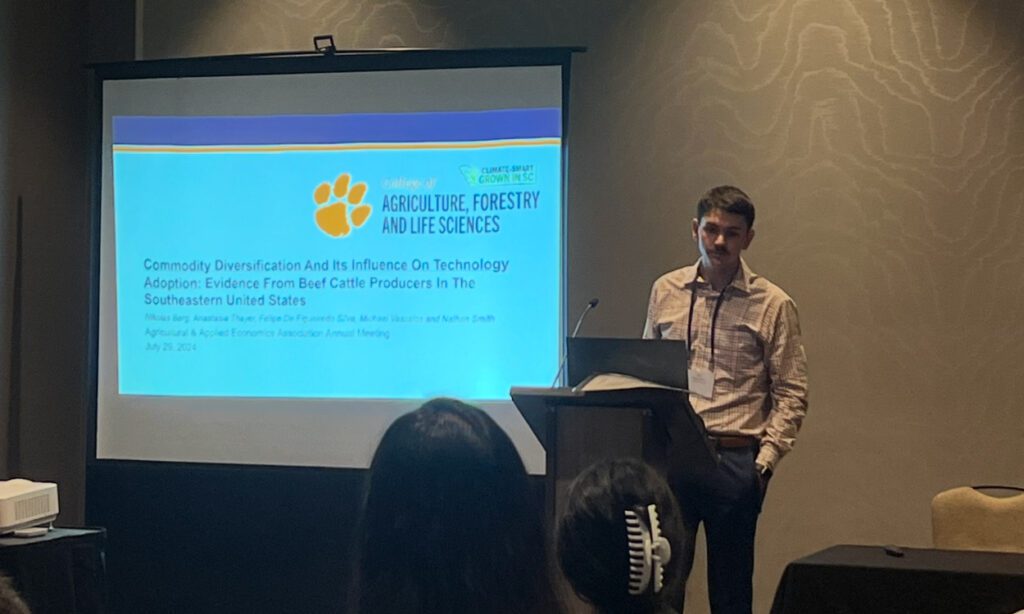
One person who took notice of Berg’s transformation was Michael Vassalos, associate professor of agricultural sciences at Clemson. Vassalos has worked with Berg from his freshman year through his completion of graduate school.
“Throughout this period, Mr. Berg encountered and overcame a number of challenges, including relocating to a new state, transitioning to online and hybrid learning during the COVID-19 pandemic and confronting a fear of public speaking in a program where many assignments are presentation-based,” Vassalos said.
“During his time as a graduate student, Nik graciously took on the role of instructor for two large undergraduate courses, a task that is challenging even for senior faculty. The feedback I received regarding his teaching was overwhelmingly positive. His ability to manage this responsibility while making steady progress on his research speaks volumes about his time management, dedication and professionalism.”
Berg’s fear has now turned into something he loves. Who knew?
“After that first day, I knew I was going to love it,” he said. “It’s super easy to teach, even to 100 students, when you’re talking about something you’re very passionate about. I think I got lucky with subjects that I was able to teach because they’re things that matter to my research, things that matter to me and things I’ve spent a long time studying. I wasn’t just thrown into a random class. It was something I actually cared about, so it was easy to sit there and ramble to these students for an hour and a half every day.”
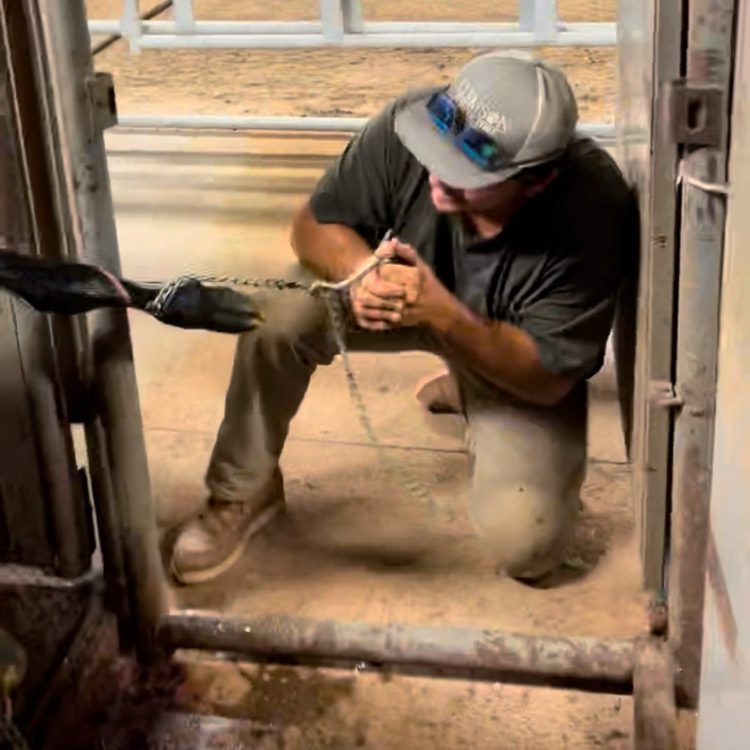
Berg came to Clemson as a natural environmental resource major before switching to agribusiness. Berg looked for farm work as an undergrad. He started working at the Musser Fruit Research Center during the summer after his sophomore year. With his interest in beef cattle and livestock, he was introduced to the Clemson Beef Cattle Farm manager.
He later took on a role with Clemson Cooperative Extension as an undergraduate livestock specialist intern under Matthew Fischer, a livestock and forages economist at the Pickens County Cooperative Extension office.
“It has been a delight to work with Nik,” said Anastasia Thayer, assistant professor of agribusiness. “I have appreciated advising him through the master’s program and supporting his interests in research, teaching and Extension outreach. He has taken advantage of a wide range of opportunities as a graduate student and, hopefully, believes that this was a rewarding experience. It is incredible to think back on all of the work and accomplishments he has made over the last two years.”
Berg had family ties to the area before choosing to attend Clemson. His mother, Betsy Berg, is from Clemson and went to Daniel High School, so he was raised as a Clemson fan. His grandfather, Edward Lewis Bryan, was a professor at Clemson.
After graduation, Berg will attend law school at Georgia State University where he plans to concentrate on transactional law.