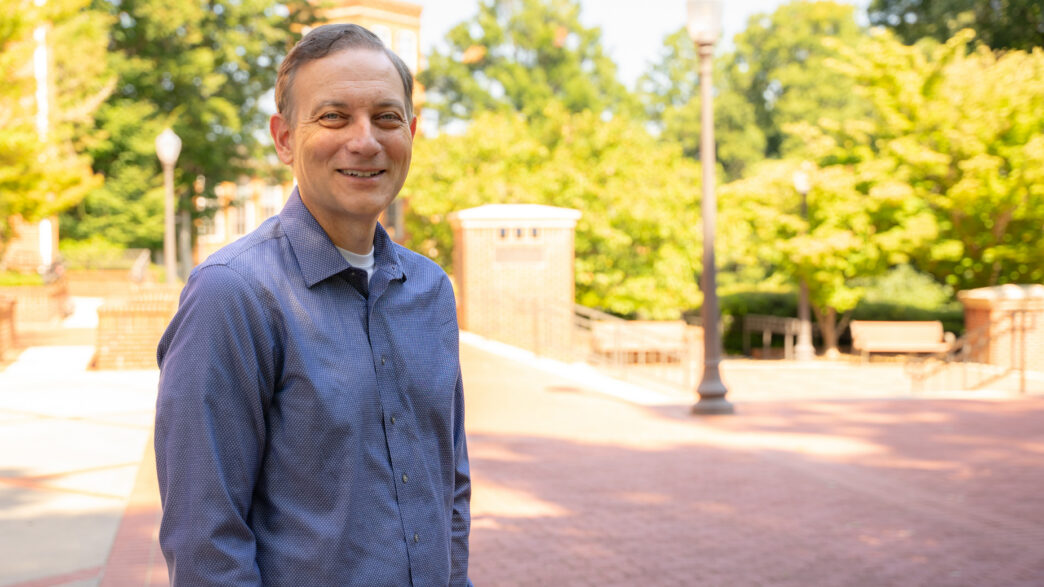
Jonathan Templin works with data and testing to show how tests can aid teachers in the classroom and policymakers who want to make the greatest impact on students. He can feel a bit removed from each individual student, but that changed when he found himself in a parent-teacher conference with one of his son’s teachers.
The teacher reported his son’s recent scores on a screener assessment, admitted that she couldn’t explain what the scores meant and was at a loss for how the findings could be used instructionally.
“This was a great teacher, and I knew right away that the teacher was not the problem,” Templin said. “A test has the potential to serve the state, the student and the teacher, so I always keep that in mind whenever I am working on an assessment that can help everyone involved.”
Templin has since moved from Kansas to South Carolina and to Clemson University, where he works as the Eugene T. Moore Endowed Distinguished Professor in the College of Education. He brings extensive experience in the intersection of quantitative research and the social sciences, and his work dives deep into data and analysis to better understand how people learn.
Templin previously collaborated with districts in that state as a faculty member at the University of Kansas to design assessments that would serve both the state and its teachers. That work has resulted in federal approval from the U.S. Department of Education that will allow the Kansas State Department of Education to pilot a new approach to statewide assessment and accountability.
According to Templin, annual state assessments play an important role in measuring student achievement and supporting accountability. However, because results are typically available near the end of the school year, they often arrive too late to guide instruction for the students who generated the data.
The assessment that Templin designed will address this limitation. Instead of relying solely on one end-of-year assessment, students in participating districts will complete brief, rigorous assessments each quarter. The assessments will align with the skills students are learning throughout the school year.
“The best part is results will be returned within 72 hours after each assessment window closes,” Templin said. “Instead of little information months after testing, teachers will be able to identify strengths, address learning needs and adjust instruction while there is still time to improve student outcomes.”
Templin also uses artificial intelligence to sidestep another costly hurdle in assessment design: writing test items. He said creating test items is one of the largest expenses for testing companies, so he has worked to develop an AI system that writes math items and the accompanying questions for copyright-cleared reading passages. These items are checked and cleared by humans after the fact, but because the cost is greatly reduced, he can also share every test item — many state assessments keep test items confidential, even from teachers.
The assessments will remain aligned with the Kansas College and Career Ready Academic Standards and will provide information for both instructional decision-making and state accountability. Results from the quarterly assessments will be combined to produce an annual determination of student performance.
Officials at the Kansas State Department of Education view this project as having the potential to transform not only accountability but also school improvement initiative. According to Zach Conrad, deputy commissioner for accountability and technology at the Kansas State Department of Education, statewide assessment results arrived months after testing, acting like an autopsy after students had already moved on.
“Aligning brief, quarterly checks to the Kansas Academic Standards turns state assessment into an active compass for daily instruction,” Conrad said.
Districts who have been participating in these assessments are already showing results. Olathe, Humboldt and Geary County all reported significant increases in state standardized test scores and the proportion of students showing advanced or proficient ability.
Spencer Brown, director of assessment, accountability and school improvement in the Olathe (Kansas) Public Schools, noted in an address to the Kansas State Board of Education that the county’s benchmark and formative assessments are far more than data collection tools. He referred to them as “anchors in our instructional decision-making” that keep assessment connected to student learning and teacher clarity.
Over the next five years, Templin will work to scale up the amount of participating districts while improving the assessment before the state makes a final decision on adoption.
“We’re in an exciting place for students and educators because these assessments can be used almost immediately to improve instruction,” Templin said. “We don’t want all that time taken out of instruction and all that cost just for data to sit on a shelf or for a teacher to admit to a parent they don’t understand how they’re supposed to use it.”
According to Kristin M. Gehsmann, dean of the College of Education, Templin’s commitment to connect cutting-edge research with educational practice — combined with years of developing relationships in Kansas — made his approach the logical choice for a positive change in that state.
“We are proud that Dr. Templin is a part of our College and lucky that his expertise is housed in a research-intensive land-grant research institution,” Gehsmann said. “We are excited to see how this project develops as Dr. Templin leads other interdisciplinary projects that connect data-driven research with applied educational improvement.”