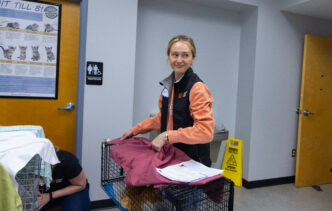


Michelle Wiltse graduated from Clemson in 2018 with degrees in Language and International Business and Economics. Today she owns her own animal wellness company: CompanAIn, an AI-driven health and wellness tool that works to anticipate problems, personalize care, and strengthen the bond between pets and those that love them.
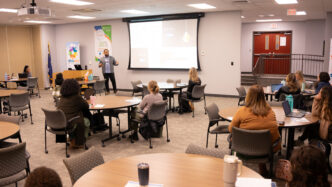
Wiltse returned to campus on December 2, 2025 as the feature speaker at the Brook T. Smith Launchpad’s entrepreneurship college of the week event for the College of Arts and Humanities. In this interview she shares more about her entrepreneurship journey, and how her time in the College of Arts and Humanities equipped her with the skills to start, and run, a business.
What led you to choose your major(s)?
Michelle Wiltse: I started at Clemson as a biochemistry major because I thought I would pursue a career in the sciences. Over time, through meaningful connections and life experiences, I realized I was just as interested in language, culture, and the human side of things as I was in science. The small, intimate classes in Clemson’s humanities programs (especially Language and International Business) made me feel seen as a whole person, not just a GPA. I chose the major because it allowed me to keep my curiosity wide: business and language and people.
Describe your path after Clemson.
MW: My path after Clemson was anything but linear. I started with a data analyst job that, on paper, had nothing to do with my major—but it taught me hard skills: analytics, systems, and how businesses really work. From there, I moved through tech and consulting roles, always gravitating toward products that solved real problems and challenged me. Eventually, I returned to my first love, animals, and founded CompanAIn: an AI-driven health and wellness platform for companion animals. It’s where all the threads meet: empathy, communication, critical thinking and technology.
How did the Language and International Business program help you achieve your goals?
MW: Language and International Business trained me to think beyond my own bubble. Learning another language and culture forces you to listen differently, articulate clearly, read between the lines and pay attention to context. The business side gave me a toolkit for strategy, negotiation and market understanding. Together, they taught me how to communicate across disciplines and perspectives — similar to my role now, where I translate between vets, pet owners, technologists, and partners to build something that truly helps families and their animals.
Did you ever expect to be a business owner?
MW: Yes, I’ve always had an entrepreneurial spirit and consistently prepared for moments of opportunity, big or small. I saw a real gap in the market and believed I could combine my professional experience, leadership style, and passion to create an empathetic, no-shortcuts solution. After working in environments full of high-IQ individuals, I felt the world was lacking empathetic technology and people. I decided to use my skills to help animals, those without a voice. I became a business owner not for the CEO title, but because I cared enough about a problem to build the solution.
Do you have a favorite memory from your time at Clemson?
MW: Coming from the Northeast, I loved experiencing the best of South Carolina. I arrived at Clemson knowing no one, and the friends I made quickly became family. Standing on The Hill for the first time, studying abroad multiple times with other Clemson students, and participating in programs like the Spiro Institute were all highlights. Conversations with my French professor, who genuinely wanted to understand who I was and what I wanted from life, were more than moments — they were life-changing.
Do you have any advice for current students?
MW: In an age of AI, don’t outsource your thinking. Your ability to understand people, stories and ethics is your superpower—use it intentionally. Liberal arts students make phenomenal leaders. You can cope when things get messy, manage different personalities, connect with people, build trust, adapt on the fly and think critically.